
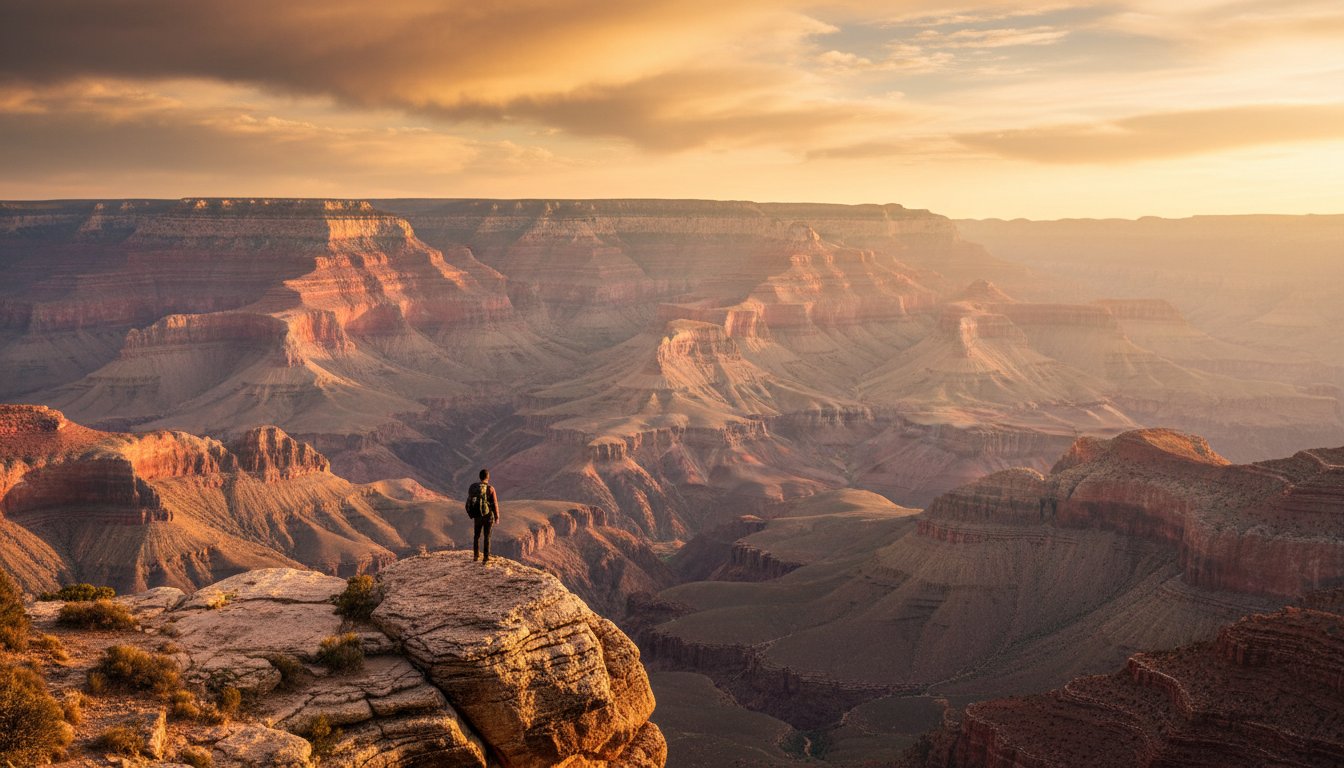
Wildlife at the Grand Canyon
Grand Canyon National Park is home to an extraordinary range of wildlife — more than 400 recorded animal species, from birds and mammals to reptiles, amphibians, and countless insects. That diversity exists because the canyon isn't one ecosystem, but many, stacked on top of each other. As elevation changes from the river corridor to the high forests along the rim, temperature, moisture, and vegetation change with it, creating a series of distinct habitats within a single park — each supporting different animals adapted to its specific conditions.
That layered geography is part of why wildlife can be seen here in every season, not just during a narrow migration window or a single time of year. Some species are most visible in spring and summer, others become more active as temperatures cool in fall and winter, and a handful — like the park's mule deer and rock squirrels — are reliably present nearly year-round. A visit at any time of year offers a genuine chance to see wildlife, even if which species are most active shifts with the seasons.
With that abundance comes real responsibility. Nearly every animal in the park is wild in the fullest sense — unhabituated to humans in ways that matter for both visitor safety and animal welfare, even the smaller, seemingly harmless species that approach picnic areas looking for food. Respecting wildlife — keeping distance, never feeding animals, and observing quietly — isn't just a courtesy here, it's essential to keeping both visitors and animals safe, and to keeping the park's wildlife wild for the next visitor who hopes to see it too.
This guide is organized the way most visitors naturally think about wildlife — by group, from the large mammals most people hope to see, to the birds soaring overhead, to the smaller reptiles, amphibians, and insects that are easy to overlook but just as essential to the canyon's ecosystem. Along the way, it also covers when different species tend to be most active, the habitats that support them, and the safety practices that keep every encounter a good one, for visitors and animals alike.
Mammals of the Grand Canyon
The Grand Canyon's mammals range from animals visitors are nearly guaranteed to see to some of the most elusive species in North America. Here's what to know about each.
California Mule Deer
Mule deer are named for their large, mule-like ears, and they're among the most commonly seen large mammals in the park — visitors have a genuinely good chance of spotting one, particularly near the rim in the early morning or evening. They're recognizable by their grayish-brown coat, white rump patch, and a distinctive bounding gait called "stotting," where all four feet leave the ground together. Mule deer favor open, forested areas along the rim, often grazing calmly within view of trails and overlooks. Despite their calm appearance, they're wild animals and should never be approached or fed — bucks in particular can become unpredictable during the fall rut. Fawns are typically born in early summer, and does with young fawns are especially protective, which is another reason to keep a respectful distance even from deer that seem entirely unbothered by nearby visitors.
Rock Squirrel
Rock squirrels are, without much competition, the animal most visitors actually interact with at the Grand Canyon — bold, common, and frequently seen right along popular trails and overlooks, sometimes uncomfortably close to visitors. That boldness comes from repeated exposure to human food, which is exactly why feeding them, even accidentally by leaving food unattended, is genuinely dangerous: it encourages behavior that leads to bites, and human food is unhealthy for a wild rock squirrel's diet. A lesser-known fact: rock squirrels are excellent climbers despite their name, and they're one of the few ground squirrel species capable of preying on smaller reptiles. They're also strong burrowers, often nesting among the rocky outcrops that give them their name, which puts them in close, frequent proximity to popular overlooks and picnic spots.
Elk
Elk are among the largest mammals visitors might encounter here, with bulls weighing up to 700 pounds and carrying impressive antlers that are shed and regrown each year. They're generally calm around visitors who keep their distance, but during the fall rut, bulls can become aggressive and territorial, making September and October a season to watch elk from a genuinely safe distance rather than approaching for a closer photo. Elk are most commonly seen around Grand Canyon Village and other developed areas along the South Rim, particularly in early morning and evening light. Their bugling call during the rut — a haunting, rising whistle — is one of the more distinctive sounds of a fall visit, often heard well before an elk comes into view.
Desert Bighorn Sheep
Desert bighorn sheep are remarkably adapted to the canyon's steep, rocky terrain, with specialized hooves that grip rock faces most other large mammals couldn't safely navigate. They're most often found on cliffs and slopes below the rim, where their coloring blends effectively into the surrounding rock. One of their more interesting adaptations is their ability to go extended periods without water, drawing much of what they need from the vegetation they eat, which allows them to thrive in terrain that would be inhospitable to most other large mammals. Rams carry large curved horns used in dramatic head-butting contests during the breeding season, a behavior occasionally witnessed by fortunate visitors and guides who happen to be looking in the right direction at the right moment.
Coyote
Coyotes are opportunistic omnivores, eating everything from small mammals and insects to berries and, unfortunately, unattended human food when they can get to it. They tend to be more active at dawn, dusk, and night, which is part of why sightings during the busiest daytime visiting hours are relatively uncommon compared to more visible species like mule deer. Coyotes are intelligent and adaptable, and their howls and yips — often heard rather than seen — are one of the more memorable wildlife sounds associated with an evening at the canyon. They typically hunt alone or in pairs rather than large packs, and a coyote's cautious, watchful body language around people is a good example of healthy wild behavior worth preserving by never offering food.
Bobcat
Bobcats are secretive, solitary hunters, and their naturally cautious, elusive nature means most visitors never see one despite bobcats being reasonably common throughout the park. They favor rocky, brushy habitat that offers cover for stalking prey like rabbits and rodents, and they're most active during low-light hours when visitor activity is lowest. A bobcat sighting is genuinely a rare and memorable moment — something even longtime guides consider a highlight rather than a routine occurrence.
Mountain Lion
Mountain lions do live in and around the Grand Canyon, but they are extremely elusive by nature, and confirmed visitor encounters are very rare. They're solitary, primarily active at dawn, dusk, and night, and they generally avoid areas with regular human activity. As with any wild predator, it's worth knowing basic safety practices — making noise while hiking, keeping children close, and never running if one is encountered — but these are precautions worth knowing rather than a reason for concern; the overwhelming majority of visitors will never see one.
Ringtail
The ringtail is one of the Grand Canyon's most fascinating residents, and also one of the least known — a small, nocturnal relative of the raccoon family with large eyes, a long banded tail nearly as long as its body, and remarkable climbing ability that lets it navigate steep canyon walls with ease. Ringtails are almost never seen during the day, since they're strictly nocturnal, but they're more common throughout the park than most visitors realize. Historically, miners and settlers sometimes kept ringtails as camp pets specifically because they were so effective at controlling rodents, which is how they earned the nickname "miner's cat," despite not being a cat at all.
Birds of the Grand Canyon
Birdlife at the Grand Canyon is remarkably diverse, ranging from one of the rarest birds in North America to small songbirds common in the forested areas along the rim.
California Condor
No animal at the Grand Canyon carries more significance than the California condor, and it deserves more attention here than any other species in this guide. With a wingspan approaching ten feet — the largest of any North American bird — condors are genuinely awe-inspiring to watch as they ride thermal currents above the canyon, rarely flapping for extended stretches as they soar. They're identifiable by their massive size, black plumage, white underwing patches, and, in adults, a bald head that ranges from pink to orange.
Condors were pushed to the very edge of extinction in the 20th century, with the entire wild population dropping to just 22 birds by 1982 — a number low enough that the species was effectively saved only through an intensive captive breeding and reintroduction program. Condors were reintroduced to the Grand Canyon region beginning in 1996, and the population here has grown steadily since, now numbering in the dozens within the immediate region and several hundred across their reintroduced range.
That recovery is widely regarded as one of the most successful endangered species conservation efforts in American history, and the Grand Canyon is one of the best places in the entire country to see a wild condor today. Many condors here are tagged with numbered wing tags used for tracking and research, which visitors sometimes notice — a visible reminder of just how closely this recovery continues to be monitored. Spotting a condor soaring over the canyon is, for many visitors, one of the most memorable wildlife moments of an entire trip.
Common Raven
Ravens are among the most frequently seen birds at the Grand Canyon, intelligent, adaptable, and often spotted at overlooks and picnic areas where they've learned to associate visitors with food. Distinguishable from crows by their larger size, wedge-shaped tail, and deep croaking call, ravens are remarkably resourceful — capable of problem-solving behavior that rivals some primates, including using tools and remembering individual people who have fed them before. Keep food secured, since ravens are bold enough to take unattended items quickly.
Golden Eagle
Golden eagles are powerful birds of prey, identifiable by their large size, dark brown plumage, and golden-hued feathers on the back of the head and neck. They hunt over open terrain, taking prey as large as jackrabbits, and are occasionally seen soaring over the canyon on the same thermal currents condors use, though they're considerably less commonly spotted than the park's more visible raptors. Golden eagles are year-round residents of the region, and a pair will often defend the same nesting territory for many years.
Red-tailed Hawk
Red-tailed hawks are the most common large hawk in the park, recognizable by their broad wings, short reddish tail, and a piercing call frequently used in film and television to represent any bird of prey. They're often seen perched on trees or rock outcrops along the rim, scanning for small mammals below, or soaring in slow circles on rising air currents. Their keen eyesight, far sharper than a human's, allows them to spot prey from remarkable heights before beginning a hunting dive.
Peregrine Falcon
Peregrine falcons nest on the canyon's cliff faces and are famous for being the fastest animal on Earth, reaching speeds over 200 miles per hour in a hunting dive called a stoop. They're smaller and more streamlined than the park's hawks and eagles, with a distinctive dark "helmet" marking on the head, and sightings are a genuine highlight for visitors who spot one in action. Like the California condor, peregrine falcons faced serious population declines decades ago and have since recovered strongly, making the canyon's cliffs an encouraging place to see both species today.
Steller's Jay
Steller's jays are hard to miss in the forested areas along the rim — bold, vocal, and strikingly colored with a deep blue body and a prominent black crest. They're intelligent, curious birds often seen investigating picnic areas and parking lots, and their harsh, scolding call is one of the more recognizable sounds of the rim's forest. They're also skilled mimics, occasionally imitating the calls of hawks, which can momentarily fool both other birds and unsuspecting visitors.
Mountain Chickadee
Mountain chickadees are small, energetic songbirds common in the coniferous forest along the South Rim, identifiable by their black cap, white eyebrow stripe, and cheerful, whistled call. They're frequently seen flitting between trees in small foraging flocks, often in the company of other small songbirds, and their year-round presence makes them one of the most reliably spotted birds in the park regardless of season. Chickadees cache food throughout the forest in fall, relying on a remarkably sharp spatial memory to relocate their hidden stores through the winter.
Reptiles and Amphibians
Reptiles and amphibians are less visible than the park's birds and mammals, but they're an important part of the canyon's ecosystem, particularly in the warmer months.
Lizards
Numerous lizard species live throughout the park, from the common side-blotched lizard to the larger collared lizard, often seen basking on sun-warmed rocks along trails and overlooks. They're entirely harmless and generally more interested in escaping notice than interacting with visitors, making quiet observation the best way to enjoy a sighting.
Gopher Snake
Gopher snakes are one of the most commonly seen non-venomous snakes in the park, and they're frequently mistaken for rattlesnakes because of similar coloring and a tendency to mimic a rattlesnake's defensive hiss and tail-shake when threatened. Despite the resemblance, gopher snakes lack rattles and pose no venomous threat, and they play a valuable role controlling rodent populations. A closer look reveals a narrower head and a more pointed tail than a rattlesnake, though the safest approach with any snake sighting is simply to keep a respectful distance rather than trying to identify it up close.
Rattlesnakes
Rattlesnakes do live in the Grand Canyon, and they deserve respect rather than fear. Several species are present, most active in warmer months, and nearly all incidents involving rattlesnakes result from someone stepping too close or attempting to handle one rather than an unprovoked encounter. Watching the trail rather than only the scenery, and never reaching into rock crevices or dense brush without looking first, prevents the overwhelming majority of encounters entirely.
A lot of the fear around rattlesnakes comes from myths rather than reality — they don't chase people, they don't seek out confrontation, and given the option, a rattlesnake will almost always retreat rather than engage. Treating them with the same calm respect given to any wild animal, rather than unnecessary alarm, is both the safest and the most accurate way to think about them.
Tree Frogs
Canyon tree frogs are small, well-camouflaged amphibians found near seasonal water sources and moist rock crevices, particularly active after monsoon rains create temporary pools. Their coloring ranges from olive to gray-brown, allowing them to blend seamlessly into the rock they rest on, and their distinctive call is sometimes heard near water sources on humid summer evenings.
Insects and Butterflies
The canyon's insect life is easy to overlook but genuinely diverse, playing an essential role in the health of the park's plants and the broader food chain. Butterflies are among the most visible, with dozens of species found across the park's different elevations and habitats, particularly active on warm days near wildflowers and riparian areas. Dragonflies are commonly seen near the Colorado River and seasonal water sources, where their aerial hunting skill and shimmering, patterned wings make them a favorite subject for photographers.
Native pollinators, including a wide range of native bee species beyond the more familiar honeybee, are essential to the reproduction of many of the canyon's flowering plants, particularly in spring and summer. Bees here are generally non-aggressive when left undisturbed, going about the business of pollination rather than seeking out interactions with visitors — another reminder that even the smallest residents of the canyon play a meaningful role in an ecosystem most visitors only see the surface of. Many of the canyon's native bee species are solitary rather than hive-dwelling, nesting individually in soil or wood rather than forming large colonies, which makes them considerably less defensive than the honeybees most visitors are used to.
Wildlife by Season
Wildlife activity at the Grand Canyon shifts throughout the year, and knowing what to expect each season helps set realistic expectations for a visit.
Spring
Spring brings increased wildlife activity as animals emerge from winter and plants begin flowering, drawing pollinators and the animals that feed on them. Mule deer and elk are commonly active, and this is one of the best seasons for spotting condors soaring on strengthening thermal currents.
Summer
Summer is a season of extremes — early mornings and evenings bring some of the most reliable wildlife activity of the year, while the heat of midday pushes many animals into shade or inactivity. Reptile sightings increase, and insects and butterflies are at their most abundant.
Fall
Fall is an especially active season, driven partly by the elk rut in September and October, when bulls become more vocal and visible. Cooler temperatures also bring many mammals back into more consistent daytime activity after the heat of summer.
Winter
Winter slows activity for many species, though mule deer and rock squirrels remain reliably visible, and condors continue to be seen regularly, if somewhat less consistently than in warmer months. Snow at higher elevations can make some animal tracks easier to spot than the animals themselves.
Where Wildlife Lives
Rather than specific viewing spots, it's more useful to understand the different habitats within the park, since each supports a distinct community of animals.
The coniferous forest along the South Rim, dominated by ponderosa pine, supports mule deer, elk, Steller's jays, mountain chickadees, and a range of smaller mammals that rely on tree cover.
Open grassy clearings within the forest provide grazing habitat for deer and elk, and hunting ground for hawks and other raptors watching from above.
Lower, drier terrain supports species adapted to heat and limited water, including many of the park's lizards, snakes, and desert bighorn sheep.
Steep rock faces provide nesting habitat for condors and peregrine falcons, and secure terrain for bighorn sheep, largely inaccessible to most predators.
Areas near the Colorado River and seasonal water sources support the greatest concentration of biodiversity in the park, including tree frogs, dragonflies, and numerous bird species.
Wildlife Safety Tips
These practices matter for every visitor, on every visit, regardless of which animals you're hoping to see.
Feeding any animal, even accidentally through unsecured food, teaches it to associate humans with an easy meal — a change in behavior that's often dangerous for both future visitors and the animal itself.
Keeping a respectful distance protects both visitor safety and natural animal behavior, even with species that appear calm or unbothered by nearby people.
Keeping food sealed and out of reach, even during a brief stop at an overlook, prevents opportunistic animals like ravens and rock squirrels from becoming bolder around visitors.
Quiet, patient observation from a distance is far more likely to result in a good sighting than approaching — most animals retreat from noise and sudden movement.
Packing out all trash and food waste keeps wildlife from associating the park's trails and overlooks with an easy meal, preserving natural behavior for the next visitor.
Fun Wildlife Facts
- Condors have a nearly ten-foot wingspan, the largest of any North American bird.
- Rock squirrels are one of the most frequently encountered animals in the entire park.
- Elk can weigh over 700 pounds, making them one of the largest animals visitors might see.
- Coyotes communicate through a range of howls, yips, and barks, often heard rather than seen.
- Ringtails are more closely related to raccoons than to cats, despite their nickname "miner's cat."
- Peregrine falcons are the fastest animals on Earth, reaching speeds over 200 miles per hour in a dive.
- Desert bighorn sheep can go extended periods without drinking water, relying on moisture from the plants they eat.
- Mountain lions are so elusive that most longtime guides go years between confirmed sightings.
Wildlife Spotting Calendar
Rather than pointing visitors toward specific locations, this calendar focuses on when each species tends to be most active — a more useful, more sustainable way to set expectations for a visit at any time of year.
| Animal | Spring | Summer | Fall | Winter |
|---|---|---|---|---|
| California Condor | ★★★★★ | ★★★★★ | ★★★★☆ | ★★★☆☆ |
| Elk | ★★★★☆ | ★★★☆☆ | ★★★★★ | ★★★☆☆ |
| Mule Deer | ★★★★★ | ★★★★☆ | ★★★★★ | ★★★★☆ |
| Coyotes | ★★★☆☆ | ★★★☆☆ | ★★★★☆ | ★★★★☆ |
| Rock Squirrels | ★★★★★ | ★★★★★ | ★★★★★ | ★★☆☆☆ |
Even in the lowest-activity season for a given species, sightings still happen — these ratings reflect relative likelihood, not a guarantee either way.
Frequently Asked Questions
Will I see wildlife?
Almost certainly, though which species depends on timing, season, and a bit of luck. Mule deer and rock squirrels are seen by the vast majority of visitors, while rarer species like mountain lions are seen by very few. Even a short visit to the rim usually turns up at least one or two species without any special effort.
Are there bears?
No — black bears are not established residents of Grand Canyon National Park, unlike many other national parks. Wildlife safety here focuses more on smaller, more commonly encountered animals like rock squirrels and, less frequently, rattlesnakes.
Are mountain lions dangerous?
They can be, as any wild predator can, but confirmed encounters with visitors are extremely rare given how elusive and human-avoidant mountain lions naturally are. Basic precautions — staying alert, keeping children close, hiking in groups — are worth knowing without being a significant source of concern.
Can I feed squirrels?
No, and this matters more than it might seem. Feeding rock squirrels or any wildlife encourages dangerous behavior, including bites, and is both unsafe and against park regulations.
When are elk most active?
Elk are especially visible during the fall rut in September and October, when bulls become more vocal and active, though they're commonly seen near Grand Canyon Village throughout the year.
Will I see a condor?
There's a good chance, particularly if you spend time at overlooks scanning the sky and canyon thermals, though condors aren't guaranteed on any single visit. Spring and summer tend to offer the most reliable sightings.
Are rattlesnakes common?
They're present but not commonly encountered, since they generally avoid humans and are most active during warmer months. Watching the trail and never reaching into brush or rock crevices without looking prevents the vast majority of encounters.
Is wildlife active in winter?
Yes, though less consistently than in warmer months. Mule deer and rock squirrels remain reliably visible, and condors are still seen regularly, even as overall activity slows for many species. Fresh snow can also make animal tracks easier to spot and identify than in other seasons, adding a different kind of wildlife awareness to a winter visit.
Continue Planning Your Grand Canyon Visit
Wildlife is just one part of a well-planned visit. These related guides cover timing, weather, gear, and more.
Experience Grand Canyon Wildlife with a Local Guide
One of the highlights of visiting the Grand Canyon is discovering its remarkable wildlife. Our experienced guides help guests understand the animals that call this landscape home, recognize signs of wildlife activity, and appreciate the unique ecosystems that make the canyon one of North America's most diverse natural environments.