
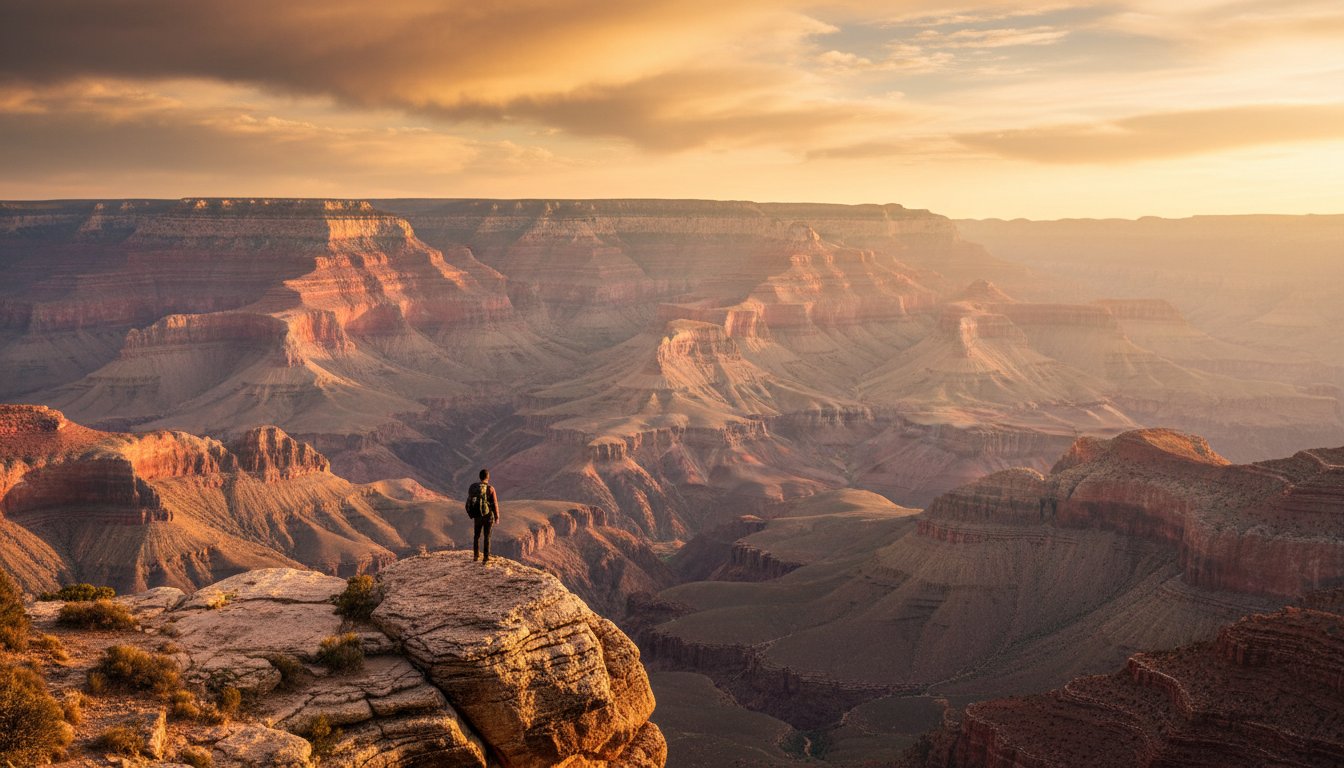
The Grand Canyon Through Time
The Grand Canyon's human story stretches back thousands of years, long before it became one of the most visited national parks in the world, and it's every bit as layered and remarkable as the rock formations the canyon is best known for. Indigenous peoples have called this landscape home for more than ten thousand years, developing deep cultural and spiritual connections to the canyon that continue today. Spanish explorers became the first Europeans to see the canyon in the 16th century, though they found little practical use for it and largely moved on. Scientific exploration began in earnest in the 19th century, culminating in John Wesley Powell's famous river expeditions.
The arrival of the railroad at the turn of the 20th century transformed the canyon from a remote scientific curiosity into an accessible tourist destination, a shift that accelerated when the site was protected first as a national monument and then, in 1919, as a national park. Today, the Grand Canyon draws millions of visitors annually while remaining a living cultural landscape for the tribes connected to it and an active site of scientific study and conservation.
The First People of the Grand Canyon
Long before European explorers ever laid eyes on the canyon, it was already home to generations of Indigenous peoples whose presence here spans thousands of years. Understanding that history is essential to understanding the canyon itself.
Early Indigenous Peoples
Archaeological evidence places human presence in and around the Grand Canyon back more than 10,000 years, with some of the earliest evidence coming from split-twig figurines and other artifacts left by early hunter-gatherer groups who moved through the region following seasonal resources. These early inhabitants adapted to a demanding landscape, developing knowledge of water sources, edible plants, and game that allowed them to live in and travel through the canyon long before permanent settlements existed. Over time, these hunter-gatherer groups gave way to more settled communities as agricultural practices developed in the region.
The split-twig figurines mentioned above are a particularly remarkable piece of this early record — small animal figures woven from single willow twigs, often found tucked into remote caves high above the canyon floor, thought to have held ritual or spiritual significance for the people who made them. Their careful placement in hard-to-reach locations suggests they weren't everyday objects, but something closer to deliberate offerings, hinting at a spiritual relationship with the canyon landscape that stretches back many thousands of years before any written record existed.
Ancestral Puebloans
Beginning around 2,000 years ago, Ancestral Puebloan communities established more permanent settlements in and around the canyon, building stone and adobe structures, some of which remain visible today as archaeological sites. They practiced agriculture, growing corn, beans, and squash in a landscape that demanded careful water management, and they developed distinctive pottery traditions that archaeologists still use today to date and identify different community groups. Trade networks connected these communities to other groups across the wider region, exchanging goods, materials, and ideas across considerable distances. By around 1200 CE, many Ancestral Puebloan communities had moved on from the immediate canyon area, likely in response to prolonged drought and changing conditions, though their descendants and their legacy remain deeply connected to the region today.
Some of the clearest physical evidence of this era survives today in structures like those visible near Desert View, where low stone walls and room outlines still trace the footprint of homes built and used many centuries ago. These sites are cared for today as important cultural and archaeological resources, offering a tangible connection to communities whose descendants remain part of the region's living tribal nations rather than a vanished or forgotten people.
The Tribes Connected to the Grand Canyon Today
Several tribal nations maintain deep, continuing connections to the Grand Canyon, and their relationship to this landscape is not a matter of history alone — it's an active, living part of their cultures today. The Hopi Tribe considers portions of the canyon deeply sacred, tied to their origin narratives and ongoing spiritual practices. The Havasupai Tribe has lived within the canyon itself for centuries, in the village of Supai near the base of the canyon, maintaining one of the most direct and continuous connections to the landscape of any tribe. The Hualapai Tribe's reservation borders the canyon's western reaches, where they've long maintained cultural and economic ties to the land. The Navajo Nation, whose reservation lies along the canyon's eastern edge, holds significant cultural and historical connections to the region as well. The Southern Paiute people have historical ties to the canyon's northern areas, and the Zuni Tribe maintains ancestral and spiritual connections tracing back to the region's earliest Puebloan communities.
Each of these tribes maintains its own distinct traditions, oral histories, and relationship to the canyon, and many sites within the park remain sacred and culturally significant today, not simply historical curiosities. Visitors are asked to treat all such sites with the same respect they would show any active place of cultural or spiritual importance.
In recent decades, the National Park Service has worked more closely with these tribal nations on matters of interpretation, land management, and cultural preservation than in earlier eras of the park's history, reflecting a broader, still-evolving effort to ensure that the canyon's Indigenous history is told by and with the communities who lived it, rather than about them alone. That collaboration remains an ongoing, active relationship rather than a finished chapter.
European Exploration
Spanish Explorers
The first documented European sighting of the Grand Canyon came in 1540, when a group of Spanish soldiers led by García López de Cárdenas, part of the larger Coronado expedition searching for wealth across the region, reached the South Rim. Guided by Hopi guides, the group attempted to descend into the canyon in search of water but turned back after finding the terrain far more difficult and time-consuming to navigate than they expected — a detail that still resonates with modern hikers who underestimate the canyon's scale. Finding no gold and no easy route through the landscape, the Spanish expedition moved on, and the canyon saw no further documented European visits for more than two centuries.
American Explorers
Serious American interest in the canyon didn't develop until the 19th century, driven largely by government-sponsored survey expeditions mapping the American West. These surveys combined practical interests — understanding the region's resources and terrain — with growing scientific curiosity about the canyon's geology and natural history. Earlier attempts to reach or cross the canyon by land parties had generally found the terrain impractical, reinforcing the canyon's reputation as an obstacle to be routed around rather than a destination in its own right. It was within this era of exploration and scientific interest that the canyon's most famous expedition would soon take place.
John Wesley Powell and the Colorado River
No figure looms larger in the canyon's exploration history than John Wesley Powell, a one-armed Civil War veteran who lost his right arm at the Battle of Shiloh and went on to lead one of the most daring expeditions in American exploration history. In 1869, Powell led a team of nine men in four wooden boats down the Green and Colorado Rivers, through the entirely uncharted Grand Canyon — a journey many assumed was effectively a suicide mission, since no one knew for certain what lay ahead, including the possibility of waterfalls large enough to be fatal.
The expedition faced brutal conditions: capsized boats, lost supplies, dwindling food, and rapids far more dangerous than anything the group had prepared for. Three men left the expedition just before its end, hiking out of the canyon rather than continuing by river — and were never seen again, likely killed shortly after leaving the group. The remaining six men completed the journey, emerging from the canyon having accomplished what many considered impossible.
By the time the surviving boats reached the mouth of the Virgin River, some newspapers had already printed premature reports of the expedition's death, making Powell and his remaining men's actual arrival feel almost like a return from the presumed dead. The story captured the public imagination immediately, and Powell wisely used that attention to build support for further scientific exploration of the American West.
Powell's expedition produced the first detailed maps and scientific descriptions of the canyon's geology, and his written accounts introduced the American public to the scale and grandeur of the Grand Canyon for the first time. He returned for a second expedition in 1871–72, refining his earlier observations and mapping work. Powell later became a prominent figure in American science and public policy, serving as the second director of the U.S. Geological Survey and advocating, often controversially, for realistic water policy in the arid American West.
Powell's legacy extends well beyond his own expeditions — his firsthand accounts and scientific descriptions helped establish the Grand Canyon in the American imagination as a landscape worth protecting, setting the stage for the conservation efforts that would follow in the decades ahead.
The Railroad Changes Everything
For decades after Powell's expeditions, the Grand Canyon remained remote and difficult to reach, accessible only by lengthy, uncomfortable stagecoach journeys that limited visitation to only the most determined travelers. That changed dramatically in 1901, when the Atchison, Topeka and Santa Fe Railway completed a rail line directly to the South Rim, reducing a multi-day journey to a matter of hours.
The railroad's arrival transformed the canyon almost overnight from a remote scientific curiosity into an accessible tourist destination. Visitor numbers climbed quickly as travel became dramatically easier and more comfortable, and the railway company invested heavily in developing the South Rim to accommodate the growing interest. The crown jewel of that development was the El Tovar Hotel, completed in 1905 — a grand, rustic-luxury lodge built directly on the rim, designed to give wealthy travelers a comfortable, elegant base from which to experience the canyon.
Early visitors during this era were often affluent tourists drawn by the novelty of a comfortable rail journey to a genuinely awe-inspiring destination, and their accounts and photographs helped further popularize the canyon nationally. This period essentially created Grand Canyon tourism as an industry, establishing patterns of visitation and infrastructure that, in many ways, still shape the visitor experience today.
The railway also brought professional photographers and artists to the rim in far greater numbers than ever before, and their widely circulated images played a real role in building the canyon's national reputation, reaching Americans who would likely never make the journey themselves. In a very real sense, the railroad didn't just bring visitors to the canyon — it brought the canyon, through photographs and postcards, into homes across the country that had never seen it in person.
Theodore Roosevelt and Conservation
Theodore Roosevelt visited the Grand Canyon multiple times beginning in 1903, and he was, by all accounts, genuinely moved by what he saw — awestruck enough that the visit helped shape the conservation philosophy he would carry through the rest of his presidency. Roosevelt was already a committed conservationist by the time he first saw the canyon, but his visits there reinforced his belief that certain landscapes were simply too extraordinary to be left vulnerable to unchecked development and exploitation.
Roosevelt used his influence to protect the canyon well before Congress was willing to grant it full national park status, urging that the landscape be preserved essentially untouched for future generations rather than developed or mined for short-term gain. His message, delivered during his visits and public remarks, was consistently the same in spirit: that the canyon's grandeur was something no human effort could improve upon, and that the greatest service anyone could offer it was to leave it exactly as it was.
That conviction mattered enormously. Roosevelt's advocacy — backed by his considerable political influence and genuine personal passion for the site — was instrumental in securing early federal protection for the canyon, laying the essential groundwork for the national park designation that would eventually follow. Without his direct intervention, the path to permanent protection would very likely have taken much longer, and the canyon's fate in the intervening years would have been considerably less certain.
What made Roosevelt's role especially significant is that he acted well ahead of broad political consensus, at a time when mining, grazing, and development interests still had considerable influence over how public land in the West was used. His willingness to use executive authority rather than wait for Congress reflects the same conservation philosophy he applied to other landscapes during his presidency — a belief that some places were simply too important to risk losing while political debate continued.
Grand Canyon National Park
Formal federal protection for the Grand Canyon developed in stages rather than all at once. In 1908, President Roosevelt used his authority under the Antiquities Act to designate the canyon a National Monument, a significant step that offered meaningful protection even though it fell short of the full national park status conservationists were hoping for. That designation faced political resistance for years, particularly from mining and development interests who saw the canyon's resources differently.
Full protection finally arrived on February 26, 1919, when President Woodrow Wilson signed legislation establishing Grand Canyon National Park, making it the seventeenth site to receive that designation in the United States. The new national park status brought stronger, more permanent protections and formally established the National Park Service's role in managing and preserving the site for future generations. Notably, the park's first full year under this new status, 1919, already drew tens of thousands of visitors — a modest number by today's standards, but a clear early signal of the popularity that would only continue to grow.
Recognition of the canyon's significance has only grown since. In 1979, UNESCO designated the Grand Canyon a World Heritage Site, an international acknowledgment of its outstanding universal value — not just as a natural wonder, but as a site of exceptional geological and scientific importance recognized well beyond U.S. borders. That designation places the canyon among a select group of sites worldwide considered to hold value significant enough to matter to all of humanity, not just the country in which they happen to be located.
Life at the Grand Canyon Today
The Grand Canyon today is a genuinely layered place, home to a wide range of people whose lives intersect with it in very different ways. Millions of visitors come each year seeking everything from a brief rim overlook to multi-day backcountry adventures, making tourism one of the defining forces shaping daily life in and around the park. Scientists continue active research here, studying everything from the canyon's ancient geology to its river ecology and wildlife, building on more than a century of scientific interest that began with Powell's own expeditions.
Park rangers manage the practical work of protecting the landscape while helping visitors experience it safely and responsibly, balancing preservation with public access in a way that requires constant attention. Conservation remains an ongoing effort, addressing everything from water management and wildlife protection to the long-term effects of tourism itself on such a heavily visited landscape. And throughout all of this, tribal communities connected to the canyon continue to maintain their cultural and spiritual relationships with the land, a living presence that predates every other chapter in this history and continues alongside it today.
That layered mix of purposes is part of what makes a visit here feel different from many other destinations — a national park is never just a scenic backdrop. It's simultaneously a workplace, a research site, a homeland, and a bucket-list destination, all occupying the same physical space at once, and understanding that layered reality only deepens an appreciation for what a visit here actually represents.
Historic Landmarks
Several structures within the park carry genuine historical significance beyond their practical use today, each representing a distinct chapter in the canyon's story.
Completed in 1905 by the Santa Fe Railway, El Tovar remains one of the most architecturally significant lodges in the National Park System, built directly on the rim in a rustic style. It has hosted countless notable visitors over more than a century and remains a working hotel today.
Completed in 1932 and designed by architect Mary Colter, the Desert View Watchtower draws inspiration from ancestral Puebloan architecture, incorporating Indigenous artwork and design throughout. It stands today as both an architectural landmark and a meaningful tribute to the canyon's Indigenous history.
The rail line that transformed canyon tourism in 1901 still operates today, connecting Williams, Arizona to the South Rim. Beyond its historical significance, it remains a functioning link to the era when the railroad first made the canyon broadly accessible.
Grand Canyon Village, the historic South Rim developed during the railroad era, contains numerous early 20th-century buildings that collectively tell the story of the canyon's transition from remote wilderness to accessible national park.
Fascinating Historical Facts
- The Grand Canyon became a National Park in 1919, though meaningful federal protection began over a decade earlier under Theodore Roosevelt.
- Millions of people visit the Grand Canyon every year, a figure that would have been unimaginable to the earliest 19th-century explorers.
- Archaeological research continues today, with ancient artifacts and sites still being studied and better understood.
- People have called the Grand Canyon home for more than 10,000 years, making its human history nearly as remarkable as its geological one.
- Three members of Powell's 1869 expedition left the group just before its completion and were never seen again.
- Mary Colter, one of the few prominent female architects of her era, designed several of the canyon's most iconic buildings.
Grand Canyon History Timeline
The canyon's human story spans such an immense stretch of time that a simple timeline helps make sense of the sequence — from the earliest evidence of human presence to the modern park protected today.
Early Indigenous Peoples — The earliest evidence of human presence in the Grand Canyon region, left by hunter-gatherer groups adapting to a demanding desert landscape.
Ancestral Puebloans — More permanent settlements emerge, with agriculture, pottery, and trade networks connecting communities throughout the region.
Spanish Expedition — García López de Cárdenas and a group of Spanish soldiers become the first documented Europeans to see the canyon, guided by Hopi guides.
John Wesley Powell Expedition — Powell leads the first documented expedition down the Colorado River through the canyon, producing the first scientific maps and descriptions.
Santa Fe Railway Arrives — A direct rail line to the South Rim transforms access to the canyon; the El Tovar Hotel opens four years later in 1905, becoming the centerpiece of early canyon tourism.
National Monument — President Theodore Roosevelt designates the Grand Canyon a National Monument, a major early step toward permanent federal protection.
National Park — President Woodrow Wilson signs legislation establishing Grand Canyon National Park, securing its status as one of America's most protected landscapes.
UNESCO World Heritage Site — UNESCO recognizes the Grand Canyon as a World Heritage Site, affirming its outstanding universal value on the world stage.
One of the World's Great Natural Wonders — Millions of visitors, ongoing scientific research, and enduring tribal connections continue to shape the canyon's story into the present day.
Voices That Shaped the Grand Canyon
History is often told as a sequence of events, but the Grand Canyon's story is just as much about the people and communities who shaped it. Here are some of the voices most responsible for the canyon we know today — a mix of ancient and recent, famous and lesser-known, whose combined influence is still visible in the canyon experienced by visitors right now.
The tribes connected to the Grand Canyon carry the longest and most continuous relationship with this landscape of anyone in its history, maintaining cultural and spiritual traditions that predate every other chapter in this story and continue actively today.
The one-armed Civil War veteran whose 1869 river expedition produced the first scientific description of the canyon, introducing its scale and grandeur to the American public for the first time.
The conservationist president whose visits and political influence were instrumental in securing the canyon's earliest federal protections, laying the groundwork for its eventual national park status.
An architect whose work, including the Desert View Watchtower and several other Grand Canyon buildings, still shapes the visitor experience today — among the few prominent female architects of her era to leave such a lasting mark on a national landscape.
The rangers and administrators who built the systems and infrastructure needed to protect the canyon while making it accessible, establishing management practices that still guide the park today.
Scientists, tribal representatives, and park staff who continue working today to balance public access with long-term preservation, addressing challenges the canyon's earliest advocates never had to consider.
Frequently Asked Questions
Who were the first people to live at the Grand Canyon?
Indigenous peoples have lived in and around the Grand Canyon for more than 10,000 years, beginning with early hunter-gatherer groups who were later followed by more settled Ancestral Puebloan communities.
Who was John Wesley Powell?
John Wesley Powell was a Civil War veteran and geologist who led the first documented expedition down the Colorado River through the Grand Canyon in 1869, producing the earliest scientific maps and descriptions of the canyon.
When did the Grand Canyon become a National Park?
The Grand Canyon officially became a National Park on February 26, 1919, though it had already received federal protection as a National Monument in 1908.
Why is Theodore Roosevelt associated with the Grand Canyon?
Roosevelt visited the canyon multiple times and became one of its most influential advocates, using his political influence to secure early federal protection well before Congress was willing to grant full national park status.
How long have people lived here?
Archaeological evidence places human presence in the region back more than 10,000 years, making the canyon's human history nearly as remarkable as its geological one.
Which tribes are connected to the Grand Canyon today?
Several tribal nations maintain continuing connections to the canyon, including the Hopi, Havasupai, Hualapai, Navajo, Southern Paiute, and Zuni, each with distinct traditions and ongoing cultural ties to the landscape.
Why is the Grand Canyon a UNESCO World Heritage Site?
UNESCO designated the Grand Canyon a World Heritage Site in 1979 in recognition of its outstanding universal value, both as a natural wonder and as a site of exceptional geological and scientific importance.
What is the oldest historic building in Grand Canyon Village?
El Tovar Hotel, completed in 1905, is among the oldest and most architecturally significant buildings in Grand Canyon Village, though several other structures from the same early tourism era remain standing nearby.
Continue Exploring the Grand Canyon
History is just one part of the canyon's story. These related guides cover its geology, wildlife, weather, and more.
Experience Grand Canyon History with Local Guides
The Grand Canyon is more than an incredible landscape—it's a place with thousands of years of human history and cultural significance. Our experienced guides share the stories behind the canyon's people, explorers, geology, and conservation, helping guests appreciate the Grand Canyon as both a natural wonder and an important part of American history.