Wupatki National Monument at a Glance
Most descriptions of Wupatki stop at "ancient pueblo with hundreds of rooms." That's technically true, but it misses the point entirely. Wupatki is the story of a community that turned a volcanic disaster into an opportunity — and built one of Northern Arizona's most significant trading centers in the process. It's a story about people, not just architecture, and understanding it changes how the ruins in front of you read once you know what actually happened here. Before diving into that story, here's the monument at a glance:
Located Northeast of Flagstaff
Northern Arizona
Protected National Monument
Managed by the National Park Service
Ancient Pueblo Communities
Ancestral Puebloan, with living Hopi connections
2,000+ Archaeological Sites
Protected within the monument
Built Nearly 900 Years Ago
Primarily in the early-to-mid 1100s
National Park Service Site
Managed alongside Sunset Crater
Why Visit Wupatki National Monument?
Wupatki rewards visitors who see past the walls to the people who built them. Here's what makes it worth the stop:
Incredible Architecture
A multi-story pueblo built from native sandstone, still standing after nearly 900 years.
Indigenous History
A rare, well-documented story of adaptation, resilience, and community growth.
Desert Landscape
Red sandstone and high desert scrub stretching toward the Painted Desert on the horizon.
Geological Connection
Directly tied to the Sunset Crater eruption that reshaped the land around it.
Photography
Warm sandstone architecture against dramatic desert skies, especially at sunrise and sunset.
Wildlife
Mule deer, ravens, and desert reptiles moving through a landscape still shaped by its volcanic past.
Archaeology
One of the best-documented ancestral Puebloan sites in the Southwest.
Cultural Significance
A living connection to Hopi clans who trace their ancestry directly to this landscape.
The Story of Wupatki
The First People
Long before Wupatki Pueblo rose above the landscape, small farming communities were already living across this stretch of Northern Arizona, growing corn, beans, and squash in the region's thin, sun-baked soils. Archaeologists have documented settlement in the wider area dating back to at least 500 CE, and by around 800 CE, distinct farming villages were well established across the high desert north and east of modern Flagstaff. These early residents were part of a broader Indigenous world that stretched across the American Southwest, connected by trade routes that carried goods, ideas, and people between distant communities. Village life at this stage was modest — small pit house settlements scattered across the high desert, each adapted to the challenge of farming in a dry, unpredictable climate, with families relying on careful water management and generations of accumulated knowledge about when and where to plant.
The Volcanic Eruption That Changed Everything
Then, around 1085 CE, everything changed. Sunset Crater erupted just a short distance away, and the landscape these communities depended on was suddenly buried under ash and cinder. In the immediate aftermath, it must have looked like a catastrophe. But in the years that followed, something remarkable happened: the same volcanic ash that had disrupted the region turned out to improve farming conditions across a much wider area, helping the thin desert soil retain scarce moisture. Word seems to have spread. Population in the region grew substantially over the following century — by some estimates, as many as 2,000 people moved into the wider area — and new villages began expanding across land that had barely supported farming before the eruption. It's one of the more remarkable stories in Southwestern archaeology: a volcanic disaster that, within a generation, helped build one of the region's largest communities.
Growth of Wupatki
As population grew, so did Wupatki. What began as a modest settlement expanded into a major hub of trade, agriculture, and community life, its architecture growing more ambitious with each generation. Farmers worked the ash-enriched fields nearby, while traders brought goods from communities hundreds of miles away. Construction became more sophisticated too, culminating in the multi-story pueblo that still stands today, along with community spaces built for gathering, ceremony, and exchange. By the early-to-mid 1100s, Wupatki had become the largest and most influential settlement for roughly fifty miles in any direction, drawing people, goods, and ideas from across the region into a single, thriving center.
Why the Villages Were Eventually Abandoned
By around 1225 CE, Wupatki and the surrounding villages had been permanently abandoned — but the reasons why are more complicated than a single explanation. Researchers point to a combination of factors: a changing, increasingly unpredictable climate that made farming harder again; the gradual depletion of local resources like firewood and fertile soil after more than a century of intensive use; and broader patterns of migration that were reshaping communities across the Southwest during this period, as many Puebloan groups consolidated into new settlements elsewhere. Scholars continue to study exactly how these pressures combined, and it's likely that no single cause tells the whole story — only that the same resourcefulness that built Wupatki eventually led its people to move on to new places, carrying their knowledge, traditions, and clan histories with them into the communities their descendants call home today.
Timeline of Wupatki
Seeing the full arc — from early farming communities through eruption, growth, and eventual migration — helps make sense of how a single volcanic event could shape centuries of history:
800 AD
↓
Early Farming Communities
↓
Sunset Crater Erupts
↓
Ash Improves Agriculture
↓
Population Grows
↓
Large Pueblos Built
↓
Regional Trade Flourishes
↓
Migration to Other Areas
↓
National Monument Established
Wupatki Pueblo
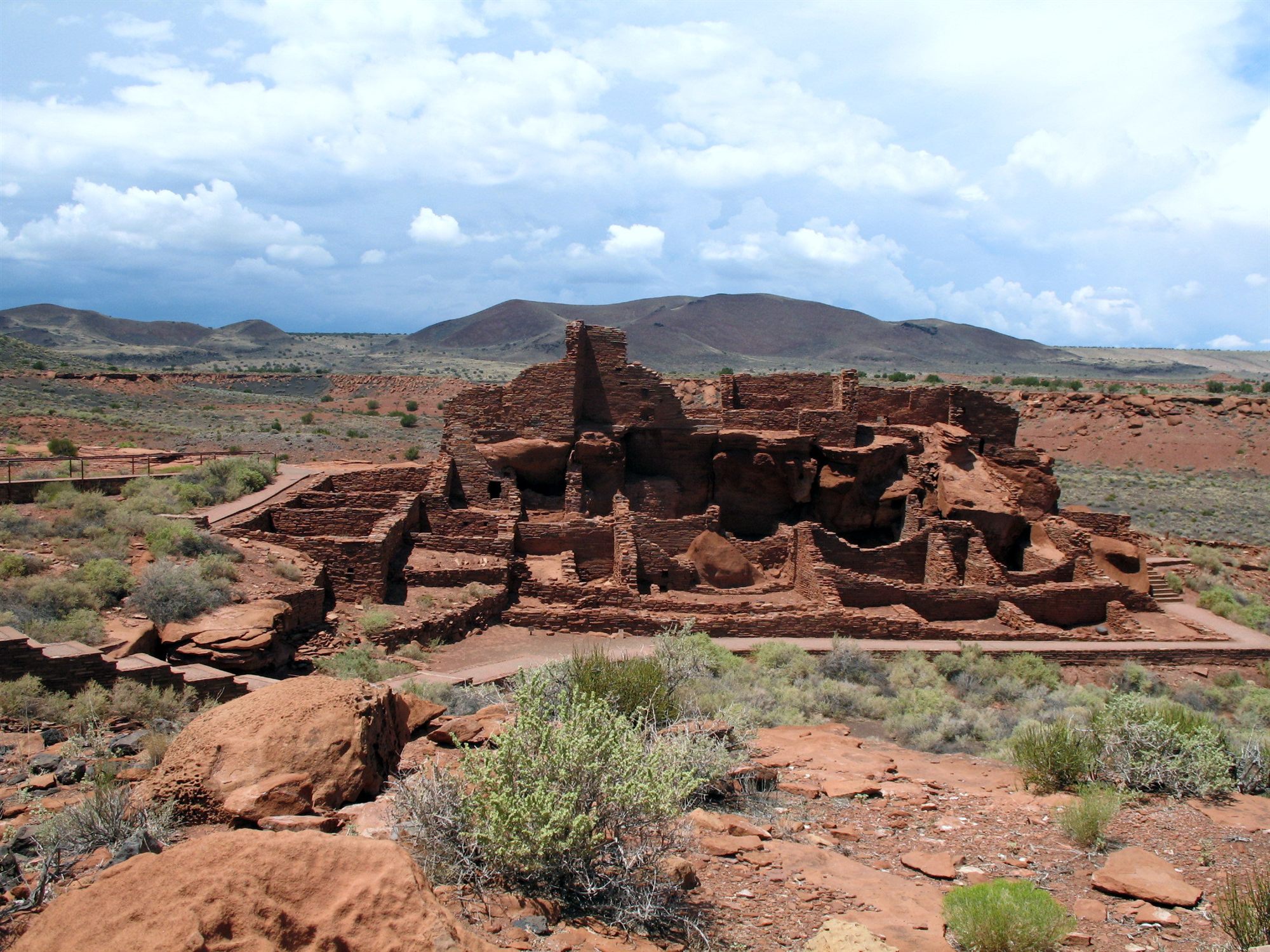
Wupatki Pueblo is the centerpiece of the monument, and for good reason. Rising four stories in places and containing over 100 rooms, it was the largest freestanding structure in the region for miles around — a remarkable feat of engineering built entirely from native Moenkopi sandstone, without metal tools, draft animals, or the wheel. At its peak, researchers estimate the pueblo itself housed somewhere between 85 and 100 residents, though it clearly served a much larger surrounding population as a hub for trade and community gatherings.
Beyond its sheer size, Wupatki Pueblo was a community hub. It included a large community room believed to have hosted gatherings for a much wider population than lived on site, along with an open amphitheater-like gathering space and a masonry ballcourt — the northernmost known ballcourt in North America, echoing architectural traditions from communities far to the south in Mesoamerica. The presence of a ballcourt this far north is one of the clearest physical signs of just how far Wupatki's connections extended, and it remains one of the more striking discoveries associated with the site.
The construction techniques on display are just as telling as the scale. Builders shaped thin, flat blocks of sandstone and stacked them with precision, without mortar in many sections, relying instead on careful fitting and thoughtful wall angles for structural stability that has held for nearly 900 years. Door and room placement suggests deliberate planning for airflow, shade, and defensibility — not a structure that grew randomly, but one that was designed, expanded, and adapted over multiple generations as the community around it continued to grow.
Walking through the pueblo today, it's worth remembering that every wall was placed by hand, one stone at a time, by people who understood this particular stretch of desert well enough to build something that has outlasted nearly nine centuries of wind, weather, and time.
Other Archaeological Sites
Citadel Pueblo
Built atop a small volcanic butte overlooking the surrounding grassland, Citadel Pueblo occupies one of the most commanding positions in the monument. Its elevated location offered sweeping views in every direction, useful for both practical and social reasons in a landscape where visibility across long distances mattered. A natural sinkhole nearby may have served as an early water source for the community living there, and the pueblo's name, given by early Euro-American visitors rather than its original inhabitants, reflects its fortress-like silhouette on the horizon.
Lomaki Pueblo
The name Lomaki is often translated from Hopi as "Beautiful House," and the pueblo lives up to it — a compact, well-preserved structure perched at the edge of a small earth crack, or fissure, in the landscape. Its position highlights how closely these communities built around the natural features of the terrain rather than against them, using the fissure itself as a natural architectural boundary rather than an obstacle to work around.
Nalakihu Pueblo
Sitting just below Citadel Pueblo, Nalakihu — roughly translated as "House Standing Alone" — was a smaller residential structure, offering a useful contrast to the scale of Wupatki Pueblo itself and a reminder that not every community structure in the monument was built to the same scale or purpose. Its proximity to Citadel Pueblo suggests the two sites were closely linked, likely home to related families or working groups sharing nearby resources.
Box Canyon Pueblo
Box Canyon Pueblo consists of a cluster of smaller dwellings built near a narrow, sheltered canyon. Less visited than the monument's larger sites, it reflects the more modest, dispersed settlements that made up much of the broader Wupatki community beyond its largest pueblos — a useful reminder that Wupatki wasn't one building, but an entire network of communities spread across the landscape.
Indigenous Culture and Heritage
Wupatki is not a relic of a vanished people. Many Hopi clans trace their ancestry and clan histories directly to Wupatki and the surrounding communities, and the site holds deep, continuing significance within Hopi tradition and oral history. Hopi oral tradition describes patterns of migration in which ancestral clans lived in many places, including sites like Wupatki, before eventually settling on the Hopi mesas — a narrative that treats sites like this one not as an endpoint, but as one chapter in a much longer, continuing story. The same holds true for other Puebloan communities across the Southwest, many of whom recognize Wupatki as part of a shared ancestral story that connects directly to the pueblos and communities they call home today.
This continuity matters. It's easy to look at stone walls and think only in the past tense, but the descendants of the people who built Wupatki are not a historical footnote — they are living communities, with living traditions, who continue to be involved in how this place is studied, interpreted, and protected. The National Park Service works directly with Hopi and other tribal representatives on decisions affecting the monument, recognizing that Wupatki belongs to an ongoing story, not a closed one. That relationship shapes everything from archaeological research protocols to how interpretive materials at the visitor center are written and reviewed.
Visiting Wupatki respectfully means holding both truths at once: appreciating the extraordinary architecture and history preserved here, while recognizing that this landscape remains sacred and significant to living people today, not simply a backdrop for historical curiosity. That's a distinction worth carrying with you throughout the entire visit, not just at the visitor center.
Architecture of Wupatki
Wupatki's builders worked with what the land provided, and did so with remarkable sophistication.
Stone masonry: Walls were built from thin, flat blocks of local Moenkopi sandstone, carefully selected and fitted together, often with minimal mortar — a technique that required real skill to keep walls stable and true over multiple stories.
Building materials: Beyond sandstone, builders used timber for roof beams, and mud and plant fiber for mortar and plaster, all sourced from the immediate surroundings rather than transported from elsewhere.
Natural ventilation: Room placement and doorway alignment appear to have been planned with airflow in mind, helping manage temperature swings in a climate that runs hot by day and cold by night. Some researchers have also studied the famous natural "blowhole" near the pueblo — a geologic vent that breathes air in and out due to underground pressure differences — as a feature the community may have been aware of and incorporated into their understanding of the landscape.
Multi-story construction: Wupatki Pueblo rises up to four stories in places, an engineering achievement that required careful load-bearing wall design, especially given the limited building materials and tools available.
Community design: Beyond individual dwellings, the site includes deliberately shared spaces — a large community room, an open gathering amphitheater, and a masonry ballcourt — all suggesting a settlement designed around communal life, not just individual households.
Water collection: In a landscape with limited and unpredictable rainfall, residents built check dams and small catchment features to direct and conserve what water was available, a critical piece of infrastructure for farming communities operating this far from a reliable water source.
Wildlife Around Wupatki
The high desert surrounding Wupatki supports a resilient mix of desert plants and wildlife adapted to a landscape of extremes — scorching summer days, cold nights, and unpredictable rainfall. Hardy desert plants like Mormon tea, saltbush, and various cacti dot the terrain between archaeological sites. Birds are a common sight, including ravens, which frequently perch on the pueblo's ancient walls, along with a variety of smaller desert songbirds. Lizards dart between sun-warmed rocks throughout the warmer months, while mule deer move quietly through the surrounding grassland, especially near dawn and dusk. Coyotes are occasionally spotted or heard in the distance, rounding out a landscape that, much like the pueblo itself, has adapted and endured.
For a closer look at the animals found throughout the wider region, see our full Arizona Wildlife → guide.
Wupatki Through the Seasons
Spring
The desert briefly blooms with wildflowers, and cool, comfortable temperatures make this one of the more pleasant times to explore the monument's exposed, largely shadeless trails.
Summer
Building monsoon clouds bring dramatic, ever-changing skies over the pueblo, often the most photogenic weather of the year — though daytime heat can be intense at this elevation and exposure.
Fall
Comfortable temperatures return, paired with some of the year's warmest, most golden light on the red sandstone walls in the late afternoon.
Winter
Snow occasionally dusts the red sandstone ruins, creating one of Arizona's most striking visual contrasts — ancient dark red stone set against a fresh layer of white.
Interesting Facts About Wupatki
A handful of details tend to surprise first-time visitors most:
- Some pueblos in the monument had over 100 rooms, housing communities far larger than most people expect from a "ruin."
- The communities were part of extensive regional trade networks, connecting Wupatki to distant corners of the Southwest and beyond.
- A natural blowhole near Wupatki Pueblo has long been a point of interest, breathing air in and out as underground air pressure shifts.
- The monument protects more than 2,000 archaeological sites, of which the major pueblos are only the most visible.
- The name "Wupatki" comes from the Hopi language and is generally translated as "Long Cut House," a reference to the pueblo's long, segmented structure.
Wupatki and Sunset Crater
Wupatki and Sunset Crater aren't two separate attractions that happen to sit near each other — they're two halves of a single story. Sunset Crater tells the story of the Earth itself: a volcanic fissure, an eruption, a cinder cone built in a matter of years. Wupatki tells the story of what came next: how the people already living in this region responded to that eruption, adapted to a changed landscape, and ultimately built one of Northern Arizona's largest and most connected communities on top of it.
Understanding one without the other means missing half the picture. Visit Sunset Crater to see the volcanic event; visit Wupatki to see its human legacy — together, they tell a more complete story than either site can on its own.
Life in Wupatki 900 Years Ago
It's easy to look at stone walls and see only architecture. But nine hundred years ago, this was a living, breathing community — and archaeologists have learned enough about ancestral Puebloan life in this region to help paint a grounded, respectful picture of what daily life may have looked like.
Early morning likely began with the smell of cooking fires and the sound of families preparing meals, grinding corn on stone metates worn smooth by generations of use. Out beyond the pueblo walls, farmers tended fields of corn, beans, and squash planted in the ash-enriched soil, watching the sky for the summer monsoon clouds that meant the difference between a good harvest and a hard year.
Inside the pueblo, potters likely shaped and fired vessels using techniques passed down through generations, creating both everyday cookware and finely decorated pieces meant for trade or ceremony. Children would have grown up learning these skills alongside their elders — not through formal instruction, but by watching, helping, and gradually taking on responsibility as they grew.
Traders arriving from distant communities would have been a regular sight, bringing goods and news from hundreds of miles away and returning home with what Wupatki had to offer in exchange. Conversations in multiple languages or dialects may well have echoed through the pueblo's rooms and courtyards, a reflection of just how many different communities passed through or traded with Wupatki during its busiest years.
And on certain days, the community's gathering spaces — the great room, the open amphitheater, the ballcourt — would have filled with people for ceremonies and communal events that reinforced the social and spiritual bonds holding this large, growing community together. Games played on the ballcourt, echoing traditions from communities far to the south, would have drawn crowds from Wupatki and neighboring villages alike, turning an ordinary day into something closer to a regional gathering.
None of this requires speculation or invention — it's a grounded picture built from what archaeologists have documented about ancestral Puebloan communities across the region: their farming practices, their material culture, their trade goods, and their communal architecture. Standing at Wupatki today, it's worth remembering that these walls once held an entire, thriving community, not simply the empty rooms that remain.
How Wupatki Fit into a Larger World
It's tempting to picture Wupatki as an isolated village, tucked away in a remote corner of the high desert. The archaeological record tells a very different story. Wupatki was a connected, cosmopolitan community, linked through trade and cultural exchange to other communities across what is now the American Southwest — and, through them, to regions far beyond.
Excavations at Wupatki have turned up shells originating from the Pacific coast and the Gulf of California, carried inland through a chain of trade relationships spanning hundreds of miles — remarkable, given that Wupatki sits hundreds of miles from either coastline. Archaeologists have also documented evidence of macaws — tropical birds native to Mesoamerica, thousands of miles to the south — traded north as valued, likely ceremonial goods, requiring a chain of trade relationships spanning multiple cultures and climates. Turquoise, sourced from mines elsewhere in the Southwest, appears in the archaeological record as well, alongside pottery styles from distant regions that reveal sustained contact and exchange rather than a single chance encounter.
This kind of evidence doesn't happen by accident. It points to established trade routes, trusted intermediary communities, and repeated exchange over generations — the infrastructure of a genuine regional economy, not isolated trading trips. Wupatki's location, at a crossroads between the Colorado Plateau, the Verde Valley, and communities further south, likely made it a natural stopping point along these routes, adding to its importance well beyond its own population.
Taken together, this evidence reshapes how Wupatki should be understood: not as a single remote settlement, but as one node in a vibrant, interconnected network of Indigenous communities and trade routes stretching across the region and beyond. The people living here nine hundred years ago were part of a genuinely wide world, one most visitors don't expect to find evidence of in the middle of the Arizona high desert.
Frequently Asked Questions
What is Wupatki?
Wupatki National Monument protects a collection of ancestral Puebloan pueblos and more than 2,000 archaeological sites in Northern Arizona, centered around Wupatki Pueblo, once the largest structure in the surrounding region.
Who lived here?
Wupatki was home to ancestral Puebloan farming communities, whose descendants include the Hopi Tribe and other Puebloan peoples of the Southwest, many of whom maintain living cultural and clan connections to the site today.
How old is Wupatki?
Wupatki Pueblo was primarily built in the decades following the eruption of Sunset Crater around 1085 CE, with major construction occurring in the early-to-mid 1100s — making it nearly 900 years old.
Why was it built?
Population in the region grew rapidly after volcanic ash from the Sunset Crater eruption improved farming conditions nearby, drawing new settlement and eventually supporting the construction of Wupatki's largest pueblos.
Why was it abandoned?
By around 1225 CE, Wupatki and its surrounding villages had been permanently abandoned. Researchers believe a combination of factors was responsible, including a changing climate, depleted local resources, and broader regional migration patterns — scholars continue to study exactly how these factors interacted.
How many pueblos are here?
The monument protects several major pueblos, including Wupatki, Citadel, Lomaki, Nalakihu, and Box Canyon, along with more than 2,000 additional archaeological sites of varying size.
Why is Wupatki important?
Wupatki offers an unusually clear, well-documented example of how an Indigenous community adapted to a major natural disaster — not just surviving it, but using the changed landscape to build one of the region's largest and most connected settlements. It's also one of the best physical illustrations anywhere in the Southwest of just how far ancestral Puebloan trade networks extended, evidenced by goods found on site from hundreds of miles away.
How is it connected to Sunset Crater?
The eruption of Sunset Crater directly shaped Wupatki's story: volcanic ash from the eruption improved farming conditions across the surrounding region, drawing the population growth that eventually built Wupatki's largest pueblos. Visiting both sites together, connected by the same scenic loop road north of Flagstaff, tells the complete story — the geological event and its human consequences — in a way that visiting either site alone cannot.
Continue Exploring Arizona
Wupatki is one chapter in a much larger story of Northern Arizona's volcanic and Indigenous history. Here's where to go next:
Sunset Crater Volcano National Monument
The eruption that reshaped the landscape Wupatki was built on.
READ GUIDE →Walnut Canyon National Monument
Another chapter of ancestral Puebloan life in Northern Arizona.
READ GUIDE →Montezuma Castle National Monument
The story continues south, into the Verde Valley.
READ GUIDE →Tuzigoot National Monument
A hilltop pueblo overlooking the Verde Valley.
READ GUIDE →Grand Canyon National Park
The centerpiece of Arizona's geological and cultural story.
READ GUIDE →
Discover Ancient Arizona with Grand Canyon Journeys
Wupatki National Monument offers a remarkable glimpse into the ingenuity and resilience of the people who lived in Northern Arizona centuries ago. Combined with nearby Sunset Crater Volcano National Monument, it tells one of Arizona's most compelling stories of human adaptation and environmental change. Our private tours help bring these places to life through engaging storytelling and local knowledge.
Sunset Crater explains the volcanic event. Wupatki explains how people adapted to it. Together with Walnut Canyon, Montezuma Castle, and Tuzigoot, these sites tell a connected story of Northern Arizona — not a handful of isolated attractions, but one continuous cultural and geological landscape.