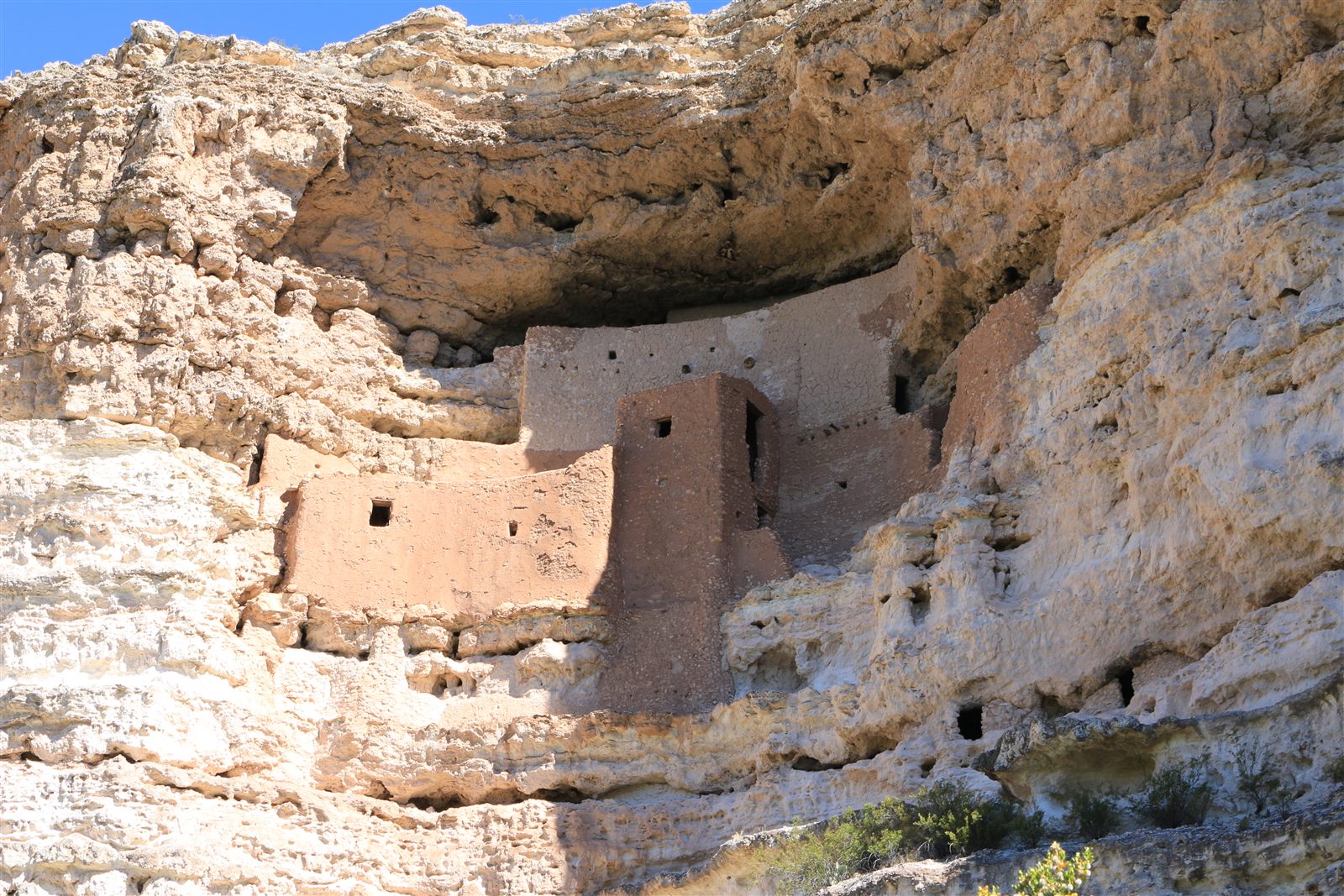
Montezuma Castle National Monument at a Glance
Ninety feet above the floor of the Verde Valley, tucked into a limestone alcove, sits a five-story home built by hand more than 800 years ago — and still standing today, almost entirely intact. Most descriptions call it simply "one of the best-preserved cliff dwellings in North America," which is true, but undersells what's actually on display here: a genuine, sophisticated engineering achievement, built without a single modern tool. Before diving into how and why it was built, here's the monument at a glance:
Located in the Verde Valley
Central Arizona
Protected National Monument
Managed by the National Park Service
Best-Preserved Cliff Dwelling
One of the finest in North America
Built by the Sinagua People
Primarily in the 1100s — 1300s
Approximately 20 Rooms
Across five stories
Built High in a Limestone Cliff
About 90 feet above the valley floor
National Park Service Site
One of the first national monuments
Why Visit Montezuma Castle National Monument?
Few sites make ancient engineering this immediately visible — the dwelling's five stories are laid out in plain view from the trail below, making the ingenuity behind it obvious even to visitors who've never thought twice about ancient architecture. Here's what makes Montezuma Castle worth the stop:
Remarkable Cliff Architecture
A five-story dwelling built into solid limestone, still standing after nearly 800 years.
Indigenous History
A rare, close-up look at Sinagua engineering and daily life.
Engineering
Multi-story construction achieved without metal tools or modern equipment.
Verde Valley Setting
A fertile, water-rich valley that shaped centuries of settlement.
Archaeology
One of the best-preserved and most studied cliff dwellings in North America.
Wildlife
A rich riparian habitat along Beaver Creek, just below the dwelling.
Beautiful Setting
Towering sycamores and cottonwoods framing a striking limestone cliff.
Photography
Warm stone architecture set against green creekside forest.
The Story of Montezuma Castle
The Sinagua People
The same Sinagua culture responsible for Wupatki and Walnut Canyon also built extensively throughout the Verde Valley, drawn south by the valley's reliable water and fertile farmland. Here, farming communities grew corn, beans, cotton, and squash along the floodplain of the Verde River and its tributaries, supported by trade networks that connected the valley to communities throughout the Southwest. Daily life centered on the rhythms of the valley itself — the planting and harvest seasons, the resources the creek provided, and a community structure built around shared farmland and shared labor. Archaeologists sometimes distinguish this southern branch as the "Southern Sinagua," recognizing that while they shared deep cultural roots with communities near Flagstaff, life in the warmer, lower-elevation Verde Valley followed a somewhat different rhythm, shaped by cotton cultivation and closer trade ties to the Hohokam culture farther south.
Building a Home in the Cliff
Like the builders of Walnut Canyon to the north, the Sinagua who built Montezuma Castle chose their site deliberately. The limestone alcove offered natural protection from the elements, kept the dwelling safely above the reach of seasonal floods along Beaver Creek below, and provided the same passive cooling and heat retention that made cliff dwellings such an effective design throughout the region. Building nearly 90 feet above the valley floor also made efficient use of a natural alcove that required minimal excavation — the cliff had already done much of the structural work before the first wall went up. The height itself was a deliberate advantage, not just a defensive afterthought: it kept the dwelling clear of the valley's seasonal flood line while still remaining close enough to the creek for water, farmland, and daily life to stay within easy reach.
Life Along Beaver Creek
Beaver Creek wasn't just scenery — it was the reason this location worked at all. The creek provided a dependable water source in an otherwise arid landscape, supporting irrigation for crops planted along its banks and offering fish and other food resources that supplemented the community's diet. Its riparian corridor of cottonwoods and willows also drew wildlife, providing additional hunting opportunities close to home, while the creek itself functioned as a natural travel corridor connecting this community to others throughout the Verde Valley. In many ways, Beaver Creek explains why the Sinagua settled here at all: reliable water, in a landscape where it couldn't be taken for granted, made this stretch of the valley one of the most desirable places to live for miles around. It's worth remembering that in the surrounding high desert, water this consistent was the exception, not the rule — which is precisely why this small stretch of the Verde Valley supported such a concentrated, long-lasting community.
Why the Community Eventually Moved
By around 1425 CE, Montezuma Castle and the surrounding Verde Valley communities had been largely abandoned — part of the same broad pattern of migration seen across Sinagua sites at Wupatki and Walnut Canyon during this general era. As with those sites, researchers point to a combination of contributing factors rather than a single cause: a shifting climate that made farming less reliable, gradual pressure on local resources after generations of sustained use, and broader migration patterns reshaping communities across the Southwest. The people who left carried their knowledge forward into new communities, some of which are the ancestors of Hopi and other Puebloan peoples today. Notably, Montezuma Castle's occupation lasted longer than many nearby Sinagua sites, likely a direct testament to just how reliable Beaver Creek's water supply remained even as conditions grew harder elsewhere in the region.
The Architecture of Montezuma Castle
Montezuma Castle is, above all, an engineering achievement — and one that rewards close attention to how each piece works together.
Limestone Cliffs
The dwelling sits within a natural limestone alcove roughly 90 feet above the valley floor, formed over millions of years by the same erosional forces that shaped much of the Verde Valley's dramatic terrain. The alcove's depth and overhang provided a natural head start on shelter before any construction began, and its particular shape — deep enough to shield multiple stories, yet open enough to admit low winter sun — made it an unusually well-suited site even among the many limestone alcoves found throughout the valley.
Building Materials
Builders used local limestone for walls, timber for support beams and floors, and mud mortar to bind everything together — all sourced from the immediate surroundings, meaning construction and repair never depended on materials from far away. Sycamore and other timber harvested from along Beaver Creek itself provided the structural beams still visible in the dwelling today, a direct physical link between the building and the creek that made its location possible.
Room Design
The roughly 20 rooms are arranged across five stories, connected by ladders that could be pulled up for security, with smaller rooms suited to storage and larger rooms suited to daily living and gathering. Each floor made efficient use of the alcove's changing depth and height as it rose up the cliff face, with upper rooms tucked into the shallower, higher reaches of the alcove and larger, more accessible rooms concentrated lower down.
Construction Techniques
Walls were built from shaped limestone blocks and mortared in place, with wooden beams spanning gaps to support upper floors — a genuine multi-story construction technique achieved entirely by hand, without pulleys, metal tools, or draft animals. Builders worked incrementally, adding rooms and stories over time as the community's needs grew, rather than executing a single fixed plan from the outset.
Natural Climate Control
The alcove's thick limestone mass and deep overhang kept interior spaces noticeably cooler in summer and warmer in winter than the exposed valley floor below, while the elevated position caught cooling breezes that rarely reached ground level in the heat of the day. In effect, residents enjoyed a noticeably more moderate microclimate than anyone farming the valley floor just below them.
Engineering Without Modern Tools
Perhaps most remarkable is what's absent from this building's history: no metal tools, no wheel, no draft animals, and no written engineering plans. Every measurement, every load-bearing wall, and every structural decision was worked out through observation, experience, and knowledge passed down through generations — and the results have held for the better part of a millennium, outlasting countless conventionally engineered buildings built in the centuries since.
Engineering Marvel of the Sinagua
Laid out side by side, it becomes clear that Montezuma Castle is as much an engineering achievement as it is an archaeological site — every challenge the Verde Valley presented had a considered, practical answer built directly into the design:
| Challenge | Sinagua Solution |
|---|
| Summer heat | Thick limestone walls and natural shade from the deep alcove overhang |
| Winter cold | Rock provided insulation and reduced wind exposure high on the cliff face |
| Flooding | Homes built safely above Beaver Creek, well out of reach of seasonal floods |
| Building materials | Limestone, timber, and mud mortar gathered locally, with nothing hauled in from afar |
| Community living | Multi-room, multi-story design supported extended family life and shared space |
Why Is It Called Montezuma Castle?
This is one of the most commonly asked questions about the monument, and the honest answer is that the name is a historical mistake. Montezuma Castle has nothing to do with the Aztec emperor Moctezuma II, and the Aztec Empire never extended anywhere near Arizona's Verde Valley.
The name dates to the 1860s, when American settlers encountering the dwelling assumed — incorrectly — that it must have been built by the Aztecs, since Moctezuma was the most famous Indigenous ruler most settlers had heard of at the time. It was a common pattern of the era: impressive Indigenous architecture across the Americas was often attributed, without evidence, to the Aztecs simply because settlers were more familiar with that name than with the actual builders. In reality, Montezuma Castle was built and occupied by the Sinagua people, and it had already been abandoned for roughly a century by the time Moctezuma II was even born, let alone rose to power in central Mexico, thousands of miles away. The name stuck anyway, and by the time the error was widely understood, it was too embedded in maps, records, and popular use to change. Today, the National Park Service and researchers are clear that the name is a misnomer — a piece of 19th-century misunderstanding preserved, ironically, right alongside a genuinely accurate archaeological site. It's a useful reminder that the names attached to historic places don't always reflect the people who actually built them.
Indigenous Heritage
Montezuma Castle was built by the Sinagua, but its significance extends to several living tribal nations today. Hopi clans trace ancestral connections to Sinagua communities throughout the Verde Valley, carrying that history forward through oral tradition and clan histories that connect directly back to sites like this one. The Yavapai and Apache peoples, who have lived in and around the Verde Valley for centuries, also hold cultural and historical ties to this landscape, shaped by their own long presence in the region and their own distinct histories of adaptation and resilience here.
These are living cultural traditions, not closed chapters of history. The National Park Service consults with associated tribes on decisions affecting the monument, and many descendant communities continue to regard sites like Montezuma Castle as meaningful, sacred places rather than simply historical curiosities. Visiting respectfully means recognizing that distinction — appreciating the architecture and history on display, while understanding that this place still matters, in an ongoing way, to the people connected to it. That perspective is worth carrying with you at every stop along the Verde Valley's chain of ancestral sites, not just this one.
Plants and Wildlife
Beaver Creek's riparian corridor supports a noticeably different, greener habitat than the surrounding high desert. Towering cottonwood and sycamore trees line the creek, providing shade and structure for a wide range of wildlife, and creating one of the most reliable riparian habitats in the entire Verde Valley. Birds are especially abundant along the water, from herons and waterfowl to a variety of songbirds drawn to the corridor's dense vegetation — birdwatchers consistently rank the area among the richest in the region for species diversity. Mule deer are regularly seen browsing near the creek, particularly at dawn and dusk, while reptiles and small mammals make use of both the creekside habitat and the drier slopes above it. The contrast between this lush, water-fed greenery and the arid limestone cliffs surrounding it is part of what makes the setting so striking, and it's easy to see, standing at the base of the dwelling, exactly why this particular spot supported a community for so many generations.
For a closer look at the animals found throughout the wider region, see our full Arizona Wildlife → guide.
Montezuma Castle Through the Seasons
Spring
Wildflowers bloom along the valley floor and the creek runs full and green, making spring one of the most pleasant times to visit, with comfortable temperatures ideal for exploring the paved trail below the dwelling.
Summer
The riparian forest along Beaver Creek offers welcome shade and noticeably lush vegetation, a cooling contrast to the dry desert surrounding the valley, even as afternoon temperatures climb well into the 90s and above.
Fall
Cottonwoods along the creek turn gold, paired with comfortable temperatures that make fall one of the most rewarding seasons to explore the site, with fewer crowds than the busier spring and summer months.
Winter
A quiet, uncrowded landscape and clear desert light make winter a uniquely rewarding season for photography, with the bare cottonwood canopy opening up new views of the dwelling itself that are hidden behind full summer foliage the rest of the year.
Interesting Facts About Montezuma Castle
A handful of details tend to surprise first-time visitors most:
- Built more than 800 years ago, with major construction continuing into the 1300s.
- One of the best-preserved cliff dwellings in North America, thanks in part to its protected, elevated position.
- Protected as one of the first National Monuments in 1906, among the earliest sites designated under the Antiquities Act, alongside Devils Tower and El Morro.
- Built about 90 feet above Beaver Creek, safely out of reach of seasonal flooding.
- Approximately 20 rooms housed an estimated 30 to 50 people at any given time.
- A larger, related structure nearby known as Castle A once stood twice the size of Montezuma Castle, before a fire in the late 1300s caused it to collapse.
- The dwelling was open for visitors to climb through by ladder until the 1950s, when the National Park Service closed it to public entry to protect the fragile structure.
Montezuma Castle and the Verde Valley
Montezuma Castle is the best-known site in the Verde Valley, but it's part of a much wider network of Sinagua settlement and, today, a living regional community built along the same river that sustained it centuries ago:
Montezuma Castle — A Five-Story Cliff Dwelling Above Beaver Creek
↓
Montezuma Well — A Spring-Fed Sinkhole That Supplied Irrigation
↓
Tuzigoot — A Hilltop Pueblo Overlooking the Valley
↓
Jerome — A Historic Mining Town on Cleopatra Hill
↓
Cottonwood — The Verde Valley's Modern Hub
↓
The Verde Valley — One Region, Shaped by the Same River
Together, these places tell the story of the Verde Valley as its own distinct region within Northern Arizona — a landscape defined, then and now, by the river running through it. Montezuma Well in particular deserves a special mention: a massive limestone sinkhole fed by a constant spring producing more than a million gallons of water daily, it was almost certainly used by the Sinagua to irrigate fields for miles around, and remains one of the most unusual natural features anywhere in the Verde Valley.
Arizona's First Master Builders
It's tempting to focus on Montezuma Castle as a structure — an impressive building, five stories tall, tucked into a cliff. But the building itself is really the visible result of something less visible and more remarkable: centuries of observation, adaptation, and engineering knowledge, refined by the Sinagua and passed down through generations, family by family, builder by builder.
The Sinagua didn't build in the cliff because it looked impressive. They built there because it was practical, efficient, and perfectly suited to the landscape — safe from floods, naturally insulated, built from materials at hand, and positioned to make the most of a demanding environment. That's not a coincidence or a lucky guess. It's the signature of genuinely skilled builders who understood their landscape at a level most modern visitors never have reason to develop, and who treated every design decision, from wall thickness to room placement, as an answer to a specific, well-understood problem.
That theme runs through every Sinagua site across Northern Arizona, each showing a different expression of the same underlying skill: Sunset Crater shows nature reshaping the landscape itself; Wupatki shows a community adapting in its aftermath; Walnut Canyon shows people learning to live with a canyon rather than against it; Montezuma Castle shows engineering and innovation creating a resilient, lasting home; and Tuzigoot shows a community grown through trade, agriculture, and regional connection. Read together, these sites don't describe a scattered collection of monuments. They describe Arizona's first master builders — and the different landscapes they learned, generation after generation, to call home. It's a legacy of practical genius that, in Montezuma Castle's case, has now outlasted eight centuries of wind, weather, and time.
Frequently Asked Questions
Who built Montezuma Castle?
Montezuma Castle was built by the Sinagua people, ancestral farming communities of Northern Arizona whose descendants include Hopi clans and other Puebloan peoples of the Southwest. The same culture built Wupatki and Walnut Canyon farther north.
Why is it called Montezuma Castle?
The name is a historical error. 1860s settlers mistakenly assumed the dwelling was built by the Aztecs and named it after the Aztec emperor Montezuma, even though the site has no connection to the Aztec Empire and was abandoned roughly a century before Montezuma II was born.
How old is it?
Construction began in the 1100s, with major building continuing into the 1300s, making the dwelling more than 800 years old — roughly contemporary with the largest pueblos at Wupatki and the cliff dwellings of Walnut Canyon.
How many rooms does it have?
The dwelling contains approximately 20 rooms spread across five stories, estimated to have housed between 30 and 50 people at its peak.
Can people enter the dwelling?
No. To protect the fragile structure, visitors view Montezuma Castle from a paved trail below rather than entering the dwelling itself, which has been closed to public entry since the 1950s due to the structure's fragility and the sheer volume of early visitors.
Why was it built in the cliff?
Building high in the limestone alcove provided natural shelter, kept the dwelling safely above seasonal flooding along Beaver Creek, and offered passive temperature control — a practical, well-reasoned choice rather than a defensive or random one, echoing the same logic behind the cliff dwellings at Walnut Canyon.
How many people lived there?
Researchers estimate the dwelling housed roughly 30 to 50 people at any given time, part of a larger Sinagua community spread throughout the surrounding Verde Valley, including nearby Montezuma Well and the broader network of Sinagua farmland.
Why is it protected?
Montezuma Castle was designated one of the first National Monuments in 1906 to preserve one of the best-examples of ancestral Puebloan architecture in North America, protecting both the structure itself and the broader archaeological record of Sinagua life in the Verde Valley.
Continue Exploring Arizona
Montezuma Castle is one chapter in a much larger story of Northern Arizona's Indigenous history. Here's where to go next:
Tuzigoot National Monument
A hilltop pueblo connected by trade and agriculture, just up the valley.
READ GUIDE →Walnut Canyon National Monument
Cliff dwellings designed to work with the canyon.
READ GUIDE →Wupatki National Monument
A community that adapted after the Sunset Crater eruption.
READ GUIDE →Verde Valley Guide
The wider region that shaped this landscape.
READ GUIDE →Arizona Native American Culture
The living tribal nations connected to this history.
READ GUIDE →
Discover Arizona's Ancient Heritage with Grand Canyon Journeys
Montezuma Castle National Monument offers a remarkable glimpse into the ingenuity of the Sinagua people and their ability to thrive in the Verde Valley centuries ago. Combined with Tuzigoot and other nearby cultural sites, it tells the story of one of Arizona's most fascinating civilizations. Our private tours help guests appreciate these remarkable places through engaging storytelling and local expertise, connecting the dots between the region's geology, its ancestral history, and the landscape you'll see today.