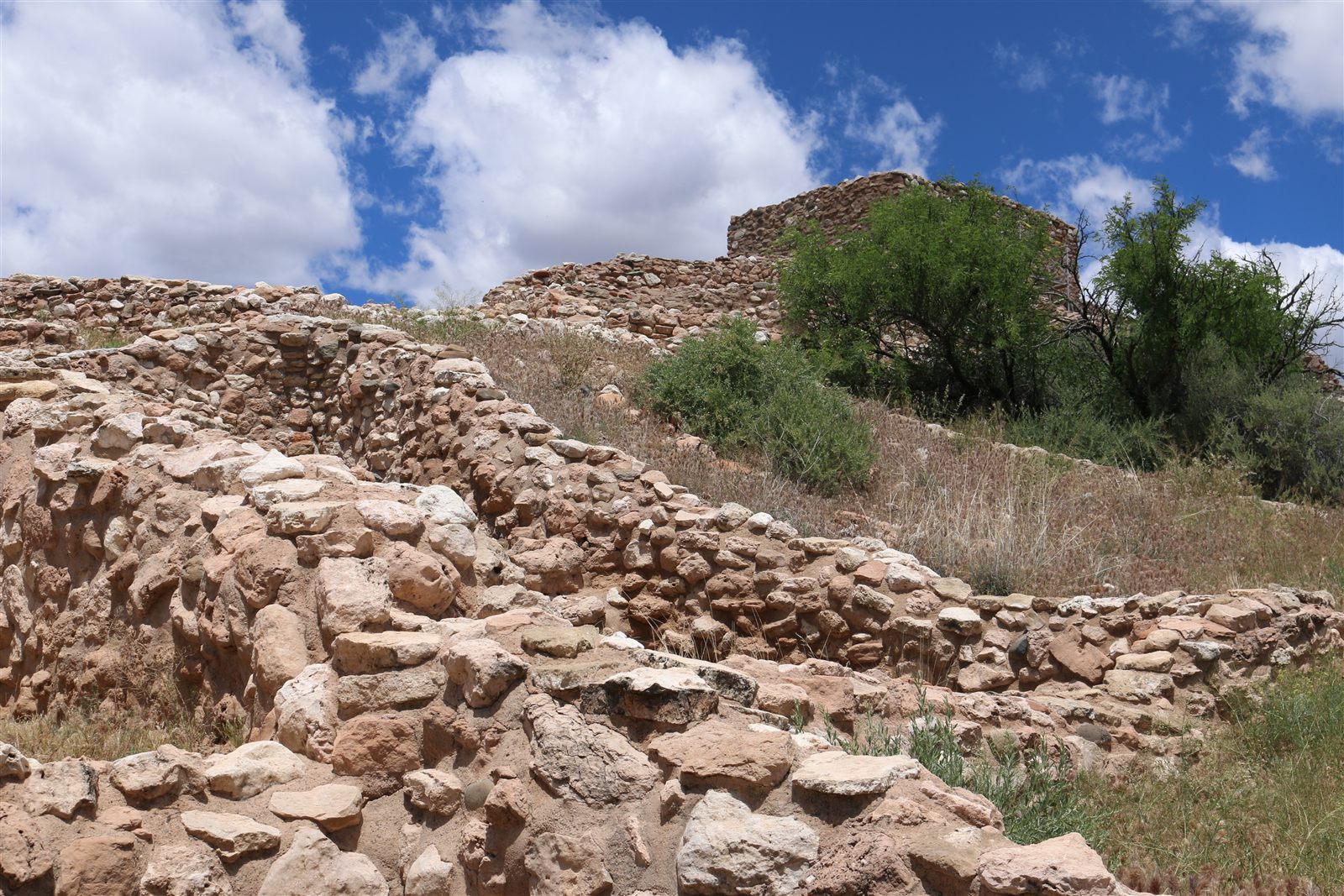
Tuzigoot National Monument at a Glance
High on a limestone ridge above the Verde River, the stone walls of a hundred-room pueblo still trace the outline of a community that once anchored an entire regional trade network. Most descriptions of Tuzigoot stop at "hilltop ruins," but that undersells what's really here: physical evidence that this small corner of Arizona was once genuinely connected to the wider ancient world. Before diving into that story, here's the monument at a glance:
Located Near Clarkdale
Arizona's Verde Valley
Protected National Monument
Managed by the National Park Service
Ancient Sinagua Pueblo
A major hilltop settlement
More Than 100 Rooms
Built up over generations
Built Atop a Limestone Ridge
Commanding views of the valley
Occupied for Centuries
Roughly 1000 — 1400 CE
National Park Service Site
Preserved for research and visitation
Why Visit Tuzigoot National Monument?
Tuzigoot rewards visitors who want to understand not just a building, but an entire connected society. Here's what makes it worth the stop:
Incredible Hilltop Pueblo
Over 100 rooms built along a limestone ridge, still standing after nearly a thousand years.
Verde Valley History
One of the largest and most influential Sinagua communities in the region.
Archaeology
Extensively excavated and studied, offering a detailed picture of Sinagua life.
Trade
Physical evidence of exchange networks stretching across the Southwest and beyond.
Agriculture
Sophisticated farming along the fertile Verde River floodplain.
Scenic Views
Sweeping panoramas of the Verde Valley from the pueblo's hilltop position.
Wildlife
A rich mix of river, riparian, and high-desert habitat nearby.
Photography
Warm stone ruins framed by valley views in every direction.
Indigenous Heritage
Living Hopi and Puebloan connections to the community that built it.
The Story of Tuzigoot
The Sinagua People
Tuzigoot was built by the same Southern Sinagua farming communities responsible for Montezuma Castle, just down the valley. Families here farmed the fertile floodplain of the Verde River, building a settled agricultural life that, over generations, grew into one of the most significant communities in the entire Verde Valley. Family life centered on shared farmland, seasonal harvests, and a community structure that expanded steadily as Tuzigoot's regional importance grew. Archaeologists estimate the settlement eventually supported a population in the hundreds, making it one of the largest concentrations of people anywhere in the Sinagua world.
Why Build on a Hill?
Unlike Montezuma Castle's cliff alcove or Walnut Canyon's canyon walls, Tuzigoot's builders chose a hilltop ridge — and that choice was just as deliberate. The elevated position offered natural visibility across the entire valley, useful for community planning, communication with neighboring settlements, and simply keeping watch over farmland and approaching visitors alike. The ridge's height provided some natural climate advantage too, catching breezes that rarely reached the valley floor, while its stony, uneven terrain wasn't suited to farming anyway — making it an efficient use of land that would otherwise have gone unused, preserving the fertile floodplain below for growing crops instead of housing. In a valley where farmland was precious, that trade-off mattered: every acre of ridge used for homes was an acre of bottomland left free for crops.
A Thriving Community
At its height, Tuzigoot was a genuinely bustling settlement. Homes were built up and outward across the ridge as the population grew, eventually reaching more than 100 rooms. Community and ceremonial spaces supported gatherings that reinforced shared identity and tradition, while active trade brought goods and visitors from communities near and far. Food production remained constant work — tending fields, processing harvests, preparing meals — but it existed alongside craft work, trade, and the kind of community life that comes with genuine, sustained prosperity. Excavations have recovered an unusually rich array of tools, pottery, and ornamental objects here, physical evidence of a community with both the resources and the connections to accumulate genuine material wealth.
Why Tuzigoot Was Eventually Abandoned
By around 1400 CE, Tuzigoot's population had left, part of the same broad wave of migration that reshaped Sinagua communities throughout the region during this period. As with Wupatki, Walnut Canyon, and Montezuma Castle, there's no single, tidy explanation for why. A changing climate likely made farming less reliable over time; resources that had sustained a large population for centuries came under increasing pressure; and wider migration patterns were already reshaping communities across the Southwest. It would be a mistake to point to any one cause as definitive — the honest picture is one of several overlapping pressures, playing out differently at each Sinagua community, that together led people to move on and build new lives elsewhere. Given Tuzigoot's size, its decline would have unfolded gradually, over multiple generations, rather than as a single dramatic departure.
The Architecture of Tuzigoot
Multi-Room Pueblo
Tuzigoot grew to more than 100 interconnected rooms, built up over generations as the community expanded. Rather than a single planned structure, the pueblo reflects organic, incremental growth — new rooms added as families grew and the population increased, resulting in a floor plan that reads almost like a physical timeline of the community's own expansion.
Building Materials
Builders used local limestone and river cobbles for walls, mortared with mud, and timber harvested from along the Verde River for roof beams and support structures — all sourced from the immediate surroundings, keeping construction and repair sustainable across generations of continuous use and expansion.
Rooftop Living
Many rooms were accessed from above via rooftops rather than ground-level doorways, with rooftops themselves doubling as usable outdoor space for daily work, food preparation, and moving between connected sections of the pueblo. This rooftop-access design also added a practical layer of security, since removing a ladder could isolate individual rooms from the rest of the settlement.
Community Design
Rooms cluster tightly together, sharing walls and access points in ways that suggest closely related families living, working, and cooperating side by side, rather than isolated, independent households. That density also made efficient use of the ridge's limited buildable space, packing a large population into a relatively compact footprint.
Construction Techniques
Walls were built in stages, thickened and raised as additional stories were added in places, with builders adapting each addition to the specific needs and constraints of the growing settlement rather than following a single fixed design. Later additions sometimes reused or reinforced earlier walls, layering new construction directly onto the community's own architectural history.
Hilltop Engineering
Building across an uneven limestone ridge required constant adaptation — terracing, varied wall heights, and creative use of the ridge's natural contours all played a role in fitting a hundred-room community onto ground that was never flat to begin with. That adaptability is, in its own way, as impressive an engineering feat as any single dramatic structure elsewhere in the Verde Valley.
Agriculture and Daily Life
Tuzigoot's success was built on farming. Corn, beans, and squash — the classic Southwest agricultural trio — were grown along the fertile floodplain below the ridge, supplemented by cotton, which thrived in the Verde Valley's warmer, lower-elevation climate and became an important trade good in its own right. Irrigation channels helped direct water from the Verde River to fields during drier stretches of the growing season, extending the land's productivity well beyond what rainfall alone could support. This combination of reliable water and warm, low-elevation farmland made the valley floor near Tuzigoot some of the most productive agricultural land anywhere in the Sinagua world.
Farming was supplemented by hunting and gathering — deer and small game from the surrounding hills, along with wild plants gathered seasonally, added variety and resilience to the community's food supply. Successful harvests were processed and stored in dedicated rooms within the pueblo, protected from moisture and pests, providing a buffer against leaner years. Daily work was constant and varied: tending fields, processing food, maintaining and expanding the pueblo, producing pottery and textiles, and managing the trade relationships that made Tuzigoot's prosperity possible. Cotton in particular deserves attention here — turning raw fiber into finished cloth was a skilled, labor-intensive process, and evidence of weaving tools found at the site suggests textile production was a significant part of Tuzigoot's economy, not just a minor household task.
Trade Across the Southwest
Tuzigoot's location in the Verde Valley placed it at a genuine crossroads, and the archaeological record shows just how far its trade connections reached. Items recovered from the site reveal a community linked to distant corners of the Southwest and beyond — goods that could only have arrived through a sustained, functioning network of trade relationships passed from community to community across hundreds of miles:
| Resource | Origin | Why It Mattered |
|---|
| Turquoise | Southwest mines | Jewelry and trade |
| Marine shells | Pacific Coast & Gulf of California | Ornaments and ceremonial use |
| Pottery | Neighboring communities | Food storage and trade |
| Cotton | Verde Valley | Clothing and textiles |
| Macaw feathers | Mesoamerica | Ceremonial significance |
Taken together, this evidence makes one thing clear: Tuzigoot wasn't a remote, self-contained village. It was a connected participant in a vast web of Southwestern and Mesoamerican trade, exchanging goods, materials, and almost certainly ideas across hundreds of miles — a genuinely cosmopolitan community by the standards of its time. Few visitors expect to find evidence of Pacific Coast shells or Mesoamerican macaws at a hilltop pueblo in the middle of Arizona, and that surprise is exactly why Tuzigoot's trade story is worth telling in detail: it reframes the entire Verde Valley as a connected hub, not an isolated outpost.
The Verde Valley
Tuzigoot didn't succeed by accident, and neither did the wider Verde Valley. Successful, long-lasting communities like this one emerged from a rare combination of advantages found together in one place: reliable water from the Verde River, fertile floodplain soils suited to sustained farming, diverse plant and animal life supporting hunting and gathering, established connections to regional trade routes, and a climate moderate enough to support agriculture for the vast majority of the year.
Few stretches of Northern Arizona offered all of these advantages at once. That combination is exactly why the Verde Valley supported not just Tuzigoot, but Montezuma Castle and dozens of smaller Sinagua communities as well — a concentration of settlement unusual for the region, and a strong sign of just how valuable this particular landscape was to the people who called it home. Understanding the Verde Valley as its own distinct cultural landscape, rather than simply the backdrop for a few individual monuments, is key to understanding why this region became one of ancestral Arizona's great population centers.
It's a pattern worth remembering as you travel through the region today: the same qualities that drew the Sinagua to settle here nearly a thousand years ago — water, fertile land, moderate climate, and connection to the wider world — are largely the same qualities that make the Verde Valley a thriving wine region, agricultural center, and visitor destination today.
A Day in Tuzigoot
Archaeological evidence — farming tools, trade goods, hearths, and room layouts — lets us imagine, in a grounded way, what daily life may have looked like in a community this large and well-connected.
Morning
Farmers would have headed out to fields along the Verde River floodplain as early light hit the valley, timing their work around the cooler morning hours before the day's heat set in. Families prepared meals back at the pueblo, and it wouldn't have been unusual to see traders arriving from neighboring communities, having traveled through the night or setting out at first light to reach Tuzigoot by morning. Given how many rooms the site eventually held, a typical morning here would have looked and sounded like a genuinely busy small town, not a quiet village.
Afternoon
As the day warmed, work shifted toward tasks suited to the pueblo itself: potters shaping vessels, toolmakers working stone and bone into farming and household implements, and children learning these same skills alongside adults. Afternoons would also have been a natural time for community gatherings, as news, goods, and people moved through a settlement this well-connected to the wider region. Rooftops doubling as workspace meant much of this activity would have happened in full view of neighbors, reinforcing the tightly woven, communal character of daily life here.
Evening
As temperatures cooled, families gathered to cook and eat, the pueblo's rooftops and open spaces filling with the sounds of a large, active community. Evenings made room for storytelling and ceremony, reinforcing the shared traditions that held such a large settlement together. And, as the light faded, it's easy to imagine residents pausing to watch the sunset settle over the Verde Valley below — the same view that draws visitors to this hilltop today, largely unchanged after nearly a thousand years.
None of this requires invention. It's a grounded picture built from what archaeologists have documented about Sinagua daily life and Tuzigoot's own extensive excavation record, used here to help imagine the thriving community that once filled this hilltop.
Plants and Wildlife
The Verde River corridor below Tuzigoot supports a lush riparian habitat noticeably different from the drier ridge above it. Cottonwoods line the riverbanks, joined by mesquite and juniper on the surrounding slopes. Birds are abundant throughout the area, drawn by the river's water and vegetation, while mule deer move through both the riparian corridor and the drier hillside terrain. Coyotes are a regular presence as well, particularly around dawn and dusk. The river ecosystem itself functions as a corridor of life through an otherwise arid landscape, much as it did for the community that settled beside it centuries ago — the same water and vegetation that draws wildlife today would have supported hunting, gathering, and daily life for Tuzigoot's residents as well.
For a closer look at the animals found throughout the wider region, see our full Arizona Wildlife → guide.
Tuzigoot Through the Seasons
Spring
Wildflowers appear across the valley floor and the Verde River runs full, framing the ruins in green at one of the most pleasant times of year to visit.
Summer
Desert plants bloom across the surrounding hillsides, with warm temperatures and building monsoon clouds adding drama to the wide valley views from the ridge.
Fall
Cottonwoods along the river turn gold, pairing comfortable temperatures with some of the most rewarding photography light of the year.
Winter
Quiet, uncrowded landscapes and exceptionally clear valley views make winter a rewarding season, with crisp air and beautiful low-angle light across the ruins.
Interesting Facts About Tuzigoot
A handful of details tend to surprise first-time visitors most:
- More than 100 rooms, built up gradually as the community grew over generations.
- Built approximately 1,000 years ago, with the community expanding significantly over the following centuries.
- Occupied for several centuries before its eventual abandonment around 1400 CE.
- Located on a commanding hilltop overlooking the Verde Valley, offering sweeping views in every direction.
- The name "Tuzigoot" comes from an Apache phrase commonly translated as "crooked water," likely a reference to the winding course of the nearby Verde River.
Tuzigoot and Montezuma Castle
Tuzigoot and Montezuma Castle are often visited together, and for good reason — they were built by the same people, in the same valley, during roughly the same era, yet they look almost nothing alike, offering two very different lessons about the same culture:
Tuzigoot
↓
Montezuma Castle
↓
Verde Valley
↓
Sinagua
↓
Shared History
↓
Different Architecture
That contrast is the point. Montezuma Castle shows the Sinagua building vertically into a sheltered cliff alcove, prioritizing flood safety and passive climate control. Tuzigoot shows the same culture building horizontally across an open hilltop, prioritizing visibility, community space, and efficient use of non-farmable land. Same people, same valley, same era — two entirely different, equally intelligent answers to the question of where and how to build a home.
One Continuous Story: Northern Arizona's Five Chapters
Tuzigoot is a remarkable site on its own. But its full significance only comes into focus alongside the other places that, together, tell the complete story of how Northern Arizona's ancient landscape and its people shaped one another — a story that unfolds, quite literally, across the ground you can still walk today:
Sunset Crater — A Volcanic Eruption Reshapes the Landscape
↓
Wupatki — People Adapt and Communities Grow
↓
Walnut Canyon — Communities Master Canyon Living
↓
Montezuma Castle — Engineering and Innovation Along Beaver Creek
↓
Tuzigoot — Trade, Agriculture, and a Thriving Verde Valley Society
Visited in sequence, these five places stop reading as a list of separate, unrelated attractions. They become one continuous story: a landscape reshaped by nature, and the generations of people who responded with resilience, ingenuity, and an ever-deepening understanding of the land they called home. Few places make that arc as visible, or as personal, as Northern Arizona's Sinagua sites do — and fewer still let you trace it, chapter by chapter, in a single, connected trip.
Frequently Asked Questions
Who built Tuzigoot?
Tuzigoot was built by the Sinagua people, the same farming culture responsible for Montezuma Castle, Wupatki, and Walnut Canyon, whose descendants include Hopi clans and other Puebloan peoples of the Southwest.
How old is Tuzigoot?
Construction began roughly 1,000 years ago, with the community growing steadily over the following centuries before its abandonment around 1400 CE, making it one of the longer-occupied Sinagua sites in the region.
Why was it built on a hill?
The hilltop ridge offered natural visibility across the valley, made efficient use of land unsuited to farming, and caught cooling breezes that rarely reached the valley floor — a deliberate, practical choice rather than a defensive afterthought.
How many rooms are there?
Tuzigoot grew to more than 100 interconnected rooms, expanded gradually over generations as the community's population increased to the hundreds.
What does Tuzigoot mean?
"Tuzigoot" comes from an Apache phrase commonly translated as "crooked water," likely referencing the winding path of the nearby Verde River. It's not the name the Sinagua themselves would have used, but rather a later Apache and, eventually, English name applied to the ruins.
Why was it abandoned?
Researchers point to a combination of factors around 1400 CE, including a changing climate, resource pressure after centuries of use, and broader regional migration patterns — not any single definitive cause, and likely a gradual process rather than a sudden departure.
Why is Tuzigoot important?
Tuzigoot offers an unusually clear picture of a large, prosperous Sinagua community and its far-reaching trade connections, extensively studied and excavated to reveal one of the most complete records of Verde Valley life available anywhere.
How is it connected to Montezuma Castle?
Both were built by the Sinagua in the same era and the same valley, but with entirely different architectural approaches — Montezuma Castle built vertically into a sheltered cliff, while Tuzigoot built horizontally across an open hilltop. Visiting both offers a fuller picture of Sinagua ingenuity than either site can provide alone.
Continue Exploring Arizona
Tuzigoot is the final chapter in Northern Arizona's Sinagua story. Here's where to go to see the rest of it:
Montezuma Castle National Monument
Engineering and innovation along Beaver Creek.
READ GUIDE →Walnut Canyon National Monument
Communities that mastered canyon living.
READ GUIDE →Wupatki National Monument
A community that adapted after the Sunset Crater eruption.
READ GUIDE →Verde Valley Guide
The wider region that shaped this landscape.
READ GUIDE →Arizona Native American Culture
The living tribal nations connected to this history.
READ GUIDE →
Experience Arizona's Ancient Civilizations with Grand Canyon Journeys
Tuzigoot National Monument tells the remarkable story of a thriving hilltop community that flourished in the Verde Valley for centuries. Together with nearby Montezuma Castle and other cultural landmarks, it offers a deeper understanding of Arizona's Indigenous history, engineering, and regional trade networks. Our private tours help bring these stories to life through engaging interpretation and local expertise.