Painted Desert at a Glance
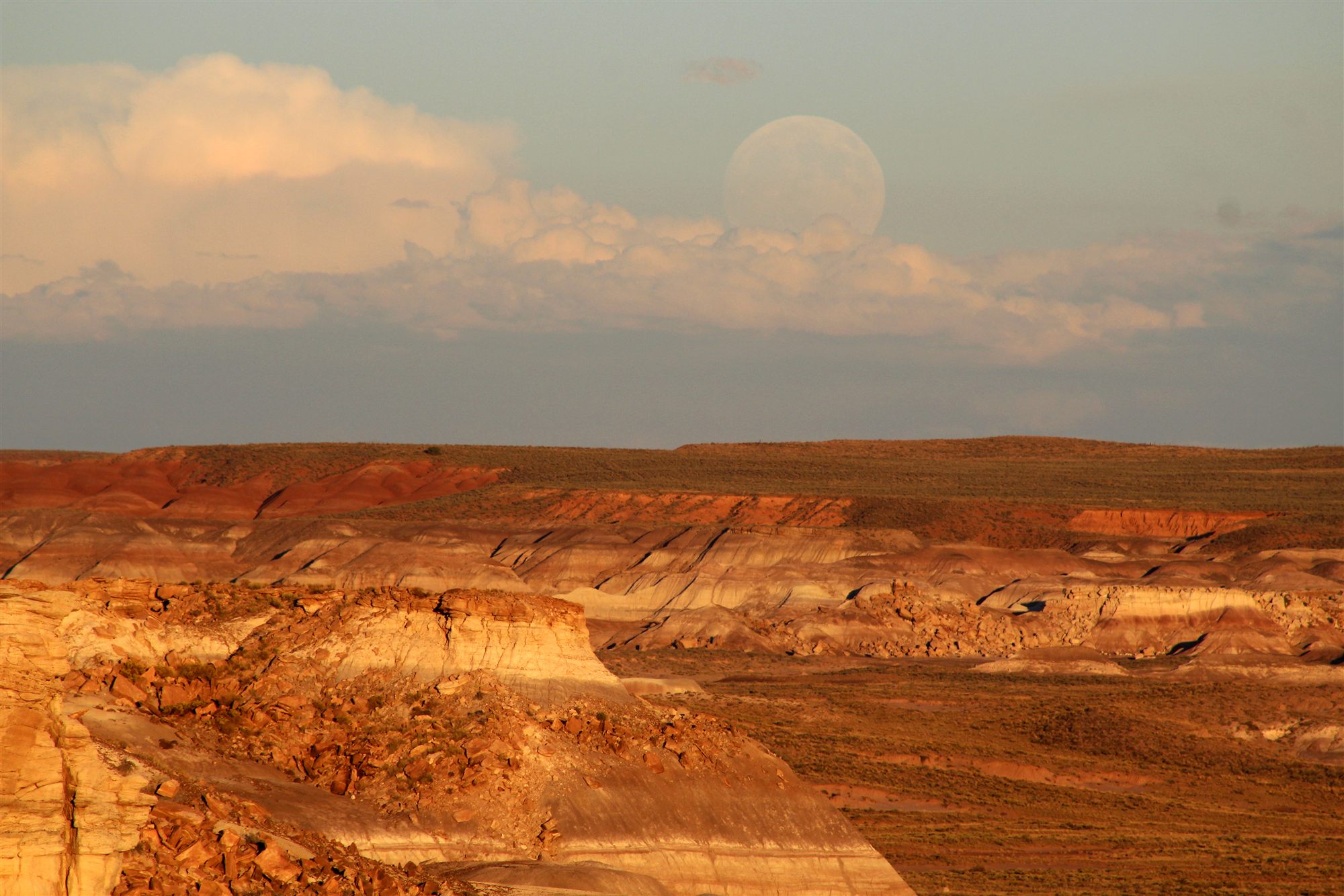
Stretching across a large swath of northeastern Arizona, the Painted Desert is one of the Southwest's most recognizable landscapes, its eroded badlands banded in red, pink, orange, lavender, blue, and gray. The National Park Service describes the Painted Desert's colorful badlands as formed largely from bentonite, a clay created from altered volcanic ash, and notes that erosion continually reshapes the terrain.
Northeastern Arizona
A vast, multi-part region
Extends Through Petrified Forest
And well beyond its boundaries
Colorful Badlands and Mesas
Broad, sweeping desert vistas
Formed by Ancient Sediment
Volcanic ash, minerals, and erosion
Connected to Route 66
And the Navajo Nation nearby
Rich Fossil Record
And archaeological resources
What Is the Painted Desert?
The Painted Desert is a broad geographic region, not a single small park or a single overlook. It stretches across a large portion of northeastern Arizona, encompassing eroded badlands, flat-topped mesas, isolated buttes, open grasslands, and dry desert washes spread across many miles of high-desert terrain.
Only part of the Painted Desert lies within Petrified Forest National Park, whose northern section protects a significant stretch of this colorful badland country. The wider Painted Desert region extends considerably beyond the park's boundaries in multiple directions, much of it crossing Navajo Nation land and other stretches of northeastern Arizona entirely outside any park boundary.
The name itself describes the region's most defining trait: an extraordinary range of color banded across its eroded hillsides, a direct visual record of the different sediments and minerals that built this landscape over many millions of years. That landscape is also far from static — erosion continues to reshape the Painted Desert's badlands today, meaning the terrain visitors see now is simply its current state in an ongoing, still-unfinished process.
It's worth being precise about this distinction, since the two names are so often used interchangeably in casual conversation. Petrified Forest National Park is a specific, federally protected unit with defined boundaries, established to protect fossils, badlands, and cultural resources. The Painted Desert, by contrast, is a broader physiographic region defined by its geology and color, only part of which happens to fall within that park's boundaries. Understanding that difference helps make sense of why some of the most famous Painted Desert views lie inside the park, while considerable additional stretches of the same colorful badland terrain lie well outside it, unprotected by any park designation at all.
Why Is It Called the Painted Desert?
The name comes directly from what early travelers saw: hillsides banded in red, orange, pink, purple, blue, green, gray, and white, arranged in such vivid, sweeping stripes that the landscape looked as though it had been painted by hand rather than shaped by geology. That impression was strong enough that Spanish explorers reportedly referred to the region using a term that translates to "painted desert" centuries before it became the landscape's official English name.
The specific colors visible at any given moment depend heavily on lighting conditions. Direct midday sun tends to flatten the landscape's colors into a more uniform palette, while the low, angled light of early morning and evening deepens contrast and intensifies reds and oranges considerably. Cloud cover changes the effect again, often deepening and saturating colors that appear paler under harsh, direct sun, since diffused light reduces glare and allows the eye to perceive richer color variation across the badlands.
Moisture adds yet another layer of visual change. Rain-dampened ground typically appears darker and more saturated than the same slopes when dry, briefly intensifying the landscape's colors before the desert sun dries the surface again. Early travelers crossing this region, often exhausted after long stretches of monotonous terrain, frequently described their first view of the Painted Desert in terms bordering on disbelief — a landscape that seemed too vividly colored to be entirely natural, and yet was.
That sense of disbelief has never entirely faded. Even visitors arriving today, having seen countless photographs beforehand, often describe the same reaction: a landscape that looks slightly unreal in person, its colors somehow more vivid and more varied than any single photograph manages to fully capture. That gap between photograph and direct experience is itself a small testament to just how unusual this landscape's coloring genuinely is.
How the Painted Desert Was Formed
Ancient Rivers and Floodplains
During the Late Triassic Period, more than 200 million years ago, ancient river systems and floodplains crossed this region, depositing layer after layer of mud, silt, and sand across a landscape considerably wetter than today's Arizona desert. Those accumulated sediments would eventually become the colorful rock layers visible throughout the Painted Desert today.
Volcanic Ash
Volcanic activity somewhere to the west periodically blanketed this region in ash during the same era, adding yet another distinct layer to the accumulating sediment. Over time, that ash chemically altered into bentonite, a distinctive clay that plays a central role in both the Painted Desert's coloring and its characteristic badland erosion patterns.
Mineral-Rich Sediments
Different minerals, and the different chemical conditions present when each layer was originally deposited, produced the contrasting colors visible in the rock today. Iron content, oxygen exposure, and the specific mix of clay and volcanic material all varied somewhat from one depositional period to the next, embedding a genuine chemical record directly into the landscape's color.
Uplift of the Colorado Plateau
Many millions of years after these sediments were deposited, the broad uplift of the Colorado Plateau raised this entire region substantially, exposing the accumulated sedimentary layers to erosion for the first time since they had originally been buried.
Wind and Water Erosion
Since that uplift, seasonal storm runoff, freezing and thawing cycles, and steady wind have all worked together to sculpt the badlands visible today, cutting gullies, rounding hillsides, and continually exposing fresh rock as older, weathered surfaces wear away. The park's primary colorful rocks belong largely to the Chinle Formation, deposited more than 200 million years ago and still being actively reshaped by these same erosional forces.
What Creates the Painted Desert's Colors?
Red, Orange, and Pink
These warm tones are primarily associated with iron oxides, the same basic chemical process responsible for rust, present within the sediment in varying concentrations and oxidation states.
Purple and Blue
Purple and blue tones result from different combinations of iron and manganese minerals, shaped by the specific chemical conditions present at the time each layer was originally deposited.
Green and Gray
Green and gray tones are often connected to reduced iron minerals, chemically distinct from the oxidized iron responsible for red and orange, typically formed under ancient low-oxygen depositional environments such as stagnant water or waterlogged sediment.
White Layers
Pale white layers may reflect volcanic ash, light-colored clay, or other naturally pale sediment largely free of the iron staining responsible for the landscape's warmer tones. The National Park Service notes that red, orange, and pink tones commonly come from iron oxide, while other colors vary with mineral composition and the specific conditions present during deposition.
The Colors of the Painted Desert
| Color | Likely Geological Cause |
|---|
| Red and orange | Iron minerals oxidized in oxygen-rich conditions. |
| Pink | Lighter concentrations of iron oxide mixed with clay. |
| Purple | Iron and manganese minerals under varying chemical conditions. |
| Blue and green | Reduced iron minerals formed in low-oxygen environments. |
| Gray | Clay-rich sediments and altered volcanic material. |
| White | Volcanic ash, pale clay, or lighter sediment layers. |
The precise appearance of any given hillside varies by exact location, lighting, moisture, and mineral composition, meaning no two stretches of the Painted Desert, and no two visits to the same overlook, ever look quite identical.
The Chinle Formation
The Painted Desert's colorful badlands are built primarily from the Chinle Formation, a Late Triassic sequence of mudstone, sandstone, clay, and volcanic ash deposited by ancient river systems more than 200 million years ago. This same formation is directly responsible for the region's famous petrified wood, preserved from trees swept into those ancient rivers and gradually replaced by mineral-rich groundwater over many thousands of years.
The Chinle Formation also holds a rich fossil record beyond petrified wood, documenting the plants and animals that lived across this ancient floodplain landscape. Its particular mix of soft mudstone and clay, especially the bentonite clay derived from altered volcanic ash, erodes readily into the smooth, rounded badland hills characteristic of the Painted Desert, rather than the sharper cliffs and mesas typical of harder, more resistant rock formations elsewhere on the Colorado Plateau. For more on how this fits into the region's rock record, see our Petrified Forest National Park →, Arizona Geology →, and Grand Canyon Geology → guides.
The Painted Desert and Petrified Forest National Park
The relationship between these two names causes genuine confusion, and it's worth clarifying directly. The northern section of Petrified Forest National Park contains an extensive stretch of Painted Desert badlands, protected within the park alongside grasslands, mesas, and dry washes. Petrified wood itself, meanwhile, is concentrated more heavily in other portions of the park, farther south, rather than throughout the colorful badlands of the park's northern Painted Desert section.
The two landscapes are geologically and geographically connected, both built substantially from the same Chinle Formation, but they represent different expressions of that shared geology within different parts of the same protected area. Petrified Forest National Park as a whole protects fossils, archaeological sites, grasslands, badlands, mesas, and petrified wood spanning more than 200 million years of history, of which the Painted Desert's colorful badlands are one significant, but not exclusive, part.
Fossils and Ancient Life
The Chinle Formation preserves a remarkably detailed record of life during the Late Triassic, including ancient plants, early reptiles, amphibians, fish, and invertebrates that lived across the floodplains and river channels that once crossed this region. Fossilized wood remains the most famous of these fossils, but it represents only one part of a considerably broader paleontological record preserved throughout the formation.
Paleontologists study this region specifically because it offers an unusually complete window into a pivotal period of Earth's history, when early dinosaurs and other significant evolutionary lineages were first becoming established. Petrified Forest National Park contains hundreds of known paleontological sites and is considered an important natural laboratory for understanding these ancient ecosystems, with active research continuing to refine scientific understanding of this period today.
Indigenous History and Cultural Connections
Indigenous peoples have maintained a presence in this region for thousands of years, long before either the name "Painted Desert" or any park boundary existed. Ancestral Puebloan communities lived throughout this landscape for many centuries, leaving behind archaeological sites, dwellings, and petroglyphs that document a sustained, detailed relationship with this specific stretch of the Colorado Plateau.
This region also served as a corridor for travel and trade connecting communities across a wide area of the ancient Southwest, part of a much larger network linking distant peoples long before any modern road crossed the landscape. Today, the Painted Desert region borders and overlaps with the Navajo Nation, and the wider area holds continuing significance for the Navajo people alongside other Indigenous nations with historical ties to this landscape, including connections recognized by the Hopi Tribe and other Puebloan descendant communities.
This landscape's significance is not merely scenic. Archaeological sites throughout the region remain culturally significant and, in many cases, sensitive, and this guide intentionally avoids describing specific site locations out of respect for their protection. Understanding the Painted Desert honestly means recognizing it as a landscape with a deep, continuous human history, not simply a striking backdrop encountered along a highway. For more on the Indigenous nations connected to this region, see our Navajo Nation → guide.
The Painted Desert and Route 66
Historic Route 66 once crossed directly through the Painted Desert, part of the highway's long run through northern Arizona during the early-to-mid 20th century. As automobile travel expanded rapidly during this period, the Painted Desert became one of the most photographed and most anticipated sights along the entire route, drawing travelers eager to see its famous colored badlands firsthand.
Roadside tourism grew up alongside this early automobile traffic, with businesses, viewpoints, and waystations developing specifically to serve travelers passing through this stretch of highway. The Painted Desert Inn became one of the most significant of these stops, a waypoint that grew into an enduring symbol of the landscape's role in the broader mythology of the American West — a place where the romance of the open road met one of the country's most extraordinary natural landscapes.
Painted Desert Inn
Early Beginnings
The Painted Desert Inn began as a modest roadside inn, built substantially from local stone and materials by early builders who recognized the commercial potential of a waystation overlooking such a dramatic view.
Pueblo Revival Architecture
The building's current character reflects Pueblo Revival architecture, a Southwestern style drawing on Ancestral Puebloan building traditions, expressed through the inn's thick walls, rounded forms, and materials chosen to harmonize with the surrounding badland landscape rather than stand apart from it.
Route 66 History
The inn's location made it a natural stopping place for early automobile tourists traveling Route 66, offering food, lodging, and, above all, a direct view over the Painted Desert at a time when reliable roadside services were still relatively scarce across this stretch of Arizona.
Preservation
The Painted Desert Inn is preserved today as a National Historic Landmark, protected for its architectural significance and its role in the history of early Southwestern automobile tourism, standing as a tangible connection between the region's Route 66 heritage and the extraordinary landscape that made this particular stretch of highway so memorable.
Plants and Wildlife of the Painted Desert
Despite its stark, eroded appearance, the Painted Desert is not a lifeless landscape. It includes genuine grassland, shrubland, badland, and dry-wash habitats, each supporting its own distinct community of plants and animals adapted to this demanding, arid environment.
Pronghorn
Pronghorn range across the open grasslands bordering the badlands, among the fastest land animals in North America and well suited to the wide-open terrain found throughout this region.
Coyotes
Coyotes move across the Painted Desert's grasslands and badlands alike, adaptable enough to make use of nearly every habitat type found within the region.
Bobcats
Bobcats move quietly through the broken terrain of the badlands, rarely seen but present throughout much of the region's more sheltered terrain.
Ravens and Raptors
Ravens are a near-constant presence overhead, while raptors including hawks and falcons make use of the open sky and updrafts common across this exposed, elevated terrain.
Reptiles
Numerous lizard and snake species inhabit the badlands and surrounding grassland, well adapted to the intense heat and minimal water typical of this landscape.
Desert Grasslands
Grasslands bordering the badlands support a genuinely distinct plant community from the badlands themselves, a reminder that the Painted Desert is considerably more ecologically varied than its colorful, largely bare hillsides might initially suggest.
Seasonal Wildflowers
Wildflowers bloom seasonally across the grasslands and more stable soil areas, adding color to the landscape well beyond the badlands' own mineral-derived hues. For a closer look at the animals found throughout the wider region, see our full Arizona Wildlife → guide.
Why So Little Vegetation Grows on Some Hills
Much of the Painted Desert's bare, strikingly banded badland terrain owes its sparse vegetation to the same bentonite clay responsible for much of the landscape's color and erosion pattern. Bentonite clay expands dramatically when wet and contracts again as it dries, creating a genuinely unstable surface that makes it difficult for plant roots to establish and survive.
That instability creates a self-reinforcing cycle: limited vegetation leaves badland slopes largely unprotected against erosion, while ongoing erosion in turn keeps the surface too unstable and shifting for most plants to take hold in the first place. Water running across these slopes during storms carves channels and gullies that deepen steadily over time, cutting the intricate, textured badland surfaces visible throughout the Painted Desert today. The National Park Service states that bentonite can expand dramatically when wet, contributing to rapid erosion and sparse vegetation on many slopes throughout the region.
The Painted Desert Through the Seasons
Spring
Spring generally brings cooler temperatures and considerable wind, along with occasional wildflower blooms across the grasslands in favorable years. Weather can shift rapidly during this season, and conditions should never be assumed fixed from one day to the next.
Summer
Summer brings intense heat across the exposed badlands, along with monsoon season's building afternoon clouds, lightning, and genuinely dramatic skies. Flash-flood awareness is a serious, ongoing consideration during this season, given how quickly runoff can move through dry washes after a storm.
Fall
Fall typically offers cooler temperatures, clearer skies, and softer light than the more volatile summer monsoon season, along with generally drier, more stable conditions.
Winter
Winter brings cold mornings and, occasionally, a dusting of snow across the badlands, producing striking color contrast between fresh snow and the landscape's naturally warm tones. Conditions can vary considerably from year to year, so visitors should avoid assuming any fixed weather pattern and should check current conditions directly before planning a visit.
Light, Color, and Photography
Low-angle light, typical of early morning and evening, brings out the Painted Desert's colors and textures far more dramatically than the flatter light of midday, throwing shadows that reveal the true shape and depth of the badlands rather than flattening them into a single uniform plane. Cloud cover can deepen colors that appear paler under harsh direct sun, while an unusual dusting of snow creates a genuinely striking contrast against the landscape's warm natural tones.
Dust and haze in the atmosphere, common during particularly dry or windy stretches of weather, can mute distant views considerably, an important consideration for anyone photographing the Painted Desert's sweeping, wide-open vistas. It's also worth understanding that cameras and human vision don't always perceive color identically — sensor processing, white balance, and dynamic range can all shift how a photograph represents colors compared to how the same scene appears to the naked eye standing at the same overlook. For more on capturing this region's scenery, see our Arizona Photography → guide, along with our Petrified Forest National Park → and Arizona Weather → guides.
A Landscape Written in Layers
The Painted Desert's story unfolds as a genuine sequence, each stage building directly on the one before it.
Ancient Rivers and Floodplains
Sediment accumulates across a Late Triassic river landscape.
↓
Volcanic Ash Falls
Ash blankets the region and later alters into bentonite clay.
↓
Sediment Builds in Layers
Mud, sand, and ash accumulate into the Chinle Formation.
↓
Minerals Create Different Colors
Iron, manganese, and chemical conditions shape each layer's hue.
↓
Colorado Plateau Rises
Regional uplift exposes the buried layers to erosion.
↓
Wind and Water Expose the Layers
Erosion sculpts today's badlands, mesas, and buttes.
↓
The Painted Desert Continues to Change
Ongoing erosion still reshapes the landscape today.
The Painted Desert is not merely colorful scenery — it is a visible record of ancient environments, geological change, human history, and ongoing erosion, all written directly into the banded layers of its badlands.
The Painted Desert as a Living Landscape
It's tempting to think of the Painted Desert as a fixed, finished scene, but erosion here is genuinely ongoing, not a process that concluded sometime in the geological past. Badland hills continually change shape as rain and wind wear away their surfaces, seasonal runoff cuts new gullies into slopes that looked different the year before, and sediment carried downslope steadily redistributes material across the landscape.
Fossils and archaeological materials can gradually become exposed as this erosion strips away the material that once covered them, a slow, ongoing process of revelation that continues to yield new scientific discoveries within the region. None of this happens quickly enough to observe in a single visit, but it happens steadily, year after year, in a landscape that only appears motionless because human timescales are so much shorter than geological ones.
The landscape visitors see today, however striking, is not permanent. It is simply the Painted Desert's current chapter in a story that has been unfolding for more than 200 million years and shows no sign of concluding — a genuinely living landscape, still being written by the same forces of wind, water, and time that built it in the first place.
Interesting Facts About the Painted Desert
- The Painted Desert spans a large portion of northeastern Arizona.
- Its colorful formations are largely part of the Chinle Formation.
- Many of its rocks were deposited more than 200 million years ago.
- Bentonite clay, found throughout the badlands, formed from altered volcanic ash.
- Historic Route 66 once crossed directly through the landscape.
- The region contains important fossils and archaeological sites.
- The landscape's colors can appear different depending on light, moisture, and weather.
Frequently Asked Questions About the Painted Desert
Where is the Painted Desert?
The Painted Desert is located primarily in northeastern Arizona, extending through and well beyond Petrified Forest National Park.
Is the Painted Desert inside Petrified Forest National Park?
Only partly. The park's northern section contains an extensive stretch of Painted Desert badlands, but the wider region extends considerably beyond the park's boundaries.
Why is it called the Painted Desert?
The name describes the landscape's vivid bands of red, orange, pink, purple, blue, green, gray, and white, which early travelers thought looked as though the hillsides had been painted.
What causes the different colors?
Iron oxides produce red, orange, and pink tones, iron and manganese combinations produce purple, reduced iron minerals produce blue and green, and volcanic ash or pale clay produces white and gray layers.
How old are the rocks?
Most of the Painted Desert's colorful rock belongs to the Chinle Formation, deposited more than 200 million years ago during the Late Triassic Period.
Is petrified wood found in the Painted Desert?
Petrified wood is part of the same Chinle Formation but is concentrated more heavily in other portions of Petrified Forest National Park, south of the main Painted Desert badlands.
Why are the hills shaped like badlands?
Soft mudstone and bentonite clay erode readily under wind and water, producing the rounded, banded badland hills characteristic of the region.
Did Route 66 cross the Painted Desert?
Yes, historic Route 66 once ran directly through the region, and the Painted Desert Inn remains a preserved landmark from that era.
What animals live there?
Pronghorn, coyotes, bobcats, ravens, raptors, and numerous reptile species all inhabit the Painted Desert's grassland, badland, and dry-wash habitats.
Does it snow in the Painted Desert?
Occasional light snow does occur in winter, though conditions vary from year to year and should not be assumed for any particular visit.
Is the landscape still changing?
Yes — erosion continues to actively reshape the Painted Desert's badlands today, making it a genuinely ongoing, unfinished landscape rather than a fixed one.
What Indigenous nations are connected to the region?
The Painted Desert region borders and overlaps with the Navajo Nation, and the wider area holds significance for the Navajo people, the Hopi Tribe, and other Puebloan descendant communities with deep historical ties to this landscape.
Continue Exploring Arizona
The Painted Desert connects to a wider network of extraordinary landscapes and history across Northern Arizona. Here's where to go next:
Petrified Forest National Park
Fossils, badlands, and petrified wood spanning 200 million years.
READ GUIDE →Navajo Nation
The largest Native American reservation in the United States.
READ GUIDE →Route 66 Arizona
The historic highway that once crossed this landscape.
READ GUIDE →Meteor Crater
A dramatic impact crater in the same region.
READ GUIDE →Arizona Geology
The deeper rock record behind the state's scenery.
READ GUIDE →Arizona Wildlife
The animals that call Arizona's varied landscapes home.
READ GUIDE →Grand Canyon National Park
The centerpiece of Arizona's geological story.
READ GUIDE →Wupatki National Monument
Ancestral Puebloan pueblos on the Colorado Plateau.
READ GUIDE →
Discover Arizona's Ancient Landscapes with Grand Canyon Journeys
The Painted Desert reveals a side of Arizona shaped by ancient rivers, volcanic ash, mineral-rich sediments, and more than 200 million years of erosion. Together with Petrified Forest National Park, Sunset Crater, Wupatki, and the Grand Canyon, it forms part of a much larger story explaining how Northern Arizona's extraordinary landscapes developed over deep time.