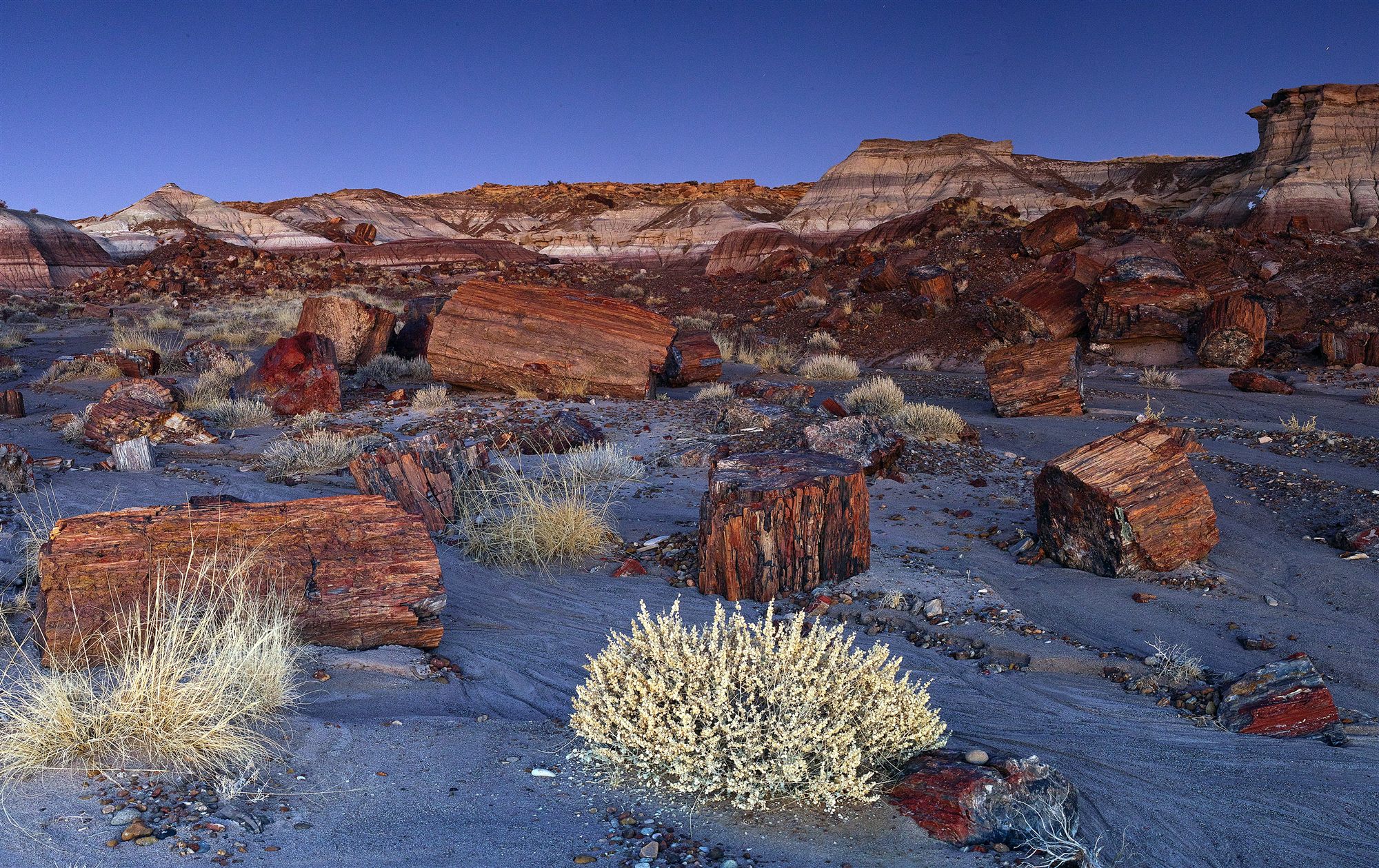
Petrified Forest National Park at a Glance
Scattered across the badlands of northeastern Arizona are thousands of fossilized logs, some more than 225 million years old, turned to solid, colorful stone while somehow preserving the fine detail of the wood grain within. It's one of the rare places on Earth where you can put your hand on wood that predates the dinosaurs most people grew up learning about — wood that has literally turned to stone while you weren't looking. Before diving into how that happened, here's the park at a glance:
Located in Northeastern Arizona
Along historic Route 66
National Park
Designated 1962; protected since 1906
More Than 200,000 Acres
Roughly 346 square miles authorized
One of the World's Largest
Concentrations of petrified wood
Includes the Painted Desert
Forms the park's northern portion
225+ Million Years of History
Late Triassic Chinle Formation
National Park Service Site
Preserved for research and visitation
Why Visit Petrified Forest National Park?
It's a park that rewards curiosity — the more you understand about what you're looking at, the more remarkable it becomes. A quick roadside stop can easily turn into an hour once you start noticing the detail preserved in each log. Here's what makes it worth the stop:
Fossilized Trees
Ancient logs turned to solid, colorful stone, scattered across the landscape by the thousands.
Painted Desert
Sweeping, striped badlands in bands of red, orange, and purple.
Colorful Badlands
Eroded hills exposing millions of years of layered sediment.
Geology
A rare, accessible window into deep time and the processes that shape it.
Paleontology
Fossils of ancient reptiles, early dinosaur relatives, and Triassic plant life.
Native American History
Petroglyphs and pueblo sites spanning centuries of Indigenous presence.
Route 66
A preserved stretch of America's historic Mother Road runs through the park.
Wildlife
Pronghorn, coyotes, and grassland species adapted to the high desert.
Photography
Vivid mineral colors that shift dramatically with the light.
How Were the Petrified Trees Created?
Ancient Forests
More than 200 million years ago, during the Late Triassic Period, this part of Arizona looked nothing like it does today. Instead of high desert, it was a humid, tropical floodplain near the equator, crossed by wide rivers and covered in towering conifer-like trees, some reaching well over 100 feet tall — more like a scene from the Amazon than the Painted Desert. These forests grew for millions of years, generation after generation of trees rising, falling, and decaying back into the floodplain soil, largely unremarkable in the geological record until conditions changed.
Flooding
When these massive trees fell — through storms, natural death, or riverbank erosion — many were swept up by rivers and floodwaters and carried downstream, eventually settling in low-lying areas and river channels alongside sediment, ash, and mud. Not every fallen tree became a fossil; the vast majority simply decayed, as fallen trees do everywhere. Only those swept into the right conditions — buried quickly enough, deeply enough, and in sediment low in oxygen — stood any chance of surviving long enough to fossilize at all.
Burial
Fallen logs were then rapidly buried under layers of volcanic ash and sediment. This burial was critical: cut off from oxygen, the wood was largely protected from the decay that would normally break it down within years, giving mineral-rich groundwater time to do its slow work instead. The speed of burial mattered enormously — logs buried gradually over years were far more likely to rot away entirely before mineralization could begin, while those buried rapidly during a single flood event had the best chance of surviving intact.
Mineral Replacement
Over time, silica-rich groundwater — much of it from dissolved volcanic ash — seeped into the buried wood, cell by cell. Silica gradually crystallized within the wood's structure, replacing organic material with quartz while preserving the wood's original cellular detail in astonishing precision. This process, known as permineralization, happened slowly enough that microscopic wood-grain structures — growth rings, cell walls, even evidence of insect damage in some specimens — were preserved in stone rather than destroyed, which is part of why the fossilized logs at Petrified Forest are considered scientifically exceptional, not just visually striking.
Millions of Years of Change
What started as buried wood slowly became solid stone, colored by trace minerals like iron and manganese that produced the reds, yellows, and purples visible today. Millions of years of subsequent erosion have since stripped away the sediment that once buried these logs, exposing them at the surface — the same fossilized wood scattered across the park today. In a very real sense, every log visible in the park is a very recent arrival at the surface, geologically speaking, even though the fossilization process itself finished tens of millions of years ago.
| Step | What Happened |
|---|
| Living Forest | Giant conifer-like trees grew in a tropical environment. |
| Flooding | Trees fell and were buried by sediment. |
| Burial | Oxygen was limited, slowing decay. |
| Mineral Replacement | Silica-rich groundwater gradually replaced the wood's cells. |
| Fossilization | Over millions of years, the wood transformed into stone while preserving its internal structure. |
It's worth emphasizing just how unusual this whole sequence really is. The vast majority of fallen trees, anywhere on Earth, simply decay and vanish within decades. Petrifaction requires an unlikely, specific combination of rapid burial, oxygen-poor conditions, and sustained access to mineral-rich water over an extremely long period — which is exactly why concentrations of petrified wood this dense and this well-preserved are genuinely rare, even on a planet that's been growing and losing forests for hundreds of millions of years.
A Journey Through 225 Million Years
Triassic Arizona
During the Late Triassic, this region sat much closer to the equator than it does today, part of the supercontinent Pangaea, with a warm, humid climate that supported dense forests and a wide floodplain ecosystem unlike anything found in Arizona now. Plate tectonics has since carried this landscape thousands of miles from where it once sat, a slow drift that unfolded over the same vast timescale as everything else in this park's story.
Ancient Rivers
Wide, braided river systems crossed the landscape, carrying sediment, volcanic ash, and fallen trees across the floodplain. These same rivers are responsible for burying and preserving the logs that would eventually become the park's namesake fossils. Layered sandstone and mudstone visible in the park's badlands today are the direct, hardened remnants of that ancient river system, each layer marking a different flood event or period of sediment deposition.
Dinosaurs and Early Reptiles
This period predates the largest, most famous dinosaurs by tens of millions of years, but the park's rock layers preserve fossils of early dinosaur relatives and a range of ancient reptiles, including large crocodile-like predators that dominated the ecosystem long before dinosaurs rose to prominence. Paleontologists consider this an especially valuable fossil record precisely because it captures a moment before dinosaurs became dominant, offering clues about the ecological conditions that eventually allowed them to take over.
Climate Change
Over the many millions of years since the Triassic, Arizona's climate and landscape changed dramatically — shifting continents, changing sea levels, and evolving ecosystems gradually transformed a humid floodplain into the arid high desert seen today. Entire seas advanced and retreated across this region more than once in the intervening years, each leaving their own layer of sediment behind before retreating again.
Today's Landscape
Millions of years of erosion have carved away the layers of sediment that once buried this ancient forest, exposing both the colorful badlands of the Painted Desert and the fossilized logs that give the park its name — a landscape still actively changing, one erosion event at a time. Rangers and researchers alike expect new fossils to continue emerging from the badlands for as long as erosion keeps exposing fresh rock.
Then and Now Timeline
Seeing the full arc — from a living Triassic forest to the national park protected today — helps make sense of just how much time separates the trees you see from the trees they once were:
225 Million Years Ago
↓
Ancient Forest
↓
Flooding
↓
Burial
↓
Petrification
↓
Erosion
↓
Modern National Park
The Painted Desert
The northern portion of Petrified Forest National Park is part of the much larger Painted Desert, a sweeping band of striped, multicolored badlands that stretches across a significant portion of northeastern Arizona, extending well beyond the park's own boundaries toward the Navajo Nation and the Little Colorado River. Its colors — bands of red, orange, purple, and gray — come from different mineral content in each layer of sediment, with iron and manganese producing much of the vivid color variation, and each distinct band representing a different period of ancient deposition, sometimes separated by millions of years.
Light plays an outsized role here: the same hillside can look muted and gray under harsh midday sun, then shift into deep, saturated color at sunrise and sunset, which is why timing matters so much for photography in this part of the park. Overlooks along the park's northern road offer some of the most accessible, sweeping Painted Desert views anywhere in Arizona, requiring nothing more than a short walk from a parking area to take in miles of layered, colorful badlands stretching to the horizon.
Perched at the edge of the Painted Desert within the park, the Painted Desert Inn is a National Historic Landmark in its own right — originally built in the late 1930s from petrified wood and local stone, and later renovated with murals by celebrated Hopi artist Fred Kabotie. It stands today as both an architectural landmark and a reminder that this landscape has drawn artists and travelers, not just scientists, for generations.
The Painted Desert deserves its own deeper exploration — for a closer look at the region's colors, geology, and best viewpoints, see our full Painted Desert → guide.
Fossils and Ancient Life
Beyond the petrified logs themselves, Petrified Forest National Park preserves one of the richest Late Triassic fossil records in the world. Ancient reptiles, including large, armored predators that filled ecological roles similar to modern crocodiles, are well represented in the park's fossil beds. Early dinosaur relatives — small, agile creatures that predate the giant dinosaurs of later periods by tens of millions of years — have also been documented here, offering a rare window into the earliest chapters of dinosaur evolution. Several species have been formally identified and named from fossils found within the park, making it an active, ongoing site of paleontological discovery rather than a closed chapter of research.
Plant fossils extend well beyond the petrified conifers themselves, including ferns and other understory plants that filled out the ancient forest floor. Insects, though far rarer in the fossil record, have also been found preserved in the park's rock layers, an especially valuable discovery given how rarely delicate insect fossils survive at all. Together, this fossil record has made Petrified Forest an important site for paleontologists studying the Late Triassic — a period that set the stage for the rise of the dinosaurs that would come to dominate the following era. Researchers continue to conduct active fieldwork within the park today, and new discoveries are still being made in its badlands on a regular basis.
What makes this fossil record especially valuable to scientists isn't just its age, but its completeness. Because sediment here was deposited continuously over such a long stretch of the Late Triassic, researchers can trace gradual changes in plant and animal life across time within a single, connected rock sequence — rather than piecing together scattered fragments from unrelated sites around the world. That continuity is part of why Petrified Forest remains an active focus of paleontological research rather than a fully cataloged, closed subject.
Native American History
Long before it was a national park, this landscape was home to ancestral Puebloan communities, whose presence here spans well over a thousand years. Puerco Pueblo, preserved within the park, was once home to a substantial farming community that took advantage of the Puerco River's water to support agriculture in an otherwise dry landscape, at its peak housing more than 100 people in a plaza-centered settlement. Petroglyphs carved into rock throughout the park — including significant sites like Newspaper Rock, which contains hundreds of individual images — record centuries of artistic, spiritual, and possibly astronomical significance, including markings some researchers believe may have tracked seasonal solar events.
These communities were part of the same broader trade networks connecting ancestral peoples across the Southwest, and archaeological evidence suggests residents here had contact with distant communities, much like their contemporaries at Wupatki and elsewhere in Northern Arizona. Interestingly, archaeologists have found evidence that ancestral residents here occasionally used petrified wood itself as a raw material, shaping durable stone tools from the same fossilized logs that draw visitors to the park today — a direct, practical link between this landscape's ancient geology and the people who later lived on it.
The descendants of these communities, including the Hopi and other Puebloan peoples, maintain living cultural and historical connections to this landscape today. As with the ancestral sites elsewhere in this region, these places remain significant, not simply historical curiosities frozen in the past — tribal historians continue to be involved in how the National Park Service interprets and protects these sites.
Route 66 Through the Park
Petrified Forest National Park holds a distinctive place in American road-trip history: it's the only national park through which the historic Route 66 once passed. Established in 1926, Route 66 — often called America's Mother Road — became one of the most iconic highways in the country, carrying migrants, adventurers, and eventually generations of vacationing families across the American Southwest, immortalized in songs, literature, and popular culture throughout the 20th century.
Though the original highway alignment through the park has long since been replaced by Interstate 40, a section of the historic route is preserved within the park, marked today by a rusted vintage automobile and a line of telephone poles evoking the era of road travel that once defined this stretch of Arizona. Early Route 66 travelers frequently stopped here specifically to see the petrified wood, and the park's proximity to the highway played a real role in popularizing it as a tourist destination long before it became a national park in 1962. Roadside curio shops selling petrified wood, often of questionable origin, sprang up along the highway throughout the early-to-mid 20th century, and concern over the sheer volume of wood being removed from the park was itself part of the motivation behind stronger federal protections in later decades. It's a small but evocative reminder that this landscape has drawn travelers for reasons far beyond its ancient fossils — as a crossroads of American travel history in its own right.
Plants and Wildlife
Despite its stark, colorful terrain, Petrified Forest supports a resilient community of high-desert grassland wildlife. Pronghorn — among the fastest land animals in North America, capable of sustained speeds that outrun nearly every predator on the continent — are regularly seen moving across the park's open grasslands. Coyotes are a common presence throughout the park, particularly around dawn and dusk, while lizards are easy to spot sunning themselves on rocks and fossilized logs during the warmer months. A variety of birds make use of the park's grasslands and badlands, including raptors that take advantage of the open terrain to hunt, and seasonal wildflowers add brief bursts of color to the landscape each spring. The park's grassland and desert ecosystems, though sparse compared to forested regions elsewhere in Arizona, support a genuinely resilient mix of species adapted to extremes of heat, cold, and aridity that few other environments demand of their wildlife.
For a closer look at the animals found throughout the wider region, see our full Arizona Wildlife → guide.
Petrified Forest Through the Seasons
Spring
Wildflowers add color to the grasslands and temperatures are comfortable, making spring one of the most pleasant times to explore the park's exposed, largely shadeless trails before summer heat sets in.
Summer
Long daylight hours and building monsoon clouds create dramatic skies over the badlands, though afternoon heat and storms are both worth planning around, especially since shade is scarce throughout most of the park.
Fall
Clear skies and comfortable temperatures make fall one of the most rewarding seasons to visit, with crowds noticeably thinner than the busier summer months and excellent visibility across the Painted Desert.
Winter
Occasional snow dusts the colorful badlands, creating a striking and uncommon contrast that makes winter a uniquely rewarding season for photography, with crisp, clear air and some of the quietest visitor numbers of the year.
Interesting Facts About Petrified Forest
A handful of details tend to surprise first-time visitors most:
- Some fossilized trees are over 225 million years old, among the oldest fossils visible anywhere in Arizona.
- Quartz gradually replaced the original wood, cell by cell, preserving fine internal detail in solid stone.
- The park protects thousands of fossil logs, along with countless smaller fossil fragments.
- The Painted Desert forms the northern portion of the park, extending well beyond its boundaries.
- Historic Route 66 once crossed the park, the only national park the famous highway ever passed through.
- The park was first protected as a national monument in 1906, the same year as Montezuma Castle and several of the country's earliest protected sites.
- Removing even a small piece of petrified wood is illegal, and rangers report that the "curse" of bad luck supposedly following stolen wood is one of the most common reasons visitors mail pieces back to the park each year.
Geology That Shaped the Park
The park's colorful badlands are built from the Chinle Formation, a sequence of Late Triassic sediment layers rich in volcanic ash — the same ash that provided the silica responsible for petrifying the park's namesake logs. Millions of years of subsequent uplift and erosion exposed these layers at the surface, stripping away the younger rock that once buried them and revealing both the fossilized wood and the striped, mineral-rich badlands of the Painted Desert. The Chinle Formation isn't unique to this one park either — it stretches across a wide swath of the American Southwest, and its ash-rich composition is part of why petrified wood, while rare globally, is found in scattered pockets across the wider region.
Uplift played its own role here too. The Colorado Plateau, the vast geological province covering much of northeastern Arizona, has been slowly rising for tens of millions of years, lifting once-buried rock layers closer to the surface and accelerating the pace at which erosion could expose them. Without that broader regional uplift, the Chinle Formation's fossilized logs might still be sitting hundreds or thousands of feet underground, entirely out of reach.
This is only a brief overview of the geological forces at work here. For a deeper look at how Arizona's rock layers formed across deep time, see our full Arizona Geology → guide.
Arizona Before the Grand Canyon
It's easy to think of the Grand Canyon as Arizona's oldest, most defining landscape. But long before the canyon existed in anything like its present form, this same state looked completely different — and Petrified Forest is one of the clearest places to see that earlier chapter for yourself.
More than 200 million years ago, Arizona was home to lush, humid forests rather than red rock desert. Wide rivers crossed a low floodplain instead of carving deep canyons. Early reptiles and dinosaur relatives, not the mule deer and California condors of today, were the dominant animal life. Volcanic activity and shifting climates repeatedly reshaped the region over the tens of millions of years that followed, long before the Colorado River began cutting the canyon that would eventually become the state's most famous landmark. To put the timescale in perspective: the Grand Canyon itself is thought to be somewhere between five and six million years old, while the trees fossilized at Petrified Forest were already ancient wood, buried deep underground, tens of millions of years before that carving even began.
Only much later — millions of years after this ancient forest was buried, petrified, and left underground — did erosion finally strip away the overlying rock and expose the fossilized wood we see today. In that sense, Petrified Forest isn't a footnote to Arizona's geological story; it's an earlier chapter of the very same story that eventually produced the Grand Canyon, just written tens of millions of years before the canyon itself began to form. Standing among the fossilized logs here, you're not looking at a separate story from the Grand Canyon — you're looking at page one.
Arizona Through Deep Time: A Geology Series
Petrified Forest is one chapter in a much larger story of how Arizona's landscape has changed across hundreds of millions of years — a story that spans several of our Arizona guides, each covering a completely different kind of geological event, separated by tens or hundreds of millions of years:
Arizona Geology — The Foundations of a Layered Landscape
↓
Petrified Forest — An Ancient Forest Turned to Stone
↓
Painted Desert — Millions of Years Exposed in Color
↓
Meteor Crater — A Single, Sudden Impact
↓
Grand Canyon Geology — Nearly Two Billion Years, Exposed at Once
↓
Sunset Crater Volcano — Arizona's Most Recent Chapter
Read together, these guides trace Arizona through deep time — from ancient forests and fossilization, to a sudden meteor impact, to the slow-carved layers of the Grand Canyon, to a volcanic eruption less than a thousand years old. It's the same state, telling a very different story at every stage, and each one uses an entirely different geological process to do it: slow mineral replacement here, a single violent impact at Meteor Crater, patient river erosion at the Grand Canyon, and sudden volcanic eruption at Sunset Crater. Few states offer such a complete, visitable record of how varied the forces shaping a landscape can really be.
Frequently Asked Questions
How old are the petrified trees?
Most of the park's fossilized trees are more than 225 million years old, dating to the Late Triassic Period, long before the earliest large dinosaurs walked the Earth.
How does wood turn to stone?
Buried wood is infiltrated by silica-rich groundwater, which gradually replaces the wood's organic material with quartz at the cellular level, preserving the wood's original structure in solid stone, a process that likely took thousands of years to complete for any individual log.
Why are the trees colorful?
Trace minerals present during petrification — particularly iron and manganese — produced the reds, yellows, and purples visible in the fossilized wood today, the same minerals responsible for coloring much of the surrounding Painted Desert.
Are dinosaurs found here?
The park's rock layers predate the largest, most famous dinosaurs, but early dinosaur relatives and a range of ancient reptiles have been documented in the park's Late Triassic fossil beds, making it valuable for understanding the period just before dinosaurs became dominant.
What is the Painted Desert?
The Painted Desert is a sweeping band of striped, multicolored badlands across northeastern Arizona, with the park's northern section forming part of this larger, colorful region that extends well beyond the park's own boundaries.
Why is the park famous?
Petrified Forest is famous for having one of the largest and most accessible concentrations of petrified wood anywhere in the world, alongside the colorful Painted Desert and a rich Triassic fossil record found in relatively few other places on Earth.
Can fossils still be found?
Yes, but collecting or removing any petrified wood or fossils is strictly prohibited and actively enforced, with rangers monitoring the park closely — the park protects these resources so future visitors and researchers can continue to study and enjoy them.
What makes this park unique?
Few places combine world-class paleontology, vivid badlands geology, ancestral Puebloan archaeology, and a stretch of historic Route 66 within a single, relatively compact national park that can realistically be explored in a single day.
Continue Exploring Arizona
Petrified Forest is one stop on a much larger journey through Arizona's deep geological history. Here's where to go next:
Painted Desert
The colorful badlands that form the park's northern reaches.
READ GUIDE →Grand Canyon National Park
Nearly two billion years of exposed rock.
READ GUIDE →Meteor Crater
A single, sudden impact frozen in time.
READ GUIDE →Arizona Geology
The forces that shaped the entire state.
READ GUIDE →Arizona Wildlife
The animals that call these landscapes home.
READ GUIDE →
Experience Arizona's Ancient Landscapes with Grand Canyon Journeys
Petrified Forest National Park offers an extraordinary glimpse into Arizona's distant past, where ancient forests, colorful fossilized wood, and dramatic desert landscapes tell a story hundreds of millions of years in the making. Combined with other iconic destinations across Northern Arizona, it showcases the incredible diversity of the state's natural history. Our private tours help guests connect these remarkable places through engaging interpretation and local expertise.