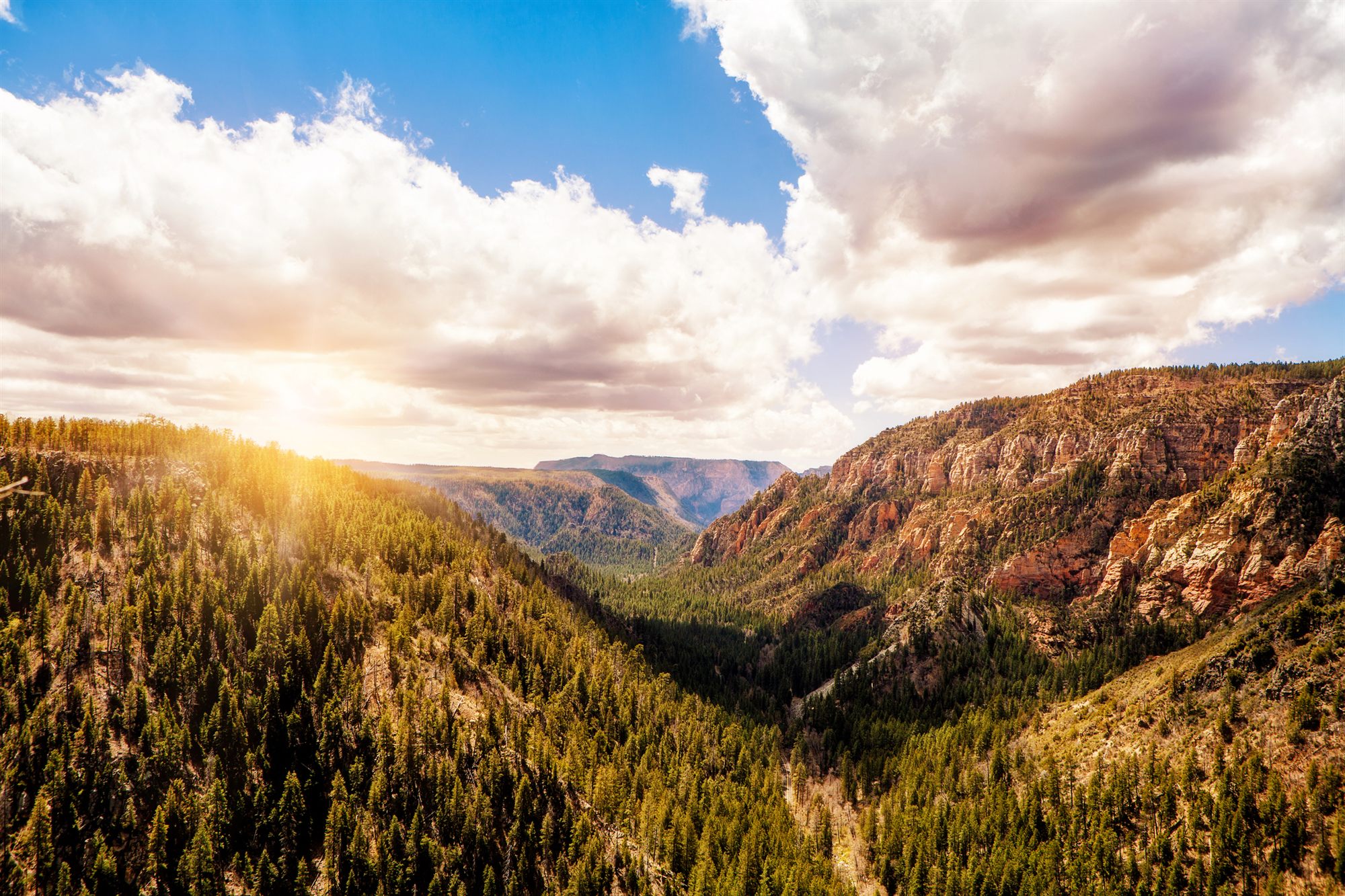
Oak Creek Canyon at a Glance
Winding between Sedona and Flagstaff, Oak Creek Canyon packs an extraordinary range of scenery, elevation, and ecology into a single, relatively short drive. Carved by one of Arizona's few year-round streams and protected within Coconino National Forest, the canyon offers dramatically different scenery at nearly every mile, shifting from red rock desert to dense pine forest over the course of a single afternoon. Before learning more about what makes this canyon so remarkable, here's an overview at a glance:
Between Sedona and Flagstaff
Along State Route 89A
Roughly 16 Miles Long
A compact but dramatic corridor
4,500 to Over 7,000 Feet
A dramatic elevation change
Part of Coconino National Forest
Federally protected land
Oak Creek Flows Year-Round
A rare, reliable desert stream
A National Scenic Byway
State Route 89A
Why Visit Oak Creek Canyon?
Few drives anywhere in Arizona compress so much dramatic change into so short a distance. Oak Creek Canyon's defining feature is contrast: towering red rock cliffs give way to dense pine forest, open desert transitions into a genuine riparian corridor, and a highway that begins among Sedona's red rocks climbs, within minutes, into cool mountain country near Flagstaff.
That contrast supports an unusually wide range of experience within a single canyon — dramatic scenery and photography opportunities at nearly every turn, a genuinely rich wildlife community supported by reliable water, and a scenic drive consistently ranked among the most beautiful in the country. Unlike landscapes defined by a single season's beauty, Oak Creek Canyon offers something distinct in every season, from spring wildflowers to brilliant fall color to snow-dusted red rock in winter.
The canyon also functions as a genuinely practical link between two of Northern Arizona's most popular destinations, meaning a visit here rarely requires a dedicated detour. For travelers already moving between Sedona and Flagstaff, Oak Creek Canyon offers a rare case of the journey itself becoming as memorable as either destination on either end of it.
For visitors splitting time between Sedona and Flagstaff, or simply looking for one of Northern Arizona's most rewarding short drives, Oak Creek Canyon delivers an outsized experience relative to the modest amount of time required to see it.
Few landscapes reward both a quick pass-through and a slower, more deliberate visit quite as well as Oak Creek Canyon does. A single drive from end to end offers sweeping views and a genuine sense of the canyon's scale, while pulling off at any of its overlooks or creekside access points reveals a considerably more intimate, detailed side of the same landscape — cool shade, running water, and a noticeably different pace than the open highway above.
How Oak Creek Canyon Was Formed
Understanding Oak Creek Canyon means understanding a story that unfolds across an almost unimaginable span of time, from ancient seafloor sediment to the ongoing work of a stream still actively shaping the landscape today.
Ancient Sandstone
Oak Creek Canyon's walls expose a considerably deeper and older sequence of rock layers than Sedona's red rocks alone, including pale limestone and sandstone laid down by ancient seas and rivers over a span of many millions of years, long before the canyon itself existed.
Uplift of the Colorado Plateau
As with so much of Northern Arizona's dramatic scenery, the broader uplift of the Colorado Plateau lifted this entire region thousands of feet over the past several million years, steepening the grade of local streams, including Oak Creek, and setting the stage for the erosion that followed.
Water Shapes the Canyon
Oak Creek itself did the primary work of carving the canyon, cutting steadily downward into the rising rock over millions of years. Unlike the flash-flood-carved slot canyons found farther north near Page, Oak Creek Canyon was shaped by the sustained, continuous flow of a permanent stream, producing a considerably broader, more open canyon profile than a narrow slot canyon. That continuous flow, rather than the episodic violence of a flash flood, is why Oak Creek Canyon reads as a genuine river valley rather than a slot canyon — wide enough for a highway and a real riparian corridor, rather than a passage barely wide enough for a single hiker.
Millions of Years of Erosion
Wind, seasonal freeze-thaw cycles, and the creek's own continued flow have all contributed to widening and shaping the canyon since its initial carving, gradually wearing back the canyon walls and contributing to the talus slopes visible along much of its length today. This combination of erosional forces, unlike the single, dominant process behind many other Southwestern landscapes, is part of why Oak Creek Canyon displays such a genuinely varied mix of landforms along its length, from sheer cliff faces to gentler, forested slopes within a single connected corridor.
The Canyon Today
The result is a canyon whose walls record an immense span of geological time, from ancient sea-floor sediment at its base to the same younger red sandstone found throughout Sedona near its southern end. Reading the canyon's walls from bottom to top is, in effect, reading millions of years of Earth's history in ascending order, each layer a distinct chapter deposited under different conditions long before Oak Creek existed to carve through any of it.
That layered record also explains why the canyon's character changes so noticeably along its length. Older, harder rock near the canyon's base tends to form steeper, more resistant walls, while softer layers higher up erode more readily, producing the gentler, more forested slopes typical of the canyon's upper reaches. For the fuller regional picture, see our Arizona Geology → guide.
Oak Creek
A Rare Desert Stream
Oak Creek is a genuine rarity in Arizona: a year-round flowing stream in a state where most watercourses run dry for at least part of the year. That reliability comes from a combination of springs and consistent watershed drainage feeding the creek along much of its length, sustaining a corridor of life found almost nowhere else in the surrounding high desert. The creek's watershed draws from a considerable stretch of the Mogollon Rim country above the canyon, collecting snowmelt and rainfall across a wide area and channeling it down through the canyon in a flow that, while it varies seasonally, rarely stops entirely even during Arizona's driest stretches.
Crystal-Clear Water
The creek's water runs remarkably clear for much of the year, fed largely by spring water rather than surface runoff alone, allowing sunlight to reach well below the surface and supporting the trout and other aquatic life that depend on clean, oxygen-rich water. That clarity can change quickly during and after significant storms, when runoff carries sediment into the creek and temporarily clouds water that is, under normal conditions, clear enough to see straight to the streambed in many pools.
Plants Along the Creek
Cottonwoods, sycamores, and bigtooth maples crowd the creek's immediate banks, forming a genuine riparian forest distinct from the surrounding pine and high-desert vegetation found just a short distance away up the canyon walls. This narrow band of riparian forest, rarely more than a few dozen yards wide in most places, packs in a density and diversity of plant life that the drier surrounding terrain simply cannot support without the creek's constant water supply.
Importance to Wildlife
Reliable water draws wildlife from the surrounding high desert and forest alike, making the creek corridor one of the single richest wildlife habitats anywhere in the region, supporting everything from fish and amphibians to the birds and mammals that depend on the corridor for both water and food. In a landscape where water is so often the limiting factor determining what can survive where, Oak Creek effectively removes that constraint along its immediate banks, concentrating wildlife activity here far beyond what the surrounding terrain alone would support.
Why Oak Creek Is So Special
Few places in Arizona allow visitors to stand beside genuinely flowing, clear water while surrounded by red rock desert cliffs on one side and dense pine forest on the other. That immediate, tangible contrast, water and desert and forest all within view at once, is what makes Oak Creek the true heart of this canyon, and arguably the single feature that makes the entire canyon worth visiting. Every other distinctive feature of Oak Creek Canyon, its forests, its wildlife, its rare biodiversity, ultimately traces back to this one simple fact: reliable water, flowing continuously through an otherwise arid landscape.
The Landscapes of Oak Creek Canyon
Towering Cliffs
Sheer canyon walls rise hundreds of feet above the creek in places, exposing multiple distinct rock layers stacked one atop another. In the steepest sections, these walls climb almost directly from the roadside, framing the highway in dramatic, close-up stone on both sides at once.
Red Rock Formations
Near the canyon's southern end, formations echoing Sedona's famous red rocks mark the transition zone between red rock country and the higher canyon beyond, a visible reminder that Oak Creek Canyon and Sedona share the same underlying geological story even as their surface character diverges considerably farther north.
Evergreen Forests
Ponderosa pine dominates much of the canyon's higher elevations, thickening steadily as the road climbs toward Flagstaff, eventually giving way to the same extensive pine forest that surrounds Flagstaff itself at the canyon's northern end.
Riparian Habitat
The immediate creek corridor supports a genuinely distinct riparian ecosystem, cooler and greener than the surrounding canyon slopes even in the height of summer, offering welcome shade and a noticeably different microclimate than the open highway just a short walk away.
Seasonal Colors
Bigtooth maples and cottonwoods along the creek turn vivid shades of yellow, orange, and red each fall, producing some of the most reliable and vivid autumn color found anywhere in Arizona, a state not typically associated with dramatic fall foliage.
Rock Layers
The canyon's exposed walls record a genuinely deep span of geological time, with older, paler limestone and sandstone layers visible beneath the younger red sandstone found closer to the canyon's southern end, offering an unusually accessible, roadside look at millions of years of accumulated rock history.
Wildlife of Oak Creek Canyon
The same layering of desert, forest, and riparian habitat that makes Oak Creek Canyon ecologically distinctive also supports one of the more varied wildlife communities found anywhere in Northern Arizona, drawing species from each of these overlapping ecosystems into a single, relatively compact corridor.
Black Bears
Black bears range through the forested upper reaches of the canyon, drawn by the combination of cover and food sources found within Coconino National Forest, generally remaining most active during the cooler hours of early morning and evening.
Mule Deer
Mule deer are a common sight throughout the canyon, particularly at dawn and dusk, moving between forest cover and the creek corridor below as they browse across the canyon's varied vegetation.
Javelina
Javelina range through the canyon's lower, drier stretches, typically moving in small family groups through brushy terrain, well adapted to the same arid conditions found throughout much of the surrounding high desert.
Bobcats
Bobcats move quietly through the canyon's varied terrain, rarely seen but present throughout much of the surrounding forest and canyon slopes, taking advantage of the canyon's dense cover and abundant small prey.
Cooper's Hawks
Cooper's hawks hunt through the canyon's forested sections, well adapted to maneuvering through dense tree cover in pursuit of smaller birds, their short wings and long tails ideally suited to quick, agile flight among closely spaced trees.
Bald Eagles
Bald eagles are occasional winter visitors to the canyon, drawn by the creek's fish population during the colder months, when eagles from farther north sometimes move into Arizona in search of reliable open water and food.
Trout
Oak Creek supports a genuine trout population, sustained by the creek's clear, oxygen-rich, spring-fed water — a rarity among Arizona streams, and a strong indicator of just how consistently clean and cold the creek's water remains even through the heat of an Arizona summer.
Lizards
Numerous lizard species inhabit the canyon's sun-exposed rock surfaces, particularly in the drier, more open stretches near the canyon's southern end, taking full advantage of sun-warmed stone to regulate their body temperature throughout the day.
Wildflowers
Seasonal wildflowers bloom throughout the canyon each spring, adding vivid color to the understory beneath the surrounding forest and canyon walls, with species varying considerably between the canyon's drier lower reaches and its cooler, wetter upper elevations.
Cottonwoods
Cottonwood trees anchor the creekside riparian corridor, their bright yellow fall foliage among the canyon's most photographed seasonal features, and their dense summer canopy providing much of the shade that keeps the immediate creek corridor noticeably cooler than the open canyon slopes above. For a closer look at the animals found throughout the wider region, see our full Arizona Wildlife → guide.
Why Oak Creek Canyon Is a Biodiversity Hotspot
Most travel guides describe Oak Creek Canyon purely in terms of scenery, but its ecological significance deserves equal attention. The canyon sits at a genuine meeting point of several distinct ecosystems, layered within a single, relatively short corridor in a way that few other places in Arizona can match.
Elevation alone accounts for much of this diversity, ranging from roughly 4,500 feet at the canyon's southern end to over 7,000 feet near its northern rim, a span that shifts the surrounding vegetation from high desert through pinyon-juniper woodland and into full ponderosa pine forest over a remarkably short distance. Layered on top of that elevation gradient, the creek itself introduces a genuine riparian ecosystem entirely distinct from the surrounding desert and forest, while the canyon's red rock formations near its southern end connect it directly to the arid ecology of Sedona and the wider Verde Valley.
The result is a corridor where desert species, forest species, and riparian species all find suitable habitat within a few miles of one another, producing a level of biodiversity considerably higher than any one of these ecosystems could support on its own. That layering of habitat, water, elevation, forest, and desert all meeting within a single canyon, is precisely what makes Oak Creek Canyon ecologically distinct, not simply scenic.
Ecologists refer to zones where distinct ecosystems meet and overlap as ecotones, and these transitional areas are consistently among the most biologically productive and diverse habitats found anywhere, precisely because they offer resources and conditions unavailable in either neighboring ecosystem alone. Oak Creek Canyon functions as an unusually long, continuous ecotone, stretching some sixteen miles and spanning nearly 3,000 feet of elevation change, making it one of the most ecologically rich single corridors in the entire state. This is a detail most visitors never learn, and one that transforms a simple scenic drive into a genuinely significant ecological corridor worth understanding on its own terms.
From Desert to Forest in Just 16 Miles
Driving the length of Oak Creek Canyon means passing through several genuinely distinct landscapes in the space of a single, relatively short trip.
| Location | Landscape |
|---|
| South End | Red rock desert environment around Sedona. |
| Lower Canyon | Cottonwoods, sycamores, and flowing creek. |
| Mid Canyon | Mixed forests and towering canyon walls. |
| Upper Canyon | Ponderosa pine forest near Flagstaff. |
Climbing through the canyon feels less like a single drive than a journey through several distinct ecosystems, each transition arriving within minutes of the last. Few highways anywhere in the country offer such a compressed, legible tour through so many distinct environments, making the drive itself a genuine geography lesson as much as a scenic experience.
Oak Creek Canyon Through the Seasons
Spring
Spring brings wildflower blooms, a strong flowing creek fed by winter runoff, and fresh new greenery across the canyon's riparian corridor. Snowmelt from the higher elevations near Flagstaff often keeps the creek running particularly full during this season, adding extra energy and sound to the water moving through the canyon's narrower stretches.
Summer
Summer offers noticeably cooler temperatures than the surrounding desert lowlands, along with lush vegetation and dramatic monsoon clouds building over the canyon most afternoons. The creek itself becomes a genuine draw during the hottest months, offering a natural respite from summer heat that few other nearby destinations can match.
Fall
Fall is widely considered the canyon's finest season, when cottonwoods and bigtooth maples turn brilliant shades of yellow and gold along the creek, producing some of the most vivid autumn color anywhere in Arizona. That color typically peaks over a relatively narrow window in mid-to-late autumn, drawing visitors specifically to witness a display more commonly associated with New England than the desert Southwest.
Winter
Winter brings a quieter, more contemplative atmosphere, with snow occasionally dusting the canyon's red rock walls and frost forming along the creek's shaded edges. The contrast between fresh snow and the canyon's warm red rock is genuinely striking, and the season's smaller crowds offer a noticeably different, more peaceful way to experience the same landscape that draws considerably larger numbers during the busier fall color season.
Why Oak Creek Never Looks the Same Twice
| Season | What Changes |
|---|
| Spring | Fresh leaves, blooming wildflowers, higher creek flows. |
| Summer | Lush greenery, warm days, afternoon monsoon clouds. |
| Fall | Brilliant yellow cottonwoods and aspens. |
| Winter | Snow on red rocks, frosty mornings, dramatic contrasts. |
Whatever time of year you visit, Oak Creek Canyon offers a genuinely different experience, rewarding repeat visits across the full span of the seasons. Few landscapes in Arizona change their character quite this visibly from one season to the next, making the canyon a destination worth returning to again and again rather than a single, one-time stop.
The History of Oak Creek Canyon
Native peoples, including the Sinagua and later the Yavapai and Apache, made use of Oak Creek Canyon's reliable water for many centuries before American settlement, part of the same broader pattern of settlement that shaped the nearby Verde Valley. The canyon's dependable water and relatively sheltered terrain made it a valuable resource and travel corridor for these communities long before it carried any formal road, valued for exactly the same practical reasons that continue to draw visitors today.
Early American travelers and settlers followed the canyon as a natural route connecting the high country around Flagstaff to the lower Verde Valley, gradually establishing a wagon road through terrain that had previously demanded considerably more difficult travel. That early route eventually developed into today's State Route 89A, engineered through the canyon's steep switchbacks over the course of the early-to-mid 20th century and now recognized as one of the most scenic drives in the country.
Conservation of the canyon has been an ongoing priority for decades, reflected in its protection as part of Coconino National Forest and in sustained efforts to balance public access with preservation of the same fragile riparian corridor that makes the canyon so ecologically significant. Managing a landscape this popular, and this ecologically sensitive, within a corridor as narrow as Oak Creek Canyon remains an active, ongoing responsibility shared between the Forest Service and the surrounding communities that depend on the canyon both economically and ecologically.
Interesting Facts About Oak Creek Canyon
- Oak Creek Canyon drops more than 2,000 feet in elevation from its northern rim to Sedona.
- It is often called Arizona's smaller cousin to the Grand Canyon.
- The canyon contains one of Arizona's richest riparian ecosystems.
- State Route 89A is recognized as one of America's most scenic highways.
- The canyon connects Sedona with Flagstaff through dramatically changing landscapes.
Oak Creek Canyon and Northern Arizona
Oak Creek Canyon is far more than a scenic drive — it's a physical connection between several of Northern Arizona's most significant landscapes and destinations, each accessible within a short distance of the canyon itself.
Sedona
Red rock country at the canyon's southern end.
↓
Flagstaff
A high-elevation mountain town at the canyon's northern end.
↓
Grand Canyon
The centerpiece of Arizona's geological story, north of Flagstaff.
↓
Verde Valley
Ancient pueblos and a fertile river valley south of Sedona.
↓
Coconino National Forest
The federally protected forest surrounding the canyon.
↓
Arizona Geology
The deeper rock record behind the canyon's scenery.
↓
Arizona Wildlife
The animals sustained by the canyon's rare year-round water.
A Canyon That Connects Two Worlds
Oak Creek Canyon is, in a real sense, a natural transition between two entirely different Arizonas. At its southern end lies Sedona's red rock desert, warm, dry, and unmistakably Southwestern. At its northern end lies Flagstaff's high-elevation pine forest, cool, green, and mountainous in a way that feels worlds apart from the desert just sixteen miles south.
Few places anywhere in Arizona let visitors experience such a dramatic change in geology, climate, vegetation, and wildlife over such a short distance, all without leaving a single, continuous canyon corridor. That transition is not incidental to Oak Creek Canyon's identity — it is the very thing that defines it, a landscape that belongs fully to neither the desert below nor the mountains above, but exists precisely in the remarkable space between them.
There is something genuinely valuable in experiencing that transition directly, rather than simply flying between two distant destinations and missing the space in between. Driving Oak Creek Canyon end to end means watching the desert gradually give way to forest in real time, watching red rock cliffs shift to pine-covered slopes, and feeling the air itself cool as the elevation climbs — a slow, physical unfolding of change that no single photograph or highlight reel can fully capture. In that sense, Oak Creek Canyon offers something increasingly rare: not simply a destination, but a genuine journey between two of Arizona's most different, most beloved landscapes.
Frequently Asked Questions
Where is Oak Creek Canyon?
Oak Creek Canyon is located in Northern Arizona along State Route 89A, connecting Sedona to Flagstaff, entirely within Coconino National Forest.
How long is Oak Creek Canyon?
The canyon stretches roughly 16 miles, with elevation ranging from about 4,500 feet near Sedona to over 7,000 feet near Flagstaff, a change of more than 2,000 feet over a relatively short distance.
How was the canyon formed?
Oak Creek carved the canyon over millions of years as the Colorado Plateau's broader uplift steepened the creek's gradient, cutting steadily downward through layers of ancient sandstone and limestone laid down long before the canyon itself existed.
Why is Oak Creek Canyon famous?
It's famous for its dramatic scenery, a rare year-round flowing creek, rich wildlife, and a scenic drive that connects two dramatically different Arizona landscapes within a short distance, often described as Arizona's smaller cousin to the Grand Canyon.
What wildlife lives there?
Black bears, mule deer, javelina, bobcats, trout, and a wide range of birds including Cooper's hawks and winter bald eagles all make their home in the canyon, supported by its unusually varied mix of desert, forest, and riparian habitat.
What makes Oak Creek special?
Oak Creek is one of Arizona's few genuinely year-round flowing desert streams, sustaining a rare riparian ecosystem found almost nowhere else in the surrounding high desert.
Why is Highway 89A so scenic?
The highway climbs through a series of dramatic switchbacks that expose changing rock layers, forest types, and canyon views at nearly every turn, connecting red rock desert to mountain forest within a single scenic drive recognized as one of the most beautiful in the country.
When is the best time to visit?
Fall offers the canyon's most vivid color, though each season, from spring wildflowers to winter snow on the red rocks, offers its own distinct character worth experiencing.
Continue Exploring Arizona
Oak Creek Canyon connects directly to some of Northern Arizona's most remarkable destinations. Here's where to go next:
Sedona
Red rock country at the canyon's southern end.
READ GUIDE →Flagstaff
A high-elevation mountain town near the San Francisco Peaks.
READ GUIDE →Coconino National Forest
The federally protected forest surrounding the canyon.
READ GUIDE →Arizona Wildlife
The animals that call Arizona's varied landscapes home.
READ GUIDE →Arizona Geology
The deeper rock record behind the state's scenery.
READ GUIDE →Grand Canyon National Park
The centerpiece of Arizona's geological story.
READ GUIDE →
Explore Northern Arizona with Grand Canyon Journeys
Oak Creek Canyon is one of Northern Arizona's most breathtaking landscapes, offering an incredible combination of red rock scenery, mountain forests, and a year-round flowing creek. Whether you're traveling between Sedona and Flagstaff or exploring the wider region, the canyon showcases the remarkable natural diversity that makes Northern Arizona unforgettable. Our private tours help guests experience these landscapes with knowledgeable local guides while discovering the stories behind the scenery.