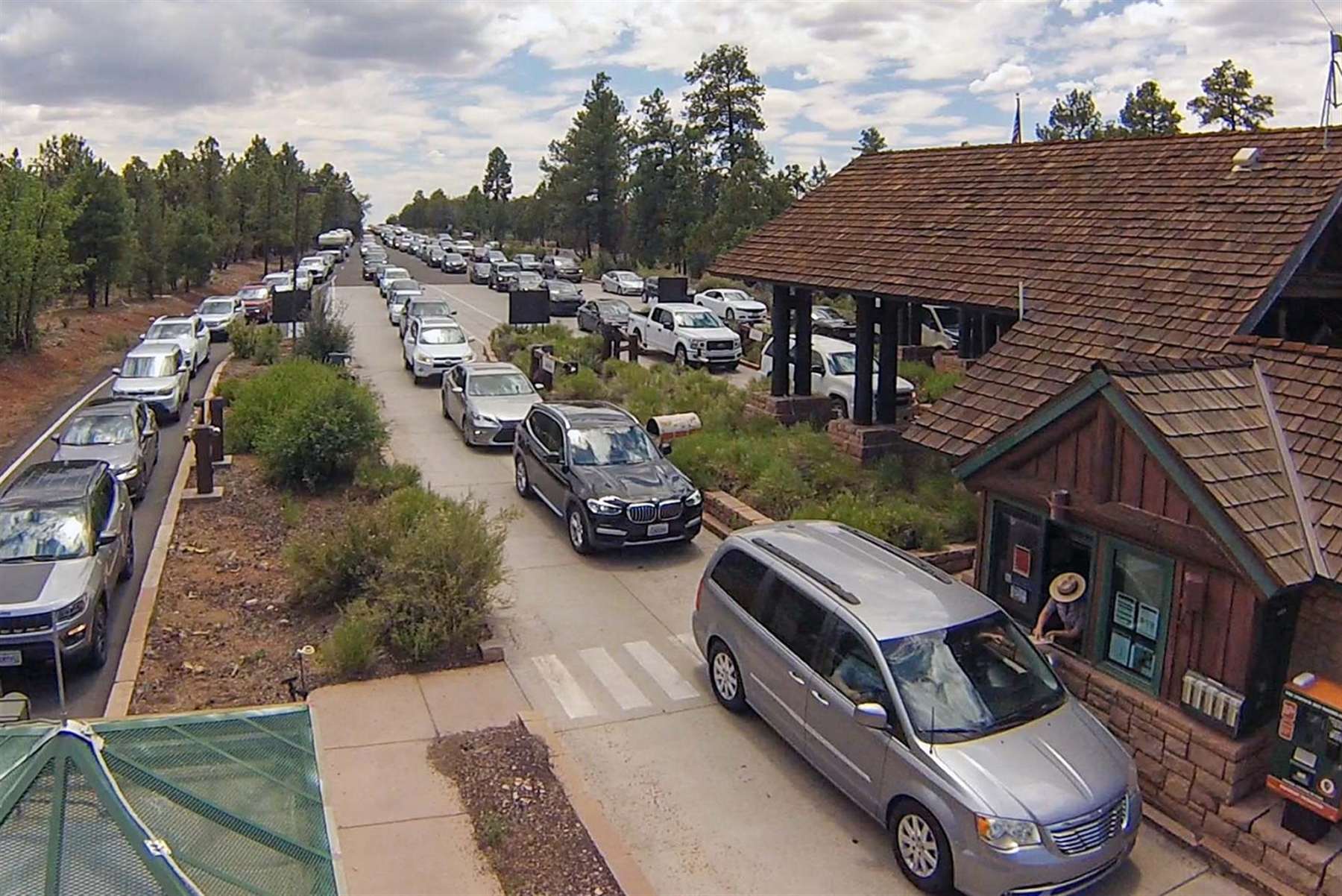
Understanding National Park Entrance Fees
Grand Canyon National Park charges an entrance fee like most major national parks, currently $35 per private vehicle, valid for seven consecutive days at both the South Rim and North Rim. That fee funds trail maintenance, visitor services, and conservation work within the park, and it's separate from any camping, lodging, or tour costs you'll pay on top of it.
Because the South Rim and North Rim are technically the same national park rather than two separate ones, a single entrance receipt or pass covers admission to both, even though they sit roughly 215 miles apart by road and are rarely visited on the same trip. If your Arizona itinerary somehow includes both rims within the same week, there's no need to pay the entrance fee twice.
What surprises many first-time visitors is how many different passes exist to cover that fee, some free, some paid, each tied to a different eligibility group. Knowing which one applies to your situation before you arrive can save real money, especially if your Arizona trip includes more than one federal recreation site.
Entrance fees are set by the National Park Service and periodically adjusted, so it's always worth double-checking the current rate directly with the park before your visit, particularly if you're planning months in advance. The figures in this guide reflect current published rates, and while they don't change often, a quick confirmation costs nothing and avoids any surprise at the gate.
The America the Beautiful Annual Pass
At $80, the Annual Pass is the most broadly useful option for most travelers. It covers entrance fees for the pass holder and accompanying passengers in a single private vehicle at every national park nationwide, plus federal recreation sites managed by the Forest Service, Bureau of Land Management, and U.S. Fish and Wildlife Service, for a full year from the month of purchase.
For a Grand Canyon trip alone, the pass pays for itself after a bit more than two visits at the standard $35 rate, which matters if your itinerary includes both the South Rim and a return trip, or a side visit to another federal site like Sunset Crater Volcano or Wupatki National Monument near Flagstaff.
The pass covers everyone traveling in the same private vehicle as the pass holder, up to the vehicle's legal passenger capacity, which makes it a particularly good value for families or groups road-tripping together rather than arriving in separate cars. It does not, however, transfer to a second vehicle arriving separately, so a group splitting into two cars will need either two passes or to plan arrival together.
The Access Pass (Free, for Permanent Disability)
The Access Pass is a free, lifetime pass available to U.S. citizens or permanent residents with a permanent disability, covering entrance fees at the Grand Canyon and other federal recreation sites nationwide. It can be obtained in person at any entrance station with documentation of the disability, or by mail through the U.S. Geological Survey for a small processing fee. Our Arizona Accessibility Guide covers planning an accessible Grand Canyon visit in much greater depth.
Acceptable documentation includes a statement from a licensed physician, proof of a federal disability benefit like Social Security Disability Insurance, or documentation from a state or federal agency confirming the disability. Because it's a lifetime pass rather than an annual one, it's genuinely worth obtaining even for a single trip if you qualify, since it will continue to work for every future visit to any federal recreation site without needing to be renewed or replaced.
The Senior Pass (62 and Older)
U.S. citizens or permanent residents age 62 or older qualify for the Senior Pass, available as an $80 lifetime pass or a $20 annual pass, both covering the same entrance fees as the standard Annual Pass. For travelers who visit national parks only occasionally, the $20 annual option is the better value; frequent visitors or those planning future trips generally come out ahead with the one-time $80 lifetime version.
Proof of age and residency, such as a driver's license or passport, is required at the time of purchase, whether buying in person at an entrance station or through the mail. Like the Access Pass, the Senior Pass covers everyone traveling in the same vehicle as the pass holder, making it a strong option for multigenerational family trips where one grandparent qualifies and the rest of the group rides along in a single car.
The Military Pass (Free for Active Duty)
Current members of the U.S. military and their dependents can obtain a free annual Military Pass by showing a Common Access Card, dependent ID, or other qualifying identification at any federal recreation site entrance. It covers the same entrance fees as the paid Annual Pass and can be renewed each year at no cost for as long as the service member remains on active duty.
This pass extends to Reserve and National Guard members as well, not just full-time active duty personnel, and Gold Star Families also qualify for a version of this free pass. Because it must be renewed annually rather than being a lifetime pass like the Access Pass, it's worth requesting a new one each year before your trip rather than assuming a prior year's pass remains valid.
The Every Kid Outdoors Pass (Free for 4th Graders)
U.S. fourth-grade students can obtain a free annual pass covering their entire vehicle's entrance fee, available by completing a simple activity on the Every Kid Outdoors website and printing a voucher to exchange at any park entrance. It's a genuinely useful option for families visiting the Grand Canyon during the school year with a fourth grader along, and it's valid through the following school year's end.
The program is designed to be completed online in just a few minutes and doesn't require any proof of enrollment or homeschool documentation beyond the child confirming they're in fourth grade, making it one of the easiest passes on this list to obtain. Print the voucher before you travel, since some remote entrance stations have limited connectivity to verify it electronically on arrival.
The Volunteer Pass (Free for Service Hours)
Volunteers who complete 250 hours of service with federal land management agencies over any 12-month period earn a free Annual Pass as recognition. It's a smaller-audience option than the others on this list, but worth knowing about if you or a family member volunteers regularly with a federal recreation site or conservation organization.
Hours can be accumulated across multiple agencies and sites rather than needing to come from a single park, and volunteer coordinators at the Grand Canyon and elsewhere can confirm how your logged hours count toward the threshold. It's worth asking about this option directly if you're already involved in trail maintenance, visitor center staffing, or citizen science programs in Arizona.
Fee-Free Days
The National Park Service designates several fee-free days each year, typically including Martin Luther King Jr. Day, the first day of National Park Week in April, the Great American Outdoors Act anniversary in August, National Public Lands Day in September, and Veterans Day in November. On these dates, the Grand Canyon's entrance fee is waived entirely, regardless of which pass, if any, you hold.
Fee-free days tend to draw noticeably larger crowds than a typical visit, so while they're a nice way to save $35, they're worth weighing against the tradeoff of busier parking areas, shuttles, and viewpoints, particularly during already-popular seasons like spring break or fall.
Which Pass Is Right for You?
| Pass | Cost | Who Qualifies | Validity |
|---|
| America the Beautiful Annual | $80 | Anyone | 1 year from purchase month |
| Access Pass | Free | Permanent disability | Lifetime |
| Senior Pass (Annual) | $20 | Age 62+ | 1 year |
| Senior Pass (Lifetime) | $80 | Age 62+ | Lifetime |
| Military Pass | Free | Active duty + dependents | 1 year, renewable |
| Every Kid Outdoors | Free | U.S. 4th graders | Through following school year |
| Volunteer Pass | Free | 250 volunteer hours | 1 year |
| Single-Visit Grand Canyon Fee | $35/vehicle | Anyone | 7 consecutive days |
For a single, one-time Grand Canyon visit with no other national park stops planned, simply paying the standard $35 entrance fee is often the simplest option — the various passes exist to save money for travelers who qualify for a free option or who'll visit more than twice in a year.
How and Where to Get Your Pass
Most passes can be purchased in advance through the official U.S. Geological Survey store, or obtained directly at any federal recreation site entrance station, including the Grand Canyon's South Entrance gate. Buying in advance online avoids any wait at the entrance station during busy periods, though the park's gates are generally efficient even during peak summer months.
Free passes requiring documentation, like the Access Pass or Military Pass, are typically easiest to obtain in person at the entrance station, where staff can verify eligibility on the spot, rather than through the mail-order process, which takes longer and involves an additional processing fee.
If you're arriving early in the morning or during a particularly busy season, purchasing your pass online before you travel removes one more step from the arrival process, letting you drive straight through the entrance gate with your pass or receipt ready to show rather than completing a transaction at the booth.
Common Pass Mistakes to Avoid
The most common mistake is buying a pass for a single Grand Canyon visit when the standard $35 entrance fee alone would have been cheaper — the Annual Pass only makes sense once you're visiting more than twice in a year or combining it with another federal site. The reverse mistake also happens: travelers paying the single-visit fee repeatedly across a multi-stop Arizona itinerary that would have justified the Annual Pass from the start.
Another frequent issue is arriving without the physical pass or proper photo ID for passes that require identification, like the Senior or Military Pass — a photo of the pass on your phone is generally not sufficient, since the physical card or paper pass is what park staff are trained to check. Keeping it in the glovebox or with your travel documents avoids a scramble at the gate.
What Passes Do and Don't Cover
Every pass on this list covers only the park's entrance fee for the pass holder's vehicle. None of them cover camping fees, backcountry permits, mule rides, guided tours, lodging, or concessioner services inside the park — those are separate costs charged directly by the park or its authorized operators. It's a common point of confusion for first-time visitors expecting a pass to function like an all-inclusive ticket.
Backcountry permits for overnight hikes below the rim, for instance, are issued and priced separately through the park's Backcountry Information Center, regardless of which entrance pass you're carrying. The same is true for the historic lodges: a room at El Tovar or Bright Angel Lodge is booked and paid for directly through the park's concessioner, entirely independent of your entrance pass.
Parking within the park is included as part of the entrance fee itself, not a separate charge, and passes cover multiple national parks if your Arizona itinerary extends beyond the Grand Canyon to sites like Petrified Forest National Park or Saguaro National Park near Tucson.
Also worth noting: the entrance fee and any pass covering it apply to the park itself, not to Arizona's separate state parks or to attractions on tribal land, such as Antelope Canyon or Monument Valley, which are operated independently by the Navajo Nation and charge their own separate admission regardless of any federal pass you carry.
Does Your Private Tour Already Include the Fee?
This varies by operator, so it's worth confirming directly when you book, but many private Grand Canyon tour companies build the per-vehicle entrance fee into the tour price itself, meaning guests don't need to purchase a separate pass or pay anything additional at the gate. It's one of the small conveniences of a guided visit versus arranging entrance and transportation separately.
If you already hold an Annual Pass, Senior Pass, or another qualifying pass from a previous trip, mention it when booking — some operators can adjust pricing accordingly since the entrance fee won't need to be collected again on your behalf.
For guests joining a tour that departs from Sedona, Flagstaff, or Williams, this also means one less thing to plan around on travel day: no separate stop at a fee kiosk, no searching for cash or a card at the gate, and no risk of a pass being misplaced between home and the trailhead. Your guide handles that piece of the day so the group's attention stays on the drive and the scenery leading up to the rim.
Skip the Gate Line Entirely
A private guided tour handles the entrance logistics for you, so you can spend your first moments at the rim looking at the view instead of sorting out fees and passes at the gate.
Frequently Asked Questions
How much does it cost to enter the Grand Canyon?
The standard private vehicle entrance fee at Grand Canyon National Park is $35, valid for seven consecutive days at both the South and North Rims. Motorcycle entry is $30, and individuals entering on foot or bicycle pay $20.
Is the America the Beautiful Annual Pass worth it?
Yes, if you'll visit two or more federal recreation sites in a year. At $80, it pays for itself after just over two Grand Canyon visits and covers entrance fees at any national park nationwide for a full year from the purchase month.
Who qualifies for the Senior Pass?
U.S. citizens or permanent residents age 62 or older qualify for the Senior Pass, available as an $80 lifetime pass or a $20 annual pass, both covering entrance fees at national parks and federal recreation sites nationwide.
Is the Access Pass really free?
Yes. The Access Pass is a free, lifetime pass for U.S. citizens or permanent residents with a permanent disability, and it covers entrance fees at national parks and federal recreation sites nationwide with proper documentation.
Do active duty military get free park entry?
Yes. Current U.S. military members and their dependents can obtain a free annual Military Pass, valid at national parks and federal recreation sites nationwide, by showing a Common Access Card or other qualifying ID.
Does a park pass cover mule rides or guided tours?
No. Entrance passes cover only the park's entrance fee. Mule rides, guided tours, camping fees, and lodging are separate costs charged by park concessioners or outside operators and are not included with any entrance pass.
Can I buy a pass in advance online?
Yes, most passes can be purchased in advance through the official U.S. Geological Survey store, or at any federal recreation site entrance station, including Grand Canyon National Park's entrance gates.
Does my private tour already include the park entrance fee?
This varies by operator, so it's worth confirming directly, but many private Grand Canyon tour companies build the per-vehicle entrance fee into the tour price so guests don't need to pay separately at the gate.
Continue Planning Your Trip
These guides go deeper into the destinations and logistics covered above.
Arizona Accessibility Guide
Travel tips for seniors and visitors with mobility concerns.
READ GUIDE →Arizona Driving Guide
Road conditions, distances, and driving tips statewide.
READ GUIDE →Grand Canyon Travel Planner
Everything you need for a South Rim visit.
READ GUIDE →Arizona Packing Guide
What to bring for every season and elevation.
READ GUIDE →Grand Canyon National Park
Everything to know about visiting the South Rim.
READ GUIDE →Grand Canyon for Seniors
Practical tips for a comfortable, low-strain visit.
READ GUIDE →