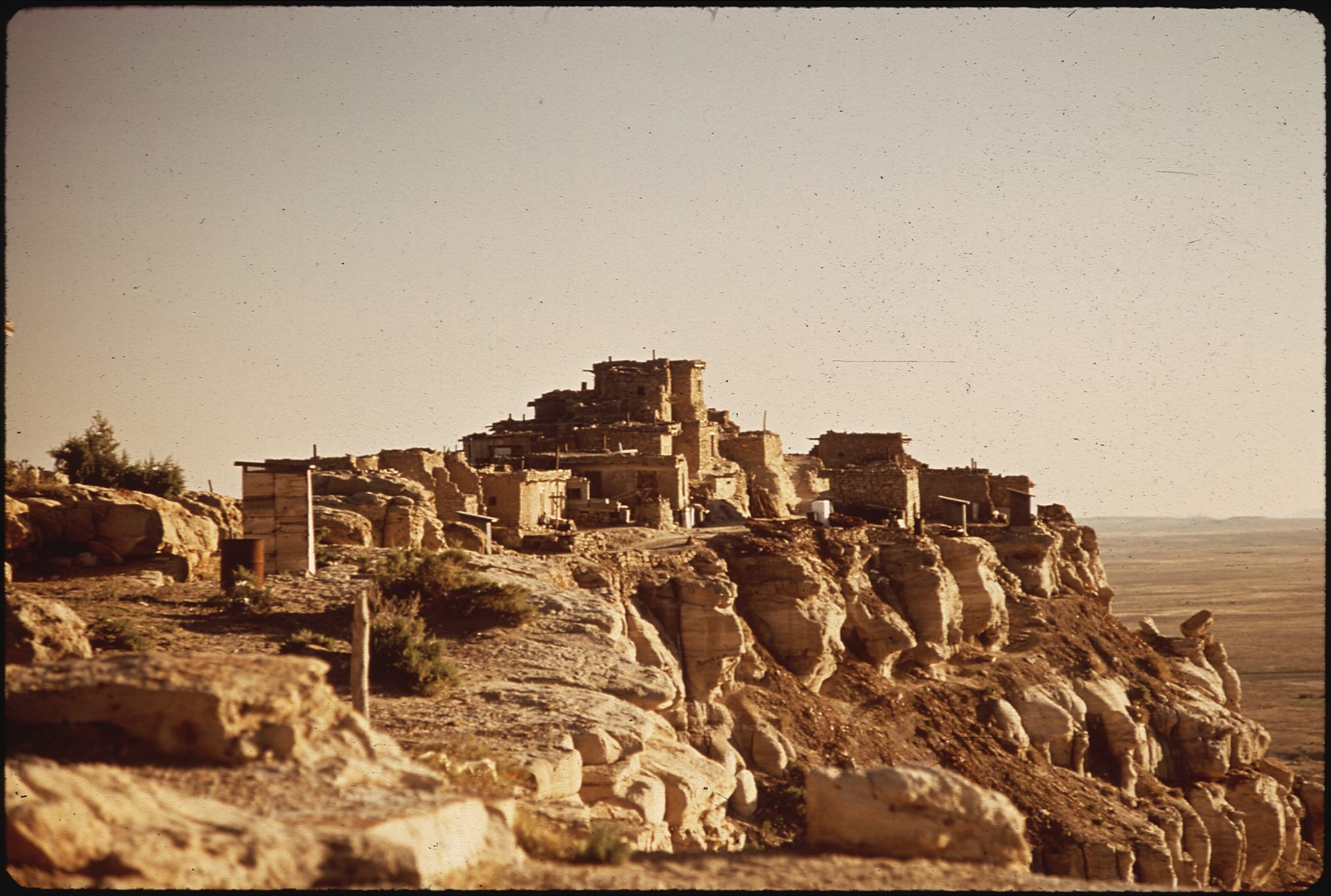
Hopi Tribe at a Glance
On three mesas rising above the high desert of northeastern Arizona, the Hopi people maintain villages that number among the oldest continuously inhabited communities anywhere in North America. Before learning more about the Hopi and their homeland, here's the Hopi Tribe at a glance:
Located in Northeastern Arizona
Surrounded by the Navajo Nation
Sovereign Federally Recognized Tribe
With its own government
Twelve Villages, Three Mesas
First, Second, and Third Mesa
One of the Oldest Regions
Continuously inhabited in North America
Rich Cultural Traditions
Ceremony, art, and community
A Distinct Language
Part of the Uto-Aztecan family
Deep Agricultural Heritage
Dry farming in the high desert
Who Are the Hopi?
The Meaning of "Hopi"
The word "Hopi" is often translated as "Peaceful People" or "Peaceful Ones," though translations can vary depending on context and are, at best, a simplification of a much fuller traditional name and self-understanding. The full traditional name carries a deeper meaning tied to living according to a specific way of life and set of values, of which peacefulness is only one part — encompassing right conduct, respect, and a way of living in accordance with instructions understood to have been given at the very beginning of Hopi history. Outsiders sometimes assume the name simply describes a temperament, when it actually describes an entire way of living correctly and in balance.
A Living Culture
Hopi culture is not confined to history. Community and family remain central to daily life, organized in part through a system of clans that shapes identity, obligation, and belonging. Language, tradition, and respect for established ways of doing things continue to guide daily interactions, even as modern Hopi life fully engages with contemporary work, education, and technology. Being Hopi today means living within both worlds at once, not choosing one over the other. A Hopi teacher, engineer, or business owner is no less connected to centuries of tradition than a farmer working ancestral fields; the culture simply expresses itself differently across different callings and generations.
Life on the Mesas
The Hopi villages are built atop three mesas — First Mesa, Second Mesa, and Third Mesa — each hosting several distinct villages with their own identities, leadership, and history. The mesas were chosen, over centuries, for practical and defensible reasons: elevated terrain offered protection, a vantage point over the surrounding land, and separation from the valley floor below, all while remaining close enough to farmland to sustain the community. That choice has proven remarkably durable — some villages here have been continuously inhabited for the better part of a thousand years, making the decision to settle here one of the most consequential in the community's history.
Village life on the mesas has always required a certain resourcefulness — water had to be carried up from springs at the base of the mesa, homes were built from hand-quarried stone, and every structure had to account for wind, sun, and the practical realities of life on exposed, rocky ground. That resourcefulness became, over time, simply how things were done, refined generation after generation rather than treated as a hardship to escape.
A Brief History of the Hopi
Ancient Origins
The Hopi trace their ancestry to the ancestral Puebloan peoples who built and inhabited communities across the Southwest for centuries before European contact, including sites now preserved at places like Wupatki, Walnut Canyon, and Mesa Verde far to the north. Hopi oral tradition describes a history of migration, in which different clans traveled from various directions over long periods of time before eventually settling at the mesas, guided by spiritual instruction and covenant rather than simple happenstance. Each clan's migration story is distinct, contributing its own history, responsibilities, and ceremonial knowledge to the community as a whole once it arrived.
This migration tradition remains a central part of Hopi identity and clan history today, understood not as legend but as a factual account of how the community came to be where it is, carrying real, ongoing significance for clan roles and responsibilities within village life.
Centuries of Village Life
Once established on the mesas, Hopi communities built a sustained way of life around agriculture, close community structure, and a ceremonial calendar that marked the passage of seasons and the needs of a farming people in an arid land. Villages adapted continuously to changing circumstances — population shifts, drought, and periods of both cooperation and tension among neighboring communities — while maintaining core traditions across many centuries of continuous settlement. Trade also connected Hopi villages to communities well beyond the immediate region, exchanging goods, materials, and knowledge along routes that stretched across much of the ancient Southwest.
Spanish Contact
Spanish explorers first reached Hopi villages in 1540, as part of the broader Coronado expedition searching for wealth rumored to lie somewhere in the region, followed by Spanish missionary efforts beginning in the early 1600s that sought to convert Hopi communities to Catholicism, with mixed and often strained results. Hopi villages were among the Pueblo communities that participated in the Pueblo Revolt of 1680, a coordinated uprising that drove Spanish colonial and missionary presence out of the region entirely for over a decade.
Notably, unlike many other Pueblo communities, the Hopi did not permit Spanish missions to be re-established afterward, even once Spanish authority was reasserted elsewhere in the region. That decision reflects a long, continuous history of asserting self-determination over village life and religious practice, one of the clearest examples of sustained Hopi autonomy in the historical record.
The Hopi Tribe Today
The Hopi Tribe operates under a tribal constitution adopted in 1936, with a tribal government including an elected chairman and tribal council, alongside continued authority held by individual villages over many aspects of local governance and tradition — a structure that balances centralized representation with the long-standing autonomy each village has always maintained over its own affairs. Education, arts, language preservation, and economic development all continue alongside sustained ceremonial and cultural life, reflecting a community that is simultaneously historic and entirely of the present.
Hopi Culture and Traditions
Hopi life is organized around a set of deeply held values and practices, best understood in general terms rather than through the specifics of ceremonies not intended for public description.
Respect for Nature: Hopi tradition holds that people bear responsibility for maintaining balance with the natural world, reflected in careful, sustainable approaches to farming, water use, and land stewardship developed over many centuries. This isn't an abstract environmental ethic; it's a practical necessity in a landscape that offers no room for waste, and a spiritual responsibility understood as part of the covenant that brought the Hopi to these mesas in the first place.
Family: Hopi society is organized through a matrilineal clan system, in which lineage and clan identity pass through the mother's line, shaping social structure, marriage customs, and individual identity from birth. Clan membership determines a great deal about a person's role and responsibilities within the community, including ceremonial obligations carried by specific clans across generations.
Community: Village life is deeply communal, with shared responsibilities for maintaining ceremonial structures, organizing seasonal events, and supporting community members in ways that extend well beyond the immediate family. Individual households remain important, but they exist within a dense web of mutual obligation that defines much of daily life on the mesas.
Agriculture: Farming is not simply an economic activity but a cultural and spiritual practice, tied closely to the ceremonial calendar and to values of patience, humility, and gratitude for what the land provides. Even Hopi families who no longer rely on farming for their primary livelihood often maintain some connection to traditional fields, treating the practice as a link to identity rather than simply a source of food.
Ceremonies: A rich ceremonial calendar marks the agricultural and spiritual year, broadly divided between a portion of the year associated with the presence of the Katsinam and a portion associated with their absence. Many ceremonies are private, restricted to community members, or otherwise not intended for public description, and this guide accordingly focuses on their general cultural role rather than their specific content.
Seasonal Traditions: Life on the mesas follows a seasonal rhythm tied closely to farming — planting, tending, and harvest — interwoven with community and ceremonial life throughout the year, in a pattern that has repeated, with variation, for longer than written records of the region exist.
Hopi Arts and Crafts
Hopi artistic traditions are highly developed, distinct by village and family lineage, and carry deep cultural meaning well beyond their considerable beauty.
Pottery: Hopi pottery, especially the polychrome pottery associated with First Mesa, is internationally recognized. The revival of traditional Sikyatki-style pottery in the late 1800s, led in large part by the celebrated potter Nampeyo, remains one of the most significant developments in Southwestern Native American art, and her descendants continue that tradition today. Nampeyo studied ancient pottery shards recovered near her home village and adapted their designs into a new generation of work, bridging centuries-old technique with her own considerable artistic innovation.
Katsina Carvings: Carved figures representing Katsinam — spiritual beings central to Hopi religious life — are widely known in English as "kachina dolls," though Katsina is the more accurate and widely accepted term. Traditionally, these carvings were given to children as teaching tools, helping familiarize them with the Katsinam they would come to know throughout their lives, rather than created simply as decorative objects. Contemporary Katsina carvers have developed the art form considerably over the past century, moving from simple, flat traditional figures toward increasingly detailed, sculptural work, while collectors and carvers alike continue to recognize the deep cultural and spiritual context underlying the art form.
Basket Weaving: Second Mesa in particular is known for exceptional coiled and wicker basketry, made using plant materials gathered and prepared according to techniques passed down through generations of skilled weavers. Each village and even each family tends to favor particular techniques and design motifs, making it possible for those familiar with the tradition to often identify a basket's community of origin.
Jewelry: Hopi silverwork is distinguished by an overlay technique developed in the mid-20th century, in which cut, textured silver designs are layered over an oxidized background, producing a style immediately distinguishable from Navajo and other Southwestern silverwork. The technique was deliberately encouraged in the years following World War II as a way to provide economic opportunity for returning Hopi veterans, and it has since grown into one of the tribe's most recognized and celebrated art forms.
Textiles: Traditional Hopi weaving includes ceremonial textiles and garments, produced using techniques and patterns maintained carefully across generations of skilled weavers. Unlike some other Southwestern weaving traditions, Hopi weaving has historically been practiced largely by men, passed down through specific family and ceremonial lines.
Each of these art forms represents far more than craftsmanship for sale; they are living expressions of Hopi identity, skill, and cultural continuity, best appreciated — and best purchased — with that understanding in mind.
The Hopi Mesas
First Mesa
Home to several historic villages, including Walpi, dramatically situated at the mesa's narrow tip with sheer drop-offs on either side. First Mesa is also closely associated with the Hopi pottery tradition, particularly the community of Hano.
Second Mesa
Center of several historic Hopi communities, Second Mesa is particularly well known for its basket-weaving tradition and continues to serve as an important cultural and community hub.
Third Mesa
Home to Old Oraibi, widely considered one of the oldest continuously inhabited communities in the United States, with roots extending back close to a thousand years. Third Mesa is known for its historic villages, distinctive craftsmanship, and sweeping views across the surrounding high desert.
| Mesa | Why It's Important |
|---|
| First Mesa | Home to some of the oldest continuously inhabited villages in North America. |
| Second Mesa | Center of several historic Hopi communities and cultural traditions. |
| Third Mesa | Known for historic villages, craftsmanship, and sweeping views across the high desert. |
Hopi Agriculture
Few agricultural traditions anywhere demonstrate the kind of patient, accumulated knowledge found in Hopi dry farming. With annual rainfall often totaling less than ten inches, and no rivers or irrigation systems available to most Hopi farmland, generations of Hopi farmers have developed techniques that make successful farming possible in conditions that would defeat most conventional agriculture.
Corn, the foundation of Hopi agriculture, is planted far deeper than is typical elsewhere — often a foot or more below the surface — reaching down to soil moisture retained from winter snow and infrequent rains. Hopi corn varieties have themselves been selected and refined over many centuries specifically for this purpose, developing unusually vigorous root systems and strong initial growth capable of pushing up through that depth of sand and soil. Fields are also spaced far more widely than conventional farming would suggest, reducing competition for scarce water between individual plants.
Beans and squash are grown alongside corn, planted and positioned to take advantage of natural runoff patterns, wind breaks, and small variations in terrain that capture and hold what little moisture falls. Farmers traditionally choose field locations carefully, often at the mouths of washes or areas where rain naturally concentrates, reading the landscape with a level of detail built from direct, sustained observation across generations rather than instruments or formal irrigation infrastructure. Windbreaks, whether natural terrain features or built by hand, help protect young plants from the drying, damaging winds common across the open mesa country.
Timing matters just as much as placement. Hopi farmers traditionally plant according to a careful reading of seasonal signs — temperature, moisture, and the specific behavior of the land itself — refined over so many generations that this accumulated knowledge functions as a genuinely sophisticated agricultural science, even without the formal instruments a modern agronomist might use. This is a farming tradition built entirely around living with scarcity rather than engineering it away — and it has sustained Hopi communities on these mesas for close to a thousand years, through droughts and hardships that would have ended most other farming traditions entirely.
Hopi Corn: More Than a Crop
It's hard to overstate how central corn is to Hopi life, and reducing it to a food crop alone misses most of its significance. Corn represents cultural continuity, resilience, and an enduring relationship between people and the land that spans not just growing seasons, but generations.
Hopi farmers maintain multiple traditional corn varieties, each adapted over centuries specifically to the demands of dry farming in this environment — deep, vigorous root systems, resilience to wind and drought, and the ability to germinate from far deeper planting than most corn varieties could survive. Passing these varieties, and the specific knowledge of how to grow them, from one generation to the next is itself an act of cultural preservation, not simply agricultural practice.
Corn also marks the rhythm of the year and the milestones of life, present in daily meals as much as in significant occasions. Blue corn in particular holds special significance within Hopi tradition, used in a wide range of traditional foods and prepared using methods, like the paper-thin bread known as piki, that themselves represent generations of accumulated culinary skill passed down primarily among Hopi women.
A successful harvest reflects not just favorable weather, but the accumulated skill and careful attention of the farmer who planted it — a tangible, edible expression of knowledge passed down with care across many generations. In that sense, every field of corn on the mesas carries history in it, as much as it carries food. Even as some Hopi families today also participate in the broader modern economy, maintaining a cornfield often remains a meaningful commitment, understood as much as a cultural responsibility as a practical one.
Landscapes of Hopi Lands
The Hopi homeland sits within a striking high-desert landscape, one that has directly shaped the culture built upon it. Mesas rise abruptly from the surrounding plain, offering both defensible high ground and sweeping views across a landscape that can otherwise feel endless. Nearby, the Painted Desert's colorful badlands stretch across the horizon, part of the same broader geological and visual landscape that surrounds Hopi land on multiple sides.
Wupatki National Monument, to the west, holds particular significance — the Hopi are among several tribes with recognized ancestral ties to the pueblos preserved there, understood as part of the same migration history described in Hopi tradition. The Little Colorado River region, though often dry for long stretches, has also played a role in the region's history and land use across centuries, valued for the water and resources it does provide in an otherwise parched landscape.
Even the open, seemingly empty grassland and high desert surrounding the mesas reflects a working relationship with this landscape, shaped by farming, grazing, and a traditional understanding of land stewardship that treats this high desert as a homeland to be cared for, not simply survived. Certain buttes, springs, and landforms across this territory carry specific traditional and spiritual significance, part of a landscape understood by the Hopi as fully inhabited by meaning, not simply empty space between villages.
Respectful Travel and Cultural Awareness
Visitors to Hopi land are guests, and a respectful visit depends on understanding and honoring that role.
- Respect Private Property — Hopi villages are active communities and homes, not open attractions; enter only areas explicitly open to visitors.
- Photography Restrictions — photography, video, and audio recording are prohibited in many areas of Hopi land, including within villages and during ceremonies; always confirm what is permitted before recording anything.
- Follow Tribal Regulations — the Hopi Tribe maintains its own rules regarding visitor access, and these should be treated with the same seriousness as any other legal or cultural boundary.
- Purchase Authentic Hopi Art Directly — buying from Hopi artists and tribally authorized galleries ensures fair compensation and authenticity, and supports the artists and traditions directly.
- Respect Ceremonies and Traditions — many ceremonies are private or restricted to community members; if a ceremony is open to visitors, following posted guidelines and community instruction is essential.
- Remember That Visitors Are Guests — Hopi land is sovereign, and a visit here should be approached with the same respect given to any host community welcoming you into their home.
Approached with genuine respect and curiosity, a visit to Hopi land can be a meaningful, memorable experience — one built on understanding rather than simple observation.
Wildlife and Nature
The high desert surrounding the Hopi mesas supports a resilient community of plants and wildlife adapted to aridity and elevation. Juniper and pinyon pine grow across the higher, cooler elevations, giving way to desert grasslands across the broader landscape. Golden eagles hold particular cultural and ceremonial significance in Hopi tradition, while ravens, coyotes, and mule deer are all regularly seen moving across the mesas and surrounding terrain. As with Hopi farming itself, wildlife here has adapted to genuine scarcity, thriving in a landscape that offers little room for error.
For a closer look at the animals found throughout the wider region, see our full Arizona Wildlife → guide.
A Culture That Continues to Thrive
It's easy for outside visitors to think of Indigenous cultures only in the past tense, as though the story ends somewhere in a history book. The Hopi Tribe today is a vibrant, contemporary community, living proof that tradition and modern life are not opposites.
Hopi artists and craftspeople continue to innovate within centuries-old traditions, exhibiting work recognized far beyond the mesas, in galleries and museums across the country and, increasingly, around the world. Farmers continue to practice and refine dry farming techniques passed down across generations, and interest in traditional Hopi corn varieties has grown even beyond the reservation among researchers and sustainable agriculture advocates studying drought-resilient farming methods. Teachers work to keep the Hopi language alive for younger generations, alongside dedicated cultural preservation programs working to document and protect traditional knowledge before it is lost.
Business owners operate enterprises spanning tourism, arts, and other industries, and the Hopi Tribe's own government continues to manage community affairs with a significant degree of self-determination, navigating modern economic and political realities while remaining accountable to village-level tradition and authority. The Hopi Cultural Preservation Office, in particular, plays an active role in protecting Hopi cultural resources, knowledge, and intellectual property, a distinctly modern institution built to safeguard a very old culture.
None of this exists in spite of tradition — it exists because of it. The same values that sustained Hopi communities on these mesas for close to a thousand years — patience, community, respect for the land, and a deep sense of continuity between generations — continue to guide a culture that is very much alive, and very much still being written.
Interesting Facts About the Hopi Tribe
- Hopi villages are among the oldest continuously inhabited communities in North America.
- Traditional Hopi farming relies primarily on rainfall rather than irrigation, a technique known as dry farming.
- The Hopi language belongs to the Uto-Aztecan language family, related to languages spoken as far away as central Mexico.
- The Hopi continue many traditions that have been practiced for centuries, alongside a fully contemporary way of life.
- The mesas provide dramatic views across Northern Arizona, chosen in part for the vantage point and protection they offered.
Frequently Asked Questions
Who are the Hopi?
The Hopi are a sovereign, federally recognized tribe whose ancestors have lived on the mesas of northeastern Arizona for close to a thousand years, maintaining one of North America's oldest continuously living cultures.
Where do the Hopi live?
The Hopi Tribe's reservation is located in northeastern Arizona, entirely surrounded by the Navajo Nation, centered on twelve villages spread across three mesas.
What language do the Hopi speak?
The Hopi language is part of the Uto-Aztecan language family and remains an important part of cultural identity, alongside ongoing efforts to support its continued use among younger generations.
What are the Hopi mesas?
First Mesa, Second Mesa, and Third Mesa are the three mesas on which Hopi villages are built, each home to several distinct communities with their own histories and traditions.
What is Hopi pottery known for?
Hopi pottery, especially the polychrome pottery associated with First Mesa, is internationally recognized, particularly following the revival of traditional Sikyatki-style designs led by the potter Nampeyo in the late 1800s.
Who are the Katsinas?
Katsinam are spiritual beings central to Hopi religious life; carved Katsina figures, often called "kachina dolls" in English, were traditionally given to children as teaching tools to help them learn about these important spiritual figures.
How old are the Hopi villages?
Some Hopi villages, including Old Oraibi on Third Mesa, are considered among the oldest continuously inhabited communities in the United States, with roots extending back nearly a thousand years.
How can visitors respectfully learn about Hopi culture?
By respecting private property and photography restrictions, following tribal regulations, purchasing art directly from Hopi artists, and approaching any visit with the understanding that Hopi land is a living homeland, not simply a destination.
Continue Exploring Arizona
The Hopi Tribe's history and homeland connect to many of Northern Arizona's most significant places. Here's where to go next:
Navajo Nation
The largest Native American reservation in the United States.
READ GUIDE →Wupatki National Monument
Ancestral pueblos with recognized Hopi clan connections.
READ GUIDE →Arizona Native American Arts & Culture
Pottery, weaving, jewelry, and artwork across the Southwest.
READ GUIDE →Painted Desert
The colorful badlands surrounding Hopi and Navajo lands.
READ GUIDE →Grand Canyon National Park
The centerpiece of Arizona's geological and cultural story.
READ GUIDE →
Discover Northern Arizona Through Its Living Cultures
The landscapes of Northern Arizona are inseparable from the people who have cared for them for generations. Learning about the Hopi Tribe offers a deeper appreciation of the region's history, traditions, and enduring cultural heritage. At Grand Canyon Journeys, we believe meaningful travel begins with respect, curiosity, and an understanding of the communities that continue to shape Arizona today.