Havasupai Tribe at a Glance
Deep within a side canyon of the Grand Canyon, along a creek famous for its blue-green waterfalls, the Havasupai Tribe maintains one of the most distinctive homelands of any Native American community. Before learning more about the Havasupai and their connection to this remarkable place, here's the Havasupai Tribe at a glance:
Homeland Within the Grand Canyon
Centered on the village of Supai
Means "People of the Blue-Green Waters"
Named for Havasu Creek
Sovereign Federally Recognized Tribe
With its own government
One of the Most Remote Communities
In the continental United States
Deep Agricultural Heritage
Farming along Havasu Creek for centuries
A Distinct Language
Part of the Upland Yuman family
Enduring Connection to the Canyon
Among the most direct of any tribe
Who Are the Havasupai?
The Meaning of "Havasupai"
The name Havasupai comes from "Havasu," meaning blue-green water, and "pai," meaning people — together, "the people of the blue-green waters." The name is not simply descriptive; it reflects a genuine relationship between the tribe and the creek that runs through their homeland. Havasu Creek, with its striking turquoise pools and waterfalls, has shaped where the Havasupai have lived, how they have farmed, and how they have understood their place in the canyon for longer than written records of the region exist. Water here is not a backdrop to Havasupai life — it is the reason life in this particular place has been possible at all.
A Living Culture
Havasupai culture continues today through a sovereign tribal government, an active community centered on the village of Supai, and traditions that remain very much part of daily life rather than something set aside as history. Family and community ties run deep, shaped by the practical reality of living in a small, tight-knit settlement where cooperation has always mattered more than it might in a larger town. Contemporary Havasupai life includes modern schools, tribal governance, and a economy shaped substantially by the natural beauty of the tribe's homeland, alongside language programs and cultural knowledge that tribal members continue to pass down to younger generations.
Living in the Grand Canyon
Few communities anywhere in the world live quite the way the Havasupai do: the village of Supai sits directly on the floor of a side canyon within the Grand Canyon, thousands of feet below the rim, reachable only by trail, mule, or helicopter. There is no road into Supai. It is often described as the most remote community in the continental United States, and for decades it has also been the last place in the country where mail is still delivered by mule train, a distinctive and widely documented fact of daily Havasupai life. Living this way is not a hardship the Havasupai simply endure — it reflects an intentional, sustained choice to remain in a homeland that has always defined who they are.
That choice carries real, everyday consequences most communities never have to consider. Every supply that cannot be grown or made locally — building materials, groceries, mail, medicine — must travel the same narrow trail into the canyon that visitors use, whether on the back of a mule or, when weather or urgency demands it, by helicopter. Rather than treating that isolation as a limitation to be engineered away, the Havasupai have built an entire way of life around working with it, much as earlier generations worked with the canyon's heat, its floods, and its narrow strip of farmable ground.
A Brief History of the Havasupai
Traditional Homeland
Historically, Havasupai life followed a seasonal rhythm that made full use of a homeland spanning both the depths of the canyon and the plateau high above its rim. Summers were spent in the canyon itself, along the fertile floodplain of Havasu Creek, farming corn, beans, squash, and other crops sustained by the creek's reliable water. As the growing season ended each autumn, families traditionally moved up onto the plateau above, where they hunted game, gathered pinyon nuts and wild plants, and lived through the winter months before returning to the canyon floor the following spring. This seasonal movement between canyon and plateau was not incidental to Havasupai life; it was the foundation of it, developed and refined across many generations.
Early History
The Havasupai are closely related to the Hualapai, and the two communities were historically part of a broader Pai-speaking people sharing language, custom, and territory across a wide stretch of northwestern Arizona before later administrative divisions separated them into distinct reservations. Spanish missionary Francisco Garcés is generally credited as the first European to document contact with the Havasupai, visiting the tribe's canyon settlement in 1776 and recording an already well-established farming community living much as their ancestors had for generations before him. For roughly a century afterward, the Havasupai continued their traditional seasonal life with comparatively limited outside contact, even as American exploration and settlement gradually increased across the wider region.
Anthropologists who later studied the tribe, including Leslie Spier in the 1920s, documented a community whose farming methods, social structure, and knowledge of the surrounding canyon and plateau reflected many centuries of accumulated adaptation to this specific landscape. That documentation, drawn from direct observation of Havasupai life at the time, remains an important record of just how established and sophisticated this way of life already was long before it came under serious outside pressure.
Changes Through the 1800s
The late 1800s brought profound and difficult change to Havasupai life. As American settlement expanded across northern Arizona and the federal government began setting aside land for what would eventually become Grand Canyon National Park, the Havasupai found their traditional plateau territory steadily restricted. In 1882, an executive order established a Havasupai reservation of just 518 acres, confined almost entirely to the floor of Havasu Canyon itself. This drastically reduced holding cut the tribe off from the vast plateau lands above the rim that families had relied on for centuries of winter hunting and gathering, confining a community accustomed to moving across a wide seasonal range to a narrow strip of canyon floor instead. The impact of this loss was severe and long-lasting, reshaping Havasupai life for close to a century afterward. It is a difficult chapter in the tribe's history, and one best understood plainly, without embellishment: a self-sufficient people who had long managed a varied, seasonal homeland were confined, by outside decision, to a small fraction of the land they had always used.
Expansion of Tribal Lands
Havasupai advocacy for the return of traditional lands continued for decades, gaining significant momentum through the 20th century. That advocacy achieved a landmark result in 1975, when Congress passed the Grand Canyon National Park Enlargement Act, which returned approximately 185,000 acres of traditional plateau land to the tribe — one of the largest land restorations ever granted to a Native American tribe in United States history. This restoration allowed the Havasupai Reservation to include meaningful plateau acreage once again, alongside continued traditional use areas within Grand Canyon National Park itself. It stands as one of the more significant, if still incomplete, acts of redress in the tribe's long relationship with the federal government.
The Havasupai Today
Today, the Havasupai Tribe governs itself through an elected tribal council, based in the village of Supai, and continues to manage its reservation lands, natural resources, and community affairs with a substantial degree of self-determination. The tribe's economy is shaped significantly by the extraordinary natural beauty of Havasu Creek and its waterfalls, alongside continued farming, tribal enterprises, and public services including a tribal school and health clinic serving the Supai community. Havasupai leaders continue to advocate at the federal level on issues ranging from water rights to environmental protection of the watershed that sustains their homeland, a modern extension of the same long struggle to protect and secure the land their ancestors depended on.
Havasu Creek
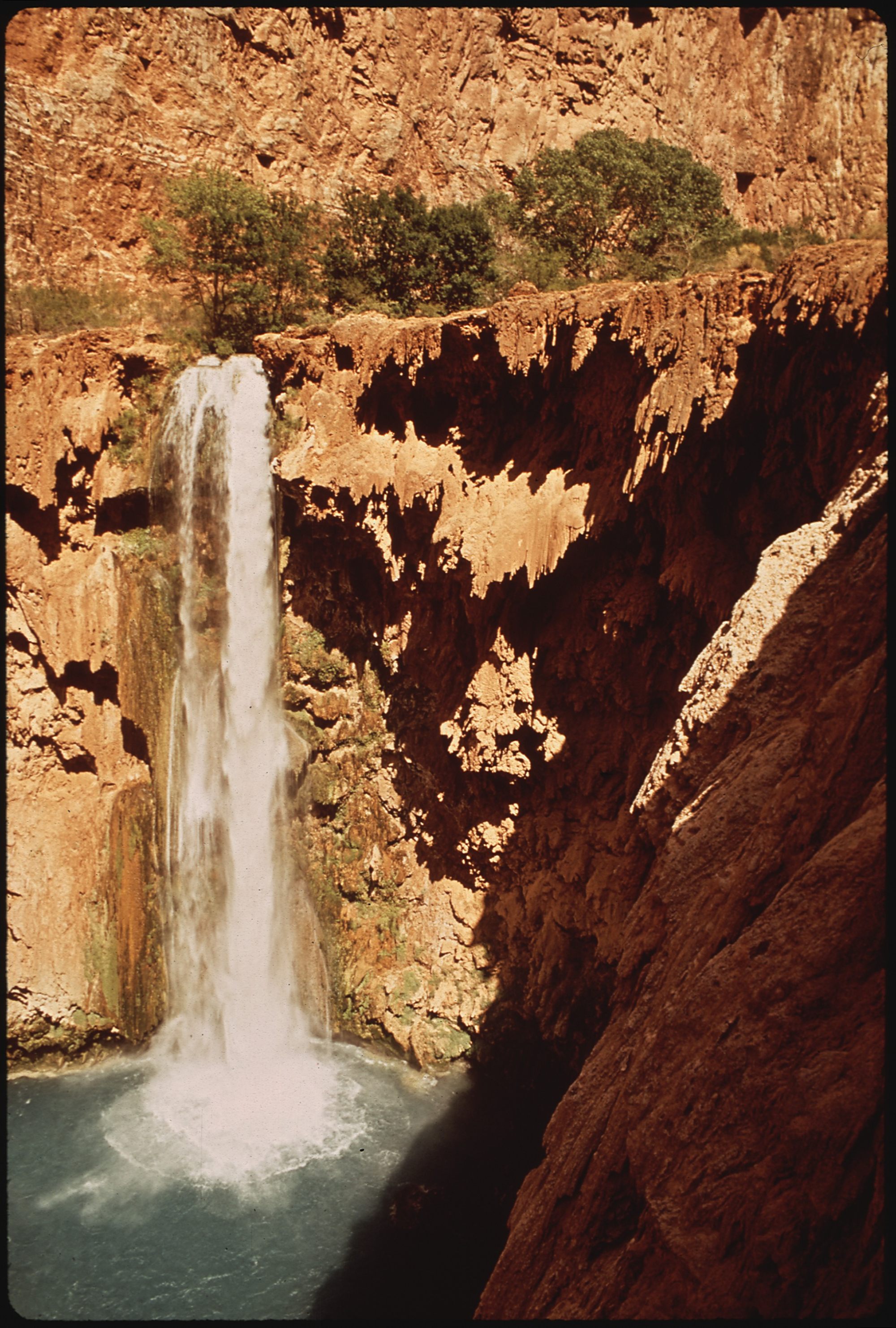
Havasu Creek is, in every meaningful sense, the reason the Havasupai homeland exists as it does. Fed by springs deep within the limestone of the surrounding plateau, the creek emerges already carrying a heavy natural load of dissolved calcium carbonate, the same mineral responsible for its remarkable, almost impossible blue-green color. As that mineral-rich water flows downstream and interacts with air and algae, it gradually deposits travertine — a form of limestone — building the natural dams and terraced pools that make this stretch of canyon so visually distinctive, and giving the creek both its color and its most iconic physical features.
In a canyon otherwise defined by heat, exposed rock, and scarcity, Havasu Creek creates something close to the opposite: a genuine desert oasis, lined with cottonwood trees, dense vegetation, and a reliable year-round water source in a landscape where such reliability is rare. That reliability made sustained farming possible along the creek's floodplain for centuries, and it remains central to why the Havasupai were able to build a permanent, continuous home in this particular side canyon rather than simply passing through it. Few places in the entire Grand Canyon combine water, shelter, and fertile ground in quite the way this stretch of Havasu Canyon does, and that rare combination is precisely what has sustained Havasupai life here for so long.
Why Is Havasu Creek So Blue?
| Question | Explanation |
|---|
| Why does Havasu Creek look blue-green? | The water carries a high natural concentration of dissolved calcium carbonate from underground limestone springs, which scatters light in a way that produces the creek's vivid turquoise color. |
| Is the color natural? | Yes. The color comes entirely from the creek's mineral content and is not the result of any treatment, dye, or human alteration — it is a naturally occurring feature of the spring-fed water itself. |
| Does the color ever change? | It can. Heavy rain and flash flooding periodically wash sediment into the creek, turning the water murky or brown for a time; the vivid blue-green color typically returns once the creek settles and runs clear again. |
Life in the Canyon
It's tempting for outsiders to see Havasu Canyon purely through the lens of its scenery, but for the Havasupai, this has always been a place defined by the steady, practical work of building a life here — adaptation and resilience, not tourism, are what have sustained the community for centuries.
A Reliable Water Source: Where much of the Grand Canyon offers little dependable water, Havasu Creek's year-round flow made permanent farming possible in a landscape that would otherwise support only passing use. That reliability has always been the community's greatest natural asset, and its careful stewardship has always been a shared responsibility.
Farming the Floodplain: Generations of Havasupai families have farmed the narrow, fertile ground along the creek, growing corn, beans, squash, and — after contact with Spanish and later American traders introduced new crops to the region — peach trees, which took root in Havasupai orchards and became a distinctive part of the tribe's agricultural life. Farming here required constant attention to the creek's moods, from gentle irrigation in dry months to rebuilding fields after flash floods reshaped the canyon floor.
Seasonal Rhythms: Life in the canyon has traditionally followed the calendar of the land itself — planting in spring, tending crops through the heat of summer, harvesting in early autumn, and, historically, moving up to the plateau as temperatures cooled. Even as that seasonal movement between canyon and rim has changed over the past century, the underlying rhythm of a life tied closely to the land's own cycles has endured.
Family and Community Ties: In a settlement as small and remote as Supai, family and community bonds are not incidental to daily life — they are what make daily life possible. Cooperation on everything from farming to maintaining the trail into the canyon has always depended on close relationships between households, reinforced across generations by simple necessity as much as by tradition.
Land Stewardship: Caring for Havasu Creek and the canyon around it has never been optional for the Havasupai; the community's continued presence here depends entirely on the health of the water and the land. That responsibility continues today through the tribe's own environmental and natural resource programs, a modern expression of a stewardship ethic that has always been part of life in this canyon.
Culture and Traditions
Havasupai culture is built around family, community, and a deep, practical relationship with the land, expressed through traditions that remain part of daily life rather than simply remembered history.
Language: The Havasupai language belongs to the Upland Yuman branch of the Yuman language family, closely related to the Hualapai language, reflecting the two tribes' shared origins as one Pai-speaking people. Like many Indigenous languages, Havasupai faces real challenges in being passed on to younger generations, and the tribe supports language programs through its school in Supai aimed at keeping the language alive and in active use.
Family and Community: With a total tribal population of several hundred members, most living in or closely connected to Supai, family relationships and community obligation shape daily life in ways that are hard to overstate. Decisions affecting the community tend to involve extensive consultation and consensus, reflecting a settlement where nearly everyone is connected to everyone else through kinship or long acquaintance.
Traditional Knowledge: Generations of close observation of the canyon, the creek, and the surrounding plateau have produced a deep body of traditional ecological knowledge — understanding seasonal water patterns, plant cycles, and the behavior of local wildlife with a level of detail built from direct, sustained experience of this specific landscape. That knowledge continues to inform how the tribe manages its land and resources today.
Agriculture: Farming along Havasu Creek remains both a practical activity and a cultural touchstone, connecting present-day Havasupai families to the same fields their ancestors worked. Corn, beans, squash, and peaches grown in the canyon's small orchards and fields represent a living agricultural tradition rather than a historical curiosity.
Respect for Nature: Water, in particular, is treated with a level of respect that goes well beyond its obvious practical value — it is the foundation of the tribe's name, homeland, and continued existence in this canyon. Land and water stewardship are understood as an ongoing responsibility passed down through generations, not a modern policy adopted from outside.
Storytelling: Oral tradition remains an important way that Havasupai history, values, and knowledge of the land are passed between generations, carrying forward accounts of the tribe's origins and its long relationship with the canyon. As with many Indigenous communities, certain stories and traditional knowledge are considered appropriate only for community members to share, and this guide accordingly focuses on the general cultural importance of storytelling rather than the specific content of any particular story.
Taken together, these traditions describe a culture defined less by any single practice than by an underlying consistency: family obligation, careful use of scarce resources, and a working relationship with the land that has had to prove itself, generation after generation, in a place that leaves little room for error. That consistency, more than any one custom, is what has allowed Havasupai culture to remain recognizably itself across so many generations of change happening around it.
The Grand Canyon and the Havasupai
For most visitors, the Grand Canyon is an extraordinary landscape to see. For the Havasupai, it is something more fundamental: home, history, and identity, bound together in a single place. The canyon is not a backdrop to Havasupai culture — it is the source of it. Every part of Havasupai life, from farming methods refined for this specific floodplain to a seasonal calendar built around this specific climate, developed in direct response to this particular stretch of canyon and no other.
That relationship runs in both directions. Just as the canyon has shaped Havasupai life for centuries, generations of Havasupai stewardship have shaped the health of this side canyon in turn — its farmland, its water, and the delicate balance that allows a permanent community to thrive in country that offers little margin for error. The tribe's continued presence in Havasu Canyon is not incidental to the canyon's story; it is one of the clearest examples anywhere in the Grand Canyon of a human community living in direct, sustained relationship with this landscape across an extraordinary span of time.
Understanding the Havasupai, then, means understanding the Grand Canyon itself a little differently — not simply as scenery or geology, but as a homeland that has been lived in, cared for, and passed down across generations. That perspective doesn't diminish the canyon's scale or beauty; if anything, it deepens it, adding a profoundly human dimension to a place too often described purely in terms of rock layers and viewpoints.
Arts and Craftsmanship
Havasupai artistic traditions reflect the same resourcefulness and close relationship with the land found throughout the tribe's culture and history.
Basket Weaving: Havasupai basketry, woven using locally gathered plant materials, has long been recognized by anthropologists and collectors alike for its fine craftsmanship, reflecting techniques passed down carefully across generations of skilled weavers. Baskets historically served practical purposes — carrying, storing, and processing food — as much as artistic ones, and that dual identity as both tool and artwork remains part of what makes the tradition distinctive.
Beadwork and Jewelry: Havasupai artisans have long produced beadwork and jewelry reflecting both traditional design and individual artistic expression, worn for both everyday and significant occasions. Contemporary Havasupai artists continue this tradition, often blending long-standing techniques with their own creative choices.
Traditional Crafts: Leatherwork, tool-making, and other practical crafts historically developed alongside farming and canyon life, shaped by the specific materials and needs of a community living in this environment. Many of these skills continue to be taught and practiced within the community today.
Contemporary Artists: A number of Havasupai artists continue to work across these traditions today, producing baskets, jewelry, and other work that carries centuries of accumulated technique forward into the present. Supporting these artists directly — buying authentic Havasupai work from the artists themselves or from tribally authorized outlets — helps ensure that the economic benefit of this artistry stays with the community that created it, and that the tradition continues to be viable for the next generation of Havasupai artisans.
Wildlife and Nature
The stretch of canyon the Havasupai call home supports a striking range of life, drawn in large part by the reliable water of Havasu Creek. Cottonwood and willow trees line the creek's banks, creating a genuine riparian oasis amid the surrounding desert, while hardy desert plants — agave, cactus, and drought-adapted shrubs — cover the drier slopes and plateau above. That contrast, lush green corridor against stark red rock, is part of what makes this side canyon so visually distinctive.
Mule deer and desert bighorn sheep move through the surrounding canyon country, well adapted to its steep terrain and limited water outside the creek corridor itself. Birdlife is especially abundant along the creek, where herons, songbirds, and other species take advantage of water and shade found nowhere else nearby. As throughout the wider Grand Canyon region, this ecosystem reflects a delicate balance between scarcity and abundance, one that both wildlife and the Havasupai community itself have learned to live within rather than against.
For a closer look at the animals found throughout the wider region, see our full Arizona Wildlife → guide.
Water as the Heart of the Havasupai Homeland
Nearly everything about Havasupai history, culture, and daily life traces back to a single source: the water of Havasu Creek. It is embedded in the tribe's own name, in the farming practices that have sustained the community for centuries, in the seasonal rhythms that shaped traditional life, and in the very reason a permanent settlement was possible in this particular side canyon at all. Where the wider Grand Canyon is defined largely by rock, heat, and scarcity, the Havasupai homeland is defined by the rare and precious exception to that rule.
That relationship also carries real responsibility. The health of Havasu Creek — its flow, its clarity, its famous color — depends on the health of the springs and watershed far above the canyon floor, much of it beyond the reservation's own boundaries. Protecting that water source has become one of the defining concerns of the modern Havasupai Tribe, carried forward through advocacy, environmental monitoring, and continued vigilance against anything upstream that might threaten it. In that sense, protecting Havasu Creek today is simply the latest chapter in a much older story: a people whose entire history has been shaped by water, working to make sure that story continues for generations still to come.
To understand the Havasupai is to understand that water, culture, and homeland are not three separate things here — they are a single, continuous relationship, sustained with remarkable care across a very long span of time.
Interesting Facts About the Havasupai Tribe
- "Havasupai" means "people of the blue-green waters," named for the striking color of Havasu Creek.
- The village of Supai is considered one of the most remote communities in the continental United States, with no road access.
- Supai is the last place in the United States where mail is still regularly delivered by mule train.
- The 1975 Grand Canyon National Park Enlargement Act returned roughly 185,000 acres of traditional plateau land to the tribe.
- The Havasupai and Hualapai share a common origin as one Pai-speaking people before later administrative divisions separated them.
Frequently Asked Questions
Who are the Havasupai?
The Havasupai are a sovereign, federally recognized tribe whose homeland lies within a side canyon of the Grand Canyon, centered on the village of Supai along Havasu Creek.
What does "Havasupai" mean?
Havasupai means "people of the blue-green waters," referring to Havasu Creek, the mineral-rich stream whose color and reliable flow have shaped the tribe's history and homeland.
Where do the Havasupai live?
The Havasupai Reservation is located within and above a side canyon of the Grand Canyon in northern Arizona, centered on the village of Supai, accessible only by trail, mule, or helicopter.
Why is Havasu Creek blue-green?
The creek's color comes from a high natural concentration of dissolved calcium carbonate absorbed from underground limestone springs, which scatters light and produces its distinctive turquoise appearance.
What language do the Havasupai speak?
The Havasupai language belongs to the Upland Yuman branch of the Yuman language family, closely related to the Hualapai language, reflecting the two tribes' shared origins.
How did the Havasupai lose and later regain traditional land?
An 1882 executive order confined the tribe to a small 518-acre reservation, cutting off access to plateau lands used for centuries; the 1975 Grand Canyon National Park Enlargement Act later returned approximately 185,000 acres of that traditional territory.
What crops have the Havasupai traditionally grown?
Corn, beans, and squash have long been grown along the fertile floodplain of Havasu Creek, joined more recently by peach trees introduced through contact with Spanish and American traders.
How can visitors respectfully learn about Havasupai culture?
By supporting Havasupai artists and tribal enterprises directly, following tribal rules and guidance, and approaching the tribe's homeland with an understanding that it is a living community and not simply a scenic destination.
Continue Exploring Arizona
The Havasupai homeland connects directly to the wider story of the Grand Canyon and the peoples who call Northern Arizona home. Here's where to go next:
Grand Canyon National Park
The centerpiece of Arizona's geological and cultural story.
READ GUIDE →Navajo Nation
The largest Native American reservation in the United States.
READ GUIDE →Hopi Tribe
One of North America's oldest continuously living cultures.
READ GUIDE →Arizona Native American Arts & Culture
Pottery, weaving, jewelry, and artwork across the Southwest.
READ GUIDE →Grand Canyon History Guide
The deeper human and geological story of the canyon.
READ GUIDE →
Understanding the Human Story of the Grand Canyon
The Grand Canyon's layered rock tells a geological story stretching back nearly two billion years — but its human story, carried forward by communities like the Havasupai, is just as remarkable. Understanding who has called this canyon home, and for how long, adds a depth to the experience of visiting that scenery alone cannot provide. At Grand Canyon Journeys, we believe a truly memorable visit includes both: the scale of the landscape, and the people whose history is inseparable from it.