Colorado River Indian Tribes at a Glance
Along a fertile stretch of the Colorado River in western Arizona, four distinct Indigenous peoples share a single reservation and a single tribal government — a community unlike any other in the Southwest. Before learning more about the Colorado River Indian Tribes, here's an overview at a glance:
Federally Recognized Tribal Nation
With its own sovereign government
Spans Two States
Western Arizona and southeastern California
Located Along the Colorado River
Fertile floodplain homeland
Headquartered in Parker, Arizona
Seat of the tribal government
Home to Four Distinct Peoples
Mohave, Chemehuevi, Hopi, and Navajo
Rich Agricultural Heritage
Farming the river's floodplain for generations
A Model of Shared Governance
Four cultures, one tribal nation
Who Are the Colorado River Indian Tribes?
A Unique Tribal Community
The Colorado River Indian Tribes, commonly known as CRIT, are made up of four distinct tribal peoples — the Mohave, Chemehuevi, Hopi, and Navajo — living together under a single, unified tribal government. This arrangement makes CRIT unusual among Indigenous nations in the United States: rather than one people governing one reservation, CRIT represents a genuine partnership between separate peoples, each with its own distinct language, history, and tradition, who came to share a single homeland and built a shared system of government to govern it together. Understanding CRIT means understanding both halves of that story — the individual heritage each people brought with them, and the community they built together once they arrived.
That combination is rare enough to be worth pausing on. Most tribal nations in the United States represent a single people with a shared, continuous history in one homeland. CRIT instead represents a deliberate, sustained act of cooperation between separate peoples with genuinely distinct origins, brought together first by geography and policy, and then held together by generations of shared governance and community life. The result is a tribal nation whose identity is built as much on that cooperation as on any single shared ancestry.
The Four Tribes
Mohave: The Mohave are the original inhabitants of this stretch of the Colorado River, with a traditional homeland and identity built directly around the river itself. Mohave culture historically centered on floodplain farming, river travel, and extensive trade relationships that connected Mohave communities to peoples across a wide stretch of the Southwest.
Chemehuevi: A Southern Paiute people, the Chemehuevi traditionally inhabited the Mojave Desert to the west of the river, developing deep, detailed ecological knowledge suited to one of the most demanding desert environments in North America. Chemehuevi bands moved into the Colorado River Indian Reservation community over the course of the 20th century, bringing their own distinct desert-adapted traditions into the shared CRIT community.
Hopi: A number of Hopi families relocated to the Colorado River Indian Reservation in the mid-20th century, as part of a federal relocation and farming program that offered reservation farmland to tribal members from other parts of Arizona. Hopi families who settled here brought their own distinct language, clan traditions, and agricultural knowledge, developed originally on the mesas of northeastern Arizona, into the CRIT community.
Navajo: Like the Hopi, Navajo families also relocated to the Colorado River Indian Reservation as part of the same mid-20th-century farming program, establishing a lasting Navajo presence and community within CRIT. Navajo members of CRIT maintain their own cultural identity and connection to broader Navajo Nation tradition, while participating fully in the shared CRIT community and government.
What makes this arrangement work, and what has allowed it to endure for generations, is that CRIT was never built on the expectation that any of these four peoples would set aside its own identity. Tribal membership today includes people who trace their heritage to any of the four founding peoples, and CRIT institutions — from tribal government to schools to cultural programs — are built to reflect and support that ongoing diversity, rather than blend it into a single, undifferentiated identity.
The Colorado River
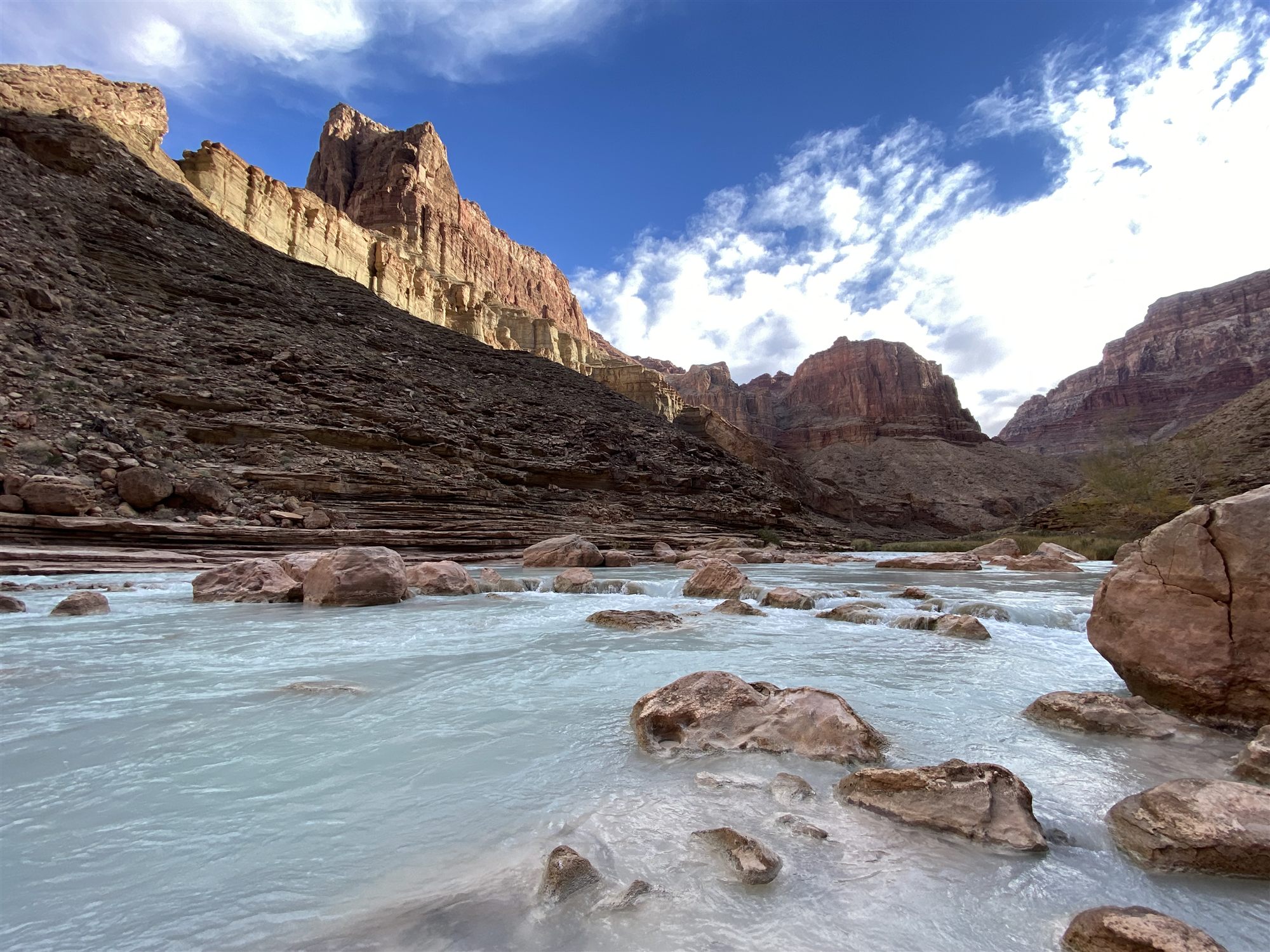
Nothing about the Colorado River Indian Tribes can be understood apart from the river itself. The Colorado River is the reason this particular stretch of desert supports a fertile, farmable floodplain rather than simply open desert, and it is the reason four distinct peoples were able to build a shared, sustained community in this specific place.
Water from the river has supported agriculture along this floodplain for many centuries, long before the reservation era began, sustaining Mohave farming communities and, later, the broader CRIT community that grew up around them. The river also provided fish, a traditional food source for river-dwelling peoples, and served as a natural highway for travel and trade, connecting communities up and down its length long before roads existed in this part of the Southwest. Even today, the river continues to define daily life across the reservation — as the source of irrigation water for tribal farmland, as a recreational and cultural resource for the community, and as the defining geographic feature of the reservation itself.
Transportation along the river was historically accomplished using rafts and boats suited to the Colorado's currents, allowing Mohave traders to move goods and information across considerable distances. That trade network connected the Mohave to peoples well beyond the immediate region, exchanging shell, pottery, textiles, and agricultural goods along routes that followed the river and the trails branching from it. The river, in other words, was never simply a water source — it was the central organizing feature of an entire regional network of communication and exchange, with Mohave communities occupying a genuinely significant position within it.
The river also supports a rich ecological community distinct from the surrounding desert — cottonwood forests, wetlands, and abundant wildlife all depend on the reliable water the Colorado provides in a landscape that otherwise offers very little. That contrast, lush river corridor against stark desert on either side, is central to understanding why this particular stretch of river has supported continuous human settlement for so long, and why it remains just as central to CRIT life today as it was to the Mohave communities who lived here first.
It's worth remembering, too, that this same river connects the CRIT community to a far larger story. The Colorado begins its journey high in the Rocky Mountains, carves the Grand Canyon hundreds of miles upstream, and passes through or borders the homelands of numerous other tribal nations before reaching Parker. CRIT's relationship with the river is therefore also a relationship with a much larger network of communities, all dependent on the same single waterway, a fact that shapes the tribe's approach to water rights and river management discussed later in this guide.
A Brief History of CRIT
Traditional Homelands
Before the reservation era, the Mohave people had lived along this stretch of the Colorado River for many centuries, developing a way of life built around floodplain farming, river travel, and extensive trade networks connecting Mohave communities to neighboring peoples across the Southwest. The Chemehuevi, meanwhile, occupied the Mojave Desert to the west, developing their own distinct traditions suited to a considerably more arid environment. These two peoples, with related but distinct histories, would eventually come to share the same reservation community.
Mohave society was historically organized along the river in a series of farming communities rather than centralized villages, taking full advantage of the Colorado's annual flood cycle to enrich the soil along its banks. That settlement pattern, spread along the river rather than concentrated in one place, reflects a way of life built in direct, practical response to the specific behavior of this particular river.
Creation of the Reservation
The Colorado River Indian Reservation was established by Congress in 1865, originally intended for the Mohave and other tribes of the river. Over the following decades, Chemehuevi families increasingly settled within the reservation community as well, joining the Mohave in building a shared, if still developing, community along the river. This laid the foundation for the multi-tribal community that would later formally become the Colorado River Indian Tribes.
The early decades following the reservation's establishment were not without hardship, as the community worked to adapt traditional Mohave and Chemehuevi ways of life to a formally bounded reservation considerably smaller than the territory either people had previously used. That adaptation, like so much of CRIT's history, required real flexibility and resilience from both founding communities.
Growth of the Community
The mid-20th century brought further significant change, as a federal relocation and farming program offered reservation farmland to tribal members from other Arizona tribes facing land shortages on their own reservations. Hopi and Navajo families took part in this program, relocating to the Colorado River Indian Reservation and establishing lasting communities alongside the Mohave and Chemehuevi already living there. Agriculture expanded significantly during this period, supported by irrigation infrastructure that made large-scale farming of the reservation's fertile floodplain possible. Tribal government, education, and other community institutions developed alongside this agricultural growth, building the foundation of the modern CRIT government.
This relocation program, while born out of practical land pressures elsewhere in Arizona, ultimately produced something considerably more significant than an agricultural expansion: it created the four-tribe community that defines CRIT today, requiring all involved to build entirely new structures of shared governance capable of representing four distinct peoples fairly and effectively.
The Colorado River Indian Tribes Today
Today, CRIT is governed by an elected tribal council representing all four constituent peoples, based in the community of Parker, Arizona. The tribe operates its own schools, healthcare services, and a range of business enterprises, alongside continued investment in agriculture, the reservation's original and still-significant economic foundation. Culture and community life continue to reflect the reservation's unique four-tribe heritage, with each people maintaining its own distinct traditions within a shared, cooperative tribal community.
The CRIT tribal museum in Parker plays a significant role in preserving and presenting this layered history, documenting the traditions of all four founding peoples alongside the shared story of how the modern CRIT community came to be. That institutional commitment to telling a genuinely four-part story, rather than simplifying it into one, is itself a reflection of the values that continue to guide the tribe today.
Culture and Traditions
Because CRIT brings together four distinct peoples, its cultural life reflects both individual tribal tradition and a shared community identity built over generations of living together.
Family: Family and kinship networks remain central to daily life within each of the four CRIT communities, shaping identity and mutual obligation according to each people's own particular tradition. Intermarriage between the four founding peoples has also become common over the generations, producing families whose heritage spans two or more of CRIT's constituent tribes.
Community: Despite their distinct origins, the four peoples of CRIT share a genuine sense of common community, built through generations of shared governance, shared land, and shared institutions. Community events, tribal council meetings, and shared civic life all reflect a working balance between individual tribal identity and collective CRIT membership.
Traditional Knowledge: Each people brought its own body of traditional ecological knowledge to the reservation — the Mohave's deep knowledge of the river and its floodplain, the Chemehuevi's knowledge of the surrounding desert, and the agricultural knowledge Hopi and Navajo farming families brought with them from their own homelands. Together, this represents an unusually broad and varied body of traditional knowledge concentrated within a single tribal community.
Language: Mohave, Chemehuevi, Hopi, and Navajo are each distinct languages, and CRIT supports efforts to preserve and teach each of them, recognizing that the reservation's linguistic diversity is itself part of its identity. Language programs must account for this diversity directly, supporting four separate languages rather than the single language program more typical of most tribal nations.
Arts: Each of the four peoples maintains its own artistic traditions, from Mohave beadwork to Hopi and Navajo textile and craft traditions carried to the reservation by relocated families, together representing an unusually broad range of Southwestern Indigenous artistry within a single community. Mohave beadwork in particular is recognized for its distinctive geometric patterns and technique, developed specifically among river communities of the lower Colorado.
Storytelling: Oral tradition remains an important way that each people's history and values are passed between generations, preserving distinct accounts of origin and homeland alongside the more recent, shared story of how the CRIT community itself came to be. That shared story — of four peoples building one community — has itself become part of what younger CRIT tribal members are taught today.
Celebrations: Community events and celebrations bring together members of all four peoples, reflecting both individual tribal tradition and the broader identity of CRIT as a unified community built from real cultural diversity.
Agriculture Along the Colorado River
Agriculture has been the economic and cultural backbone of life along this stretch of the Colorado River for longer than any written record of the region exists, and it remains central to the CRIT economy today. The Mohave practiced floodplain farming here long before the reservation was established, taking advantage of the river's natural annual flooding to enrich farmland without the need for artificial irrigation — a pattern of agriculture adapted specifically to this river and its particular seasonal rhythm.
The construction of dams and irrigation infrastructure across the Colorado River system in the 20th century changed this pattern significantly, ending the natural flood cycle but making large-scale, reliable irrigated farming possible across a much greater area of reservation land. CRIT farmland today produces cotton, alfalfa, wheat, and a range of vegetable crops, supported by an extensive irrigation canal system drawing water directly from the river. Agriculture remains one of the tribe's most significant economic sectors, employing tribal members and generating revenue that supports the broader CRIT community.
This agricultural tradition connects the present-day CRIT community directly back to the original Mohave farmers who first cultivated this floodplain, even as the specific techniques and crops have changed considerably over the generations. Farming here has never simply been an economic activity; it has always been a direct, practical expression of the relationship between this community and the river that makes its homeland possible.
The scale of modern CRIT agriculture is considerable — tens of thousands of acres of tribal farmland under cultivation, made possible by senior water rights and an irrigation system that draws directly from the Colorado River. That agricultural base provides not only revenue but employment across the reservation, and it continues to anchor CRIT's economy even as the tribe has diversified into other business enterprises over recent decades. Farming leases to outside agricultural operators also generate significant tribal revenue, allowing CRIT to benefit from its agricultural land in more than one way.
Beyond its economic role, agriculture also continues to carry cultural weight within the CRIT community, understood by many tribal members as a living link to the Mohave farmers who first proved that this stretch of desert could sustain a fertile, productive homeland — a fact that remains just as true, and just as remarkable, today as it was many centuries ago.
Wildlife and Nature
The stretch of the Colorado River running through the reservation supports a rich ecosystem found nowhere else in this part of the desert Southwest. Cottonwood forests and wetlands line the riverbanks, creating a genuine riparian oasis amid the surrounding Mojave and Sonoran desert country, while the drier reservation land beyond supports its own distinct desert ecosystem.
Waterfowl are abundant along the river, and egrets and herons are a common sight roosting and nesting in the cottonwood trees that line its banks. Bald eagles visit seasonally, drawn by the river's fish population, while beavers work the waterways and coyotes range across the surrounding desert terrain. Fish native to the river have long served as both an ecological cornerstone and a traditional food source for the Mohave and other river-dwelling peoples.
This riparian corridor is increasingly rare across the wider Colorado River system, much of which has been reshaped by dams, diversion, and development over the past century. The stretch of river running through CRIT land remains an important refuge for wildlife that depends on this kind of habitat, making the tribe's ongoing stewardship of its riverside land significant well beyond the boundaries of the reservation itself.
For a closer look at the animals found throughout the wider region, see our full Arizona Wildlife → guide.
Meet the Four Tribes
It's easy for outsiders to think of the Colorado River Indian Tribes as a single people, but CRIT is best understood as a partnership of four distinct peoples, each bringing its own heritage to a shared community.
| Tribe | Traditional Homeland | Distinctive Heritage |
|---|
| Mohave | Colorado River | River-based culture, farming, and trade. |
| Chemehuevi | Mojave Desert | Desert adaptation and extensive ecological knowledge. |
| Hopi | Northeastern Arizona mesas | Ancient villages, farming, and artistic traditions. |
| Navajo (Diné) | Arizona, New Mexico, and Utah | Largest tribal nation in the U.S., rich language and cultural heritage. |
Four distinct histories, four distinct languages, and four distinct traditions — brought together through a shared reservation and a shared tribal government that respects and preserves each people's individual identity.
Life Along the Colorado River
The river shapes nearly every aspect of daily life for the CRIT community, in ways both obvious and easy to overlook.
| Resource | Importance to the Community |
|---|
| Water | Drinking, farming, and daily life. |
| Floodplains | Fertile land for agriculture. |
| Fish | Traditional food source. |
| Cottonwood forests | Habitat, shade, and natural resources. |
| Wildlife | Hunting, ecological balance, and cultural connections. |
This is why the Colorado River has always been central to life in this part of the Southwest — not as scenery, but as the practical foundation that makes a fertile, farmable, livable community possible in the middle of the desert.
The Colorado River Today
The Colorado River faces significant modern challenges, from prolonged regional drought to the competing water demands of agriculture, growing cities, and multiple states and tribal nations across the river's watershed. CRIT holds some of the oldest and most senior water rights on the entire river, a legal standing that carries real responsibility as the region works to manage an increasingly strained water supply.
The tribe has taken an active role in regional water conservation and management efforts, participating in agreements aimed at protecting the long-term health of the river for the benefit of every community that depends on it, tribal and non-tribal alike. Environmental stewardship of the river corridor, including protection of the cottonwood forests and wetlands that support its wildlife, remains an ongoing priority for the CRIT government.
CRIT's senior water rights position the tribe as a genuinely significant voice in regional water policy discussions that affect millions of people across Arizona, California, and beyond, well outside the boundaries of the reservation itself. In recent years, the tribe has taken part in agreements to voluntarily conserve water and leave a portion of its allocation in the river system, a contribution to the broader stability of the Colorado River during a period of sustained drought across the entire watershed. That willingness to participate in solutions extending far beyond the reservation's own boundaries reflects an understanding that the health of this single river is ultimately a shared responsibility, not something any one community can protect alone.
That stewardship reflects a responsibility the CRIT community takes seriously: protecting river ecosystems for future generations is not simply an environmental policy, but a continuation of a relationship with this river that has sustained the Mohave and, later, the broader CRIT community for longer than recorded history in this part of the Southwest.
Four Histories, One Community
The story of the Colorado River Indian Tribes is, in the end, a story about what becomes possible when different peoples choose cooperation over division. The Mohave, Chemehuevi, Hopi, and Navajo each arrived at this stretch of the Colorado River by a different path and for different reasons — some as the original inhabitants of this land, others brought here generations later by policy and circumstance. What they built together, over more than a century, is a single tribal government capable of representing all four, without asking any of them to set aside what makes their own heritage distinct.
That is not a simple achievement. Shared governance between separate peoples, each with its own language, history, and tradition, demands a genuine, sustained commitment to fairness and mutual respect — qualities that are far easier to describe than to build and maintain across generations. CRIT's continued success as a unified tribal nation, more than a century after its reservation was first established, speaks to just how successfully that commitment has been honored.
Their story is one of cooperation, resilience, and stewardship of one of the Southwest's most important rivers — a reminder that Indigenous identity in Arizona is not a single, uniform story, but a genuinely diverse family of histories, sometimes overlapping, sometimes distinct, and here, remarkably, brought together into one enduring community.
Few places in Arizona offer a clearer lesson in what shared stewardship of land and water can look like in practice, sustained not for a single generation but for well over a century, and still going strong today.
Interesting Facts About the Colorado River Indian Tribes
- Four tribal groups — Mohave, Chemehuevi, Hopi, and Navajo — form the Colorado River Indian Tribes.
- The reservation spans both western Arizona and southeastern California.
- The Colorado River has supported Indigenous communities in this area for countless generations.
- Agriculture remains an important part of the tribal economy today.
- The reservation includes both fertile river floodplain and surrounding desert habitats.
Frequently Asked Questions
Who are the Colorado River Indian Tribes?
The Colorado River Indian Tribes, or CRIT, are a federally recognized tribal nation made up of four distinct peoples — Mohave, Chemehuevi, Hopi, and Navajo — sharing a single reservation and tribal government along the Colorado River in western Arizona.
Which tribes are part of CRIT?
CRIT is made up of the Mohave, the original inhabitants of this stretch of the river; the Chemehuevi, a Southern Paiute desert people; and Hopi and Navajo families who relocated to the reservation in the mid-20th century.
Where is the reservation located?
The Colorado River Indian Reservation spans western Arizona and southeastern California along the Colorado River, with the tribal headquarters located in Parker, Arizona.
Why is the Colorado River important?
The river provides water for agriculture and daily life, supports fish and wildlife central to traditional food and culture, and has enabled sustained human settlement on this fertile floodplain for many centuries.
How is the reservation governed?
CRIT is governed by an elected tribal council representing all four constituent peoples, based in Parker, Arizona, overseeing tribal land, resources, and community institutions.
What languages are spoken?
Mohave, Chemehuevi, Hopi, and Navajo are each spoken within the CRIT community, reflecting the reservation's unique four-tribe heritage.
What industries support the community today?
Agriculture remains a major economic sector, supported by irrigation from the Colorado River, alongside tribal government services, healthcare, education, and a range of tribally owned business enterprises.
How can visitors respectfully learn about CRIT?
By recognizing CRIT as a partnership of four distinct peoples rather than a single culture, supporting tribal enterprises directly, and approaching the reservation with an understanding that it is a living, sovereign homeland built on a genuinely unique history.
Continue Exploring Arizona
The Colorado River Indian Tribes connect to the wider story of Arizona's Indigenous peoples and the landscapes they call home. Here's where to go next:
Hualapai Tribe
The western Grand Canyon and the Colorado River.
READ GUIDE →Navajo Nation
The largest Native American reservation in the United States.
READ GUIDE →Hopi Tribe
One of North America's oldest continuously living cultures.
READ GUIDE →Arizona Native American Arts & Culture
Pottery, weaving, jewelry, and artwork across the Southwest.
READ GUIDE →Arizona Wildlife
The animals that call Arizona's varied landscapes home.
READ GUIDE →
Discover Arizona Through Its Living Indigenous Communities
Arizona's history is shaped by many Indigenous nations, each with its own traditions, landscapes, and stories. The Colorado River Indian Tribes reflect the strength of four distinct cultures coming together while maintaining their unique identities. Learning about these communities offers a deeper appreciation of the Colorado River and the people who have lived along its banks for generations.