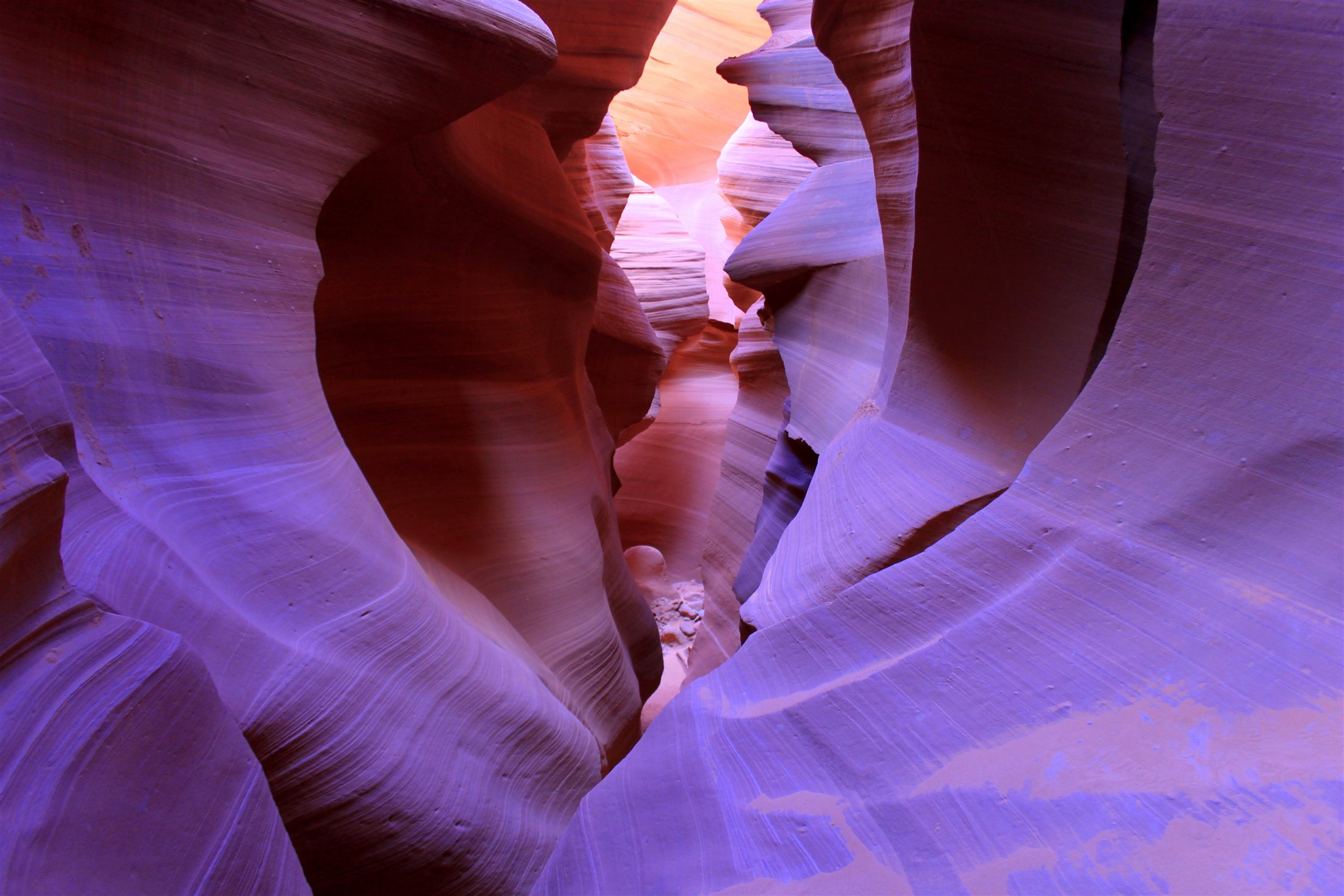
Antelope Canyon at a Glance
Carved from Navajo sandstone near Page, Arizona, Antelope Canyon ranks among the most extraordinary slot canyons on Earth — a place where light, water, and stone have worked together for millions of years. Before learning more about how this remarkable canyon formed and what makes it so famous, here's an overview at a glance:
Located on Navajo Nation
Near Page, Arizona
World-Famous Slot Canyon
Among the most photographed on Earth
Formed by Flash Floods
And centuries of erosion
Managed by the Navajo Nation
Guided access only
Two Distinct Sections
Upper and Lower Antelope Canyon
Carved From Navajo Sandstone
Part of the Colorado Plateau
Why Is Antelope Canyon So Famous?
Few landscapes anywhere in the world combine geology and light quite the way Antelope Canyon does. Its defining feature is the sandstone itself — walls that don't simply rise vertically like a typical canyon, but flow and curve overhead in smooth, sculpted ripples, shaped by countless generations of moving water and windblown sand. That flowing form is the direct result of the canyon's unusual origin, carved almost entirely from within by flash flood water moving through a narrow crack in the sandstone, rather than worn down gradually from above like most canyons.
Light is the second half of the story, and arguably the reason Antelope Canyon became a global photography icon in the first place. Because the canyon is so narrow and its walls so smoothly curved, sunlight entering from the opening above bounces repeatedly off the sandstone before reaching the canyon floor, taking on rich, saturated shades of orange, red, and purple along the way. Around midday, when the sun sits high enough to reach directly down into the narrowest sections, that reflected light can appear as visible beams cutting through suspended dust in the air — a phenomenon so striking it has become one of the most recognizable natural images in modern photography.
Beyond its geology and light, Antelope Canyon carries deep cultural significance as part of the Navajo Nation, adding a human and spiritual dimension to a landscape already extraordinary on purely physical terms. Together, unique rock formations, world-class natural lighting, and rich Navajo heritage make Antelope Canyon a genuinely rare combination — a place that rewards visitors on scientific, artistic, and cultural levels all at once.
It's also worth noting just how unusual this combination of features is on a global scale. Slot canyons themselves are relatively rare landforms, requiring a specific combination of soft, uniform sandstone, episodic flash flooding, and enough time for that flooding to cut deep, narrow passages rather than wide, open valleys. Even among the world's slot canyons, few combine Antelope Canyon's particular width, depth, curvature, and light exposure into a single, accessible location — which helps explain why a relatively small crack in the sandstone near Page, Arizona has become one of the most recognized natural landmarks on the planet.
How Antelope Canyon Was Formed
Millions of Years of Sandstone Formation
The story of Antelope Canyon begins roughly 190 million years ago, when vast fields of windblown sand dunes covered much of what is now the Colorado Plateau. Over immense spans of time, those dunes were buried, compressed, and cemented together by mineral deposits, gradually hardening into the pale, cross-bedded sandstone known today as Navajo Sandstone — the same rock formation responsible for many of the Southwest's most famous red-rock landscapes. The diagonal, layered patterns visible in Antelope Canyon's walls today are fossilized echoes of those ancient dune slopes, preserved in stone long after the wind that shaped them stopped blowing.
Geologists refer to this diagonal layering as cross-bedding, and it forms because sand dunes migrate and shift as wind reshapes them over time, burying earlier slopes at an angle beneath later ones. Reading those angled layers today is, in a very real sense, reading the wind patterns of a desert that existed nearly 200 million years before the canyon itself came to be — long before flowing water ever touched this particular stretch of stone.
Flash Floods
Antelope Canyon itself is a far more recent feature, carved not by the slow, steady flow of a permanent river but by the sudden, violent force of flash floods. Rain falling many miles away collects in normally dry desert washes, and when that water reaches a narrow crack or fracture in the sandstone, it accelerates dramatically, channeled into a fast-moving torrent capable of carrying sand, gravel, and even boulders. That abrasive, sediment-laden water is the true sculptor of Antelope Canyon, cutting and smoothing the sandstone from within the crack itself rather than eroding it gradually from above.
This process, carving from the inside of an existing crack rather than wearing down an open channel from above, is what distinguishes a slot canyon from an ordinary canyon, and it explains why Antelope Canyon can be so narrow — in places barely wider than a person's shoulders — while still reaching considerable depth. A tragic 1997 flash flood, triggered by a storm many miles from the canyon itself, remains a sobering reminder of just how much force this process still carries today, and it led directly to the improved warning systems and guide training now used to help keep visitors safe.
Wind and Water
While flash floods do the heavy carving, wind plays an important supporting role, continuing to smooth and polish exposed sandstone surfaces between flood events. This combination — violent, episodic water erosion followed by patient, continuous wind erosion — is what gives Antelope Canyon its particular character: dramatic, swirling forms cut by water, softened and refined by wind.
The Smooth Curves
The canyon's famous flowing curves result directly from how water moves through a confined space. Rather than cutting a straight or angular channel, floodwater naturally follows the path of least resistance, curling around harder pockets of stone and carving deeper into softer sections, producing the sinuous, wave-like forms Antelope Canyon is known for. Over time, repeated flooding smooths these curves further, rounding out sharp edges and polishing exposed surfaces to the satiny finish visible today.
Why No Two Walls Look the Same
Because every flash flood carries a different volume of water, sediment, and force, no two sections of Antelope Canyon have been shaped in quite the same way. Variations in the sandstone itself — subtle differences in hardness, mineral content, and layering inherited from those ancient dune fields — further ensure that erosion proceeds unevenly from one stretch of canyon to the next. The result is a canyon whose walls constantly change in form and color as you move through it, a direct physical record of both the ancient dunes that built the sandstone and the more recent floods that carved it. For a deeper look at how this fits into the broader story of the region's rock layers, see our Arizona Geology → guide.
Upper and Lower Antelope Canyon
Antelope Canyon is actually made up of two separate sections, each with its own distinct character, separated by a stretch of open ground above and accessed through separate entrances on Navajo land.
Upper Antelope Canyon
Known to the Navajo as Tsé bighánílíní, "the place where water runs through rocks," Upper Antelope Canyon is the section most closely associated with the canyon's famous light beams, a result of its wider opening and relatively level, sandy floor. Visitors walk through the canyon at ground level rather than descending into it, moving through a series of narrow, glowing sandstone corridors that curve overhead in dramatic, cathedral-like formations. Its comparatively level walking route and open sight lines make it a particularly popular destination for photography.
The canyon's entrance sits at essentially the same elevation as the surrounding wash that feeds it, which is part of why its floor remains relatively flat and easy to walk compared to its lower counterpart — floodwater has less distance to cut downward here, spreading its erosive energy more evenly along the passage's length instead.
Lower Antelope Canyon
Known to the Navajo as Hazdistazí, "spiral rock arches," Lower Antelope Canyon offers a considerably different physical experience. Rather than walking through at ground level, visitors descend into the canyon via a series of metal stairways and walkways, following a narrower, more twisting passageway carved deeper into the sandstone. The formations here tend to be tighter and more intricate than in the upper canyon, rewarding visitors with a different, in some ways more immersive, photographic experience.
That greater depth reflects a different erosional history — floodwater entering this section of the crack has cut considerably further downward over time, producing the layered, spiraling passageways that give the canyon its Navajo name. The stairways and walkways installed here are a relatively recent addition, built to make a passage that was once considerably more difficult and hazardous to navigate safely accessible to visitors today.
Neither section is objectively "better" than the other — they simply offer different physical experiences of the same extraordinary sandstone formation, shaped by the same forces of flash flood and wind but expressed in different ways depending on the specific geometry of each crack in the rock.
The Navajo Connection
Antelope Canyon lies entirely within the Navajo Nation, and understanding it means understanding that it is not simply a scenic backdrop but a living part of Navajo land, managed and protected by the people whose homeland it has always been. Access to both Upper and Lower Antelope Canyon is only possible through guided tours led by Navajo guides, a requirement that reflects both the practical need to protect a fragile, ever-changing environment and the tribe's own authority over its own land.
That guided-access system serves an important dual purpose. Navajo guides bring detailed, place-specific knowledge of the canyon's conditions, formations, and history that greatly enriches a visit, while also helping limit the physical impact of visitation on sandstone surfaces that can be damaged by touch, and helping ensure visitor safety in a canyon that remains genuinely vulnerable to flash flooding. Respecting this system — and understanding it as an expression of Navajo sovereignty over Navajo land, not simply a logistical requirement — is an essential part of visiting Antelope Canyon respectfully.
Beyond its practical management, the canyon carries cultural and spiritual significance within Navajo tradition, tied to the broader relationship between the Navajo people and the dramatic sandstone landscapes of their homeland. Visitors who take the time to learn even a little of that context, rather than treating the canyon purely as a photography backdrop, come away with a considerably richer understanding of the place they've visited. For more on the broader Navajo homeland and culture, see our Navajo Nation → guide.
Navajo guides themselves are often the most valuable part of a visit, offering firsthand, place-specific knowledge built from years, and often generations, of direct familiarity with this particular stretch of canyon — knowledge of how the light moves through specific formations at specific times of year, which passages have shifted since the last major flood, and how weather far from the canyon itself can signal danger long before a storm becomes visible overhead. That expertise cannot be replicated by a guidebook or a map; it is a direct product of sustained, generational presence on this land.
The Geology of Antelope Canyon
Antelope Canyon sits within the Navajo Sandstone formation, a layer of rock built from ancient, wind-deposited sand dunes and now exposed across large stretches of the Colorado Plateau, the vast, uplifted region of layered rock spanning parts of Arizona, Utah, Colorado, and New Mexico. Understanding the canyon means understanding this larger geological context: the same sandstone that forms Antelope Canyon's walls also underlies much of the region's other iconic scenery, from nearby Glen Canyon to the red-rock formations of southern Utah.
Erosion is the central force shaping this landscape, working through two distinct but connected processes here. Flash floods provide the dramatic, episodic carving that cuts channels and passageways through solid rock, while the slower, continuous action of wind smooths and polishes exposed surfaces between flood events. Rock layering, visible throughout the canyon as subtle bands and curves in the stone, records variations in how those ancient dunes were originally deposited, each layer slightly different in composition, hardness, and color.
Changing light plays its own role in how the canyon's geology is perceived, if not in the geology itself — the same sandstone can appear dramatically different in color and texture depending on the time of day and the angle of the sun, a phenomenon explored in more detail below. For a broader look at how Antelope Canyon fits into the region's rock record, see our full Arizona Geology → guide.
The Colorado Plateau itself is a geological anomaly worth understanding on its own terms: a massive block of the Earth's crust that has remained comparatively intact and stable even as it was lifted thousands of feet over the past several million years, all without the intense folding and fracturing typically seen in other uplifted mountain regions. That relatively gentle uplift is precisely why the region's rock layers remain so clearly readable today, preserved in the kind of orderly, legible sequence that makes places like Antelope Canyon and the Grand Canyon such valuable windows into deep geological time.
Why the Light Changes Throughout the Day
The dramatic shifts in light and color inside Antelope Canyon are a matter of straightforward physics, even though the visual effect feels almost otherworldly in person. Because the canyon is so narrow, direct sunlight can only reach the floor when the sun sits at a steep enough angle overhead, generally close to midday — earlier or later in the day, the canyon walls themselves block most direct light from entering at all.
When sunlight does enter, it rarely strikes the canyon floor directly. Instead, it reflects repeatedly off the curved sandstone walls on its way down, and each reflection shifts the light's color slightly toward the warm orange and red tones of the iron-rich sandstone itself. That repeated reflection is why the canyon's interior often appears to glow with color far more saturated than the stone would show in direct, unfiltered sunlight. Suspended dust in the air, kicked up by wind or foot traffic, can make this effect even more visible, scattering light along its path and revealing the beams as distinct, visible shafts rather than simply illuminated patches of canyon floor.
Season affects this phenomenon considerably, since the sun's angle in the sky changes throughout the year; the light beams associated with Upper Antelope Canyon are most likely to appear during the summer months, when the midday sun sits high and steep enough to reach directly into the narrow opening above. Even without direct beams, the canyon's colors shift noticeably across the day and across the seasons, as the angle and intensity of reflected light changes the balance of orange, red, purple, and gold visible on the walls at any given moment. None of this is a trick of photography — it is simply how light behaves inside an unusually narrow, unusually smooth stone passage, and it's part of why no two visits to Antelope Canyon ever look quite the same.
The purple and blue tones visitors sometimes notice in shaded sections of the canyon result from a related but distinct effect: in areas where direct or heavily reflected orange light doesn't reach, the ambient blue light of the open sky above still filters down, mixing with the sandstone's own warm base color to produce the canyon's characteristic cooler, violet-tinted shadows. Every color visible inside Antelope Canyon, in other words, has a specific, explainable physical cause — there is no artificial enhancement at work, only the ordinary behavior of sunlight interacting with an extraordinary piece of stone.
The Science Behind the Famous Light Beams
| Element | Why It Matters |
|---|
| Narrow canyon walls | Limit direct sunlight to a brief window each day. |
| Sun angle | Determines when light reaches the canyon floor. |
| Suspended dust | Helps make light beams visible under the right conditions. |
| Sandstone reflections | Create the canyon's rich orange, red, and purple hues. |
Wildlife Around Antelope Canyon
The high-desert country surrounding Antelope Canyon supports a resilient community of plants and animals adapted to the intense heat, sparse rainfall, and exposed sandstone terrain typical of this part of the Colorado Plateau. Hardy desert plants, including various species of cactus and drought-adapted shrubs, take hold in the thin soil and rock crevices above the canyon itself, while the canyon's interior remains largely too narrow and exposed to support much vegetation at all.
Lizards are a common sight sunning themselves on exposed sandstone near the canyon entrances, well adapted to the surface heat that would be unbearable for less specialized desert species. Ravens are frequently seen and heard overhead, while coyotes and other small desert mammals range across the broader high-desert ecosystem surrounding the canyon, generally staying well clear of the narrow slot itself. For a closer look at the animals found throughout the wider region, see our full Arizona Wildlife → guide.
Antelope Canyon Through the Seasons
Spring
Spring brings comfortable temperatures and changing light conditions as the sun's angle climbs steadily higher through the season, gradually approaching the steep midday angle needed for the canyon's famous light beams to appear.
Summer
Summer is peak season for the light beams themselves, when the sun sits high enough in the sky to reach directly into Upper Antelope Canyon's narrow opening around midday. It is also monsoon season across the Colorado Plateau, and sudden, intense storms — sometimes falling many miles away — can trigger flash floods that lead to canyon closures with little advance warning, a serious reminder of the same natural force responsible for carving the canyon in the first place. Long daylight hours make summer a popular time to visit despite the heat and flood risk.
Fall
Fall typically brings excellent, stable weather and a warm, rich quality of light well suited to the canyon's naturally warm color palette, without the intense heat or flash flood risk of summer monsoon season.
Winter
Winter brings cooler temperatures, fewer visitors, and a noticeably different quality of light, as the lower winter sun angle changes how and where reflected light appears within the canyon. While the dramatic midday beams are less likely to appear, winter light often produces its own distinctive, softer color effects across the sandstone walls.
Across every season, the underlying geology tells the same consistent story even as its surface appearance shifts considerably — the canyon's fundamental shape changes only gradually, over years and flood events, while its color and light change constantly, sometimes minute to minute, as the sun moves across the sky above.
The Life of a Flash Flood
It's easy to think of Antelope Canyon as a finished, static landscape, but the same process responsible for carving it originally is still actively reshaping it today.
| Stage | What Happens |
|---|
| Rain falls many miles away | Water collects in normally dry washes. |
| Water accelerates | The narrow canyon channels the flow into powerful flash floods. |
| Sand and rock move | Sediment carried by the water sculpts the sandstone walls. |
| New formations appear | Every major flood subtly reshapes the canyon. |
| The canyon continues to evolve | Antelope Canyon is a landscape that is still changing today. |
Antelope Canyon, in other words, is not a static feature frozen in time — it is a landscape still actively being carved by nature, one flash flood at a time.
A Landscape Still Being Created
Most visitors assume Antelope Canyon is an ancient, finished landscape — ancient in one sense, since its sandstone dates back roughly 190 million years, but very much unfinished in another. Flash floods continue to reshape the canyon with every significant storm, carrying away sediment in some places and depositing it in others, subtly altering the shape of passageways that visitors will walk through in years to come. Wind continues its own slower, quieter work between floods, smoothing exposed surfaces and softening edges left behind by the last major flood event.
Even light itself changes the canyon from one minute to the next, if only in how it is experienced rather than in the stone itself — the same wall that glows deep purple in one moment can shift to brilliant orange minutes later, as the sun's angle continues its steady movement across the sky. Taken together, these forces mean that the canyon visitors see today is, in some small but real way, slightly different from the one seen by visitors years ago — and it will continue to evolve for as long as flash floods, wind, and light continue their ancient, ongoing work on this stretch of Navajo sandstone.
There is something genuinely humbling in that realization. Antelope Canyon can feel, standing inside it, like a finished work of art — but it is closer to a living process caught in a single, temporary frame, the same way a river or a coastline is never truly finished either. What visitors experience is simply the canyon's current state in an ongoing, geological-scale process that began long before any person walked through it and will continue long after.
Protecting Antelope Canyon for Future Generations
Antelope Canyon's beauty is inseparable from its fragility. The same soft, easily eroded sandstone that gives the canyon its flowing, sculpted walls can also be damaged by something as simple as repeated touching, and the canyon's narrow, confined geometry leaves little room for error when it comes to flash flood safety. That combination is precisely why access is managed by the Navajo Nation and why every visit requires a Navajo guide.
Guided entry serves conservation and safety in equal measure. Guides monitor weather conditions and canyon access in real time, helping ensure visitors are never present during genuine flood risk, while also helping limit the everyday physical impact of visitation on surfaces that took millions of years to form and cannot simply be restored once damaged. Following guide instruction, staying on marked paths, and treating the canyon with the same care asked of any fragile natural or cultural site are not simply rules to tolerate — they are a direct, practical form of respect for both the land itself and the Navajo Nation that stewards it.
Conservation of a place like Antelope Canyon is ultimately about time horizons longer than any single visit. The choices made today about how the canyon is accessed and protected will determine whether future generations, Navajo and visitor alike, are able to experience the same extraordinary combination of stone and light that draws people here today. That responsibility, shared between the Navajo Nation and every visitor who enters the canyon, is what allows a place this remarkable, and this fragile, to remain open at all.
Antelope Canyon and the Colorado Plateau
Antelope Canyon does not exist in isolation. It is one link in a much larger chain of geology and landscape that defines the Colorado Plateau, the vast, uplifted region of layered sedimentary rock spanning Arizona, Utah, Colorado, and New Mexico. Understanding that larger context transforms the canyon from an isolated curiosity into part of a genuinely connected regional story, one that stretches across some of the most celebrated landscapes in the American Southwest.
Grand Canyon
Nearly two billion years of exposed rock layers, carved by the Colorado River.
↓
Antelope Canyon
Navajo Sandstone carved by flash floods into flowing slot canyon walls.
↓
Horseshoe Bend
A dramatic incised meander of the Colorado River through the same sandstone country.
↓
Vermilion Cliffs
Towering, colorful sandstone escarpments marking the edge of the plateau.
↓
Painted Desert
Colorful badlands revealing older rock layers exposed by erosion.
↓
Colorado Plateau
The vast uplifted region connecting all of these landscapes into one story.
Seen this way, Antelope Canyon is not simply a striking photograph opportunity — it's a window into the same immense geological story visible at the Grand Canyon, Horseshoe Bend, and across the wider Colorado Plateau, each landscape a different chapter of the same deep-time narrative written in stone. For the full regional picture, see our Colorado Plateau → guide.
Interesting Facts About Antelope Canyon
- Antelope Canyon was created primarily by flash floods cutting through Navajo Sandstone.
- The canyon is located entirely on Navajo Nation land near Page, Arizona.
- It is one of the world's most photographed slot canyons.
- The sandstone belongs to the Navajo Sandstone formation, dating back roughly 190 million years.
- Every significant flood subtly reshapes the canyon, which continues to change today.
Frequently Asked Questions
What is Antelope Canyon?
Antelope Canyon is a slot canyon carved from Navajo Sandstone on the Navajo Nation near Page, Arizona, famous for its flowing rock walls and dramatic reflected light.
How was it formed?
The canyon was carved primarily by flash floods moving through a narrow crack in the sandstone, with wind erosion smoothing and polishing the exposed surfaces between flood events.
Why is it famous?
Its uniquely smooth, flowing rock formations and the striking reflected light beams that can appear inside Upper Antelope Canyon around midday have made it one of the most photographed natural landscapes in the world.
Why is it called Antelope Canyon?
The English name refers to pronghorn antelope that historically roamed the surrounding high-desert plains; the canyon's Navajo names, Tsé bighánílíní and Hazdistazí, describe the water-carved rock itself.
Where is it located?
Antelope Canyon is located on Navajo Nation land near the town of Page in northern Arizona, close to Lake Powell and Horseshoe Bend.
Why are guides required?
Guided access, led by Navajo guides, is required to protect the fragile sandstone environment, help ensure visitor safety given the canyon's genuine flash flood risk, and reflect the Navajo Nation's authority over its own land.
What makes the colors change?
Sunlight reflecting repeatedly off the canyon's curved sandstone walls shifts in color with each reflection, while the sun's changing angle throughout the day and across the seasons alters how and where that light reaches the canyon floor.
How old is the canyon?
The Navajo Sandstone itself formed roughly 190 million years ago from ancient sand dunes, while the canyon's current form results from flash flood erosion that continues to reshape it today.
Continue Exploring Arizona
Antelope Canyon connects to a wider network of extraordinary landscapes across northern Arizona and the Colorado Plateau. Here's where to go next:
Grand Canyon National Park
The centerpiece of Arizona's geological story.
READ GUIDE →Horseshoe Bend
A dramatic curve of the Colorado River nearby.
READ GUIDE →Lake Powell
A vast reservoir amid dramatic sandstone canyon country.
READ GUIDE →Colorado Plateau
The vast geological region connecting Arizona's iconic landscapes.
READ GUIDE →Arizona Geology
The deeper rock record behind the state's scenery.
READ GUIDE →
Discover Arizona's Natural Wonders with Grand Canyon Journeys
Antelope Canyon is one of Arizona's most extraordinary natural wonders, where geology, light, and the cultural heritage of the Navajo Nation come together to create an unforgettable landscape. Our private Arizona experiences help guests discover the remarkable diversity of Northern Arizona while encouraging respectful appreciation of the places and communities that make this region so special.
Secret Antelope Canyon & Horseshoe Bend Tour
From $419
VIEW TOUR →