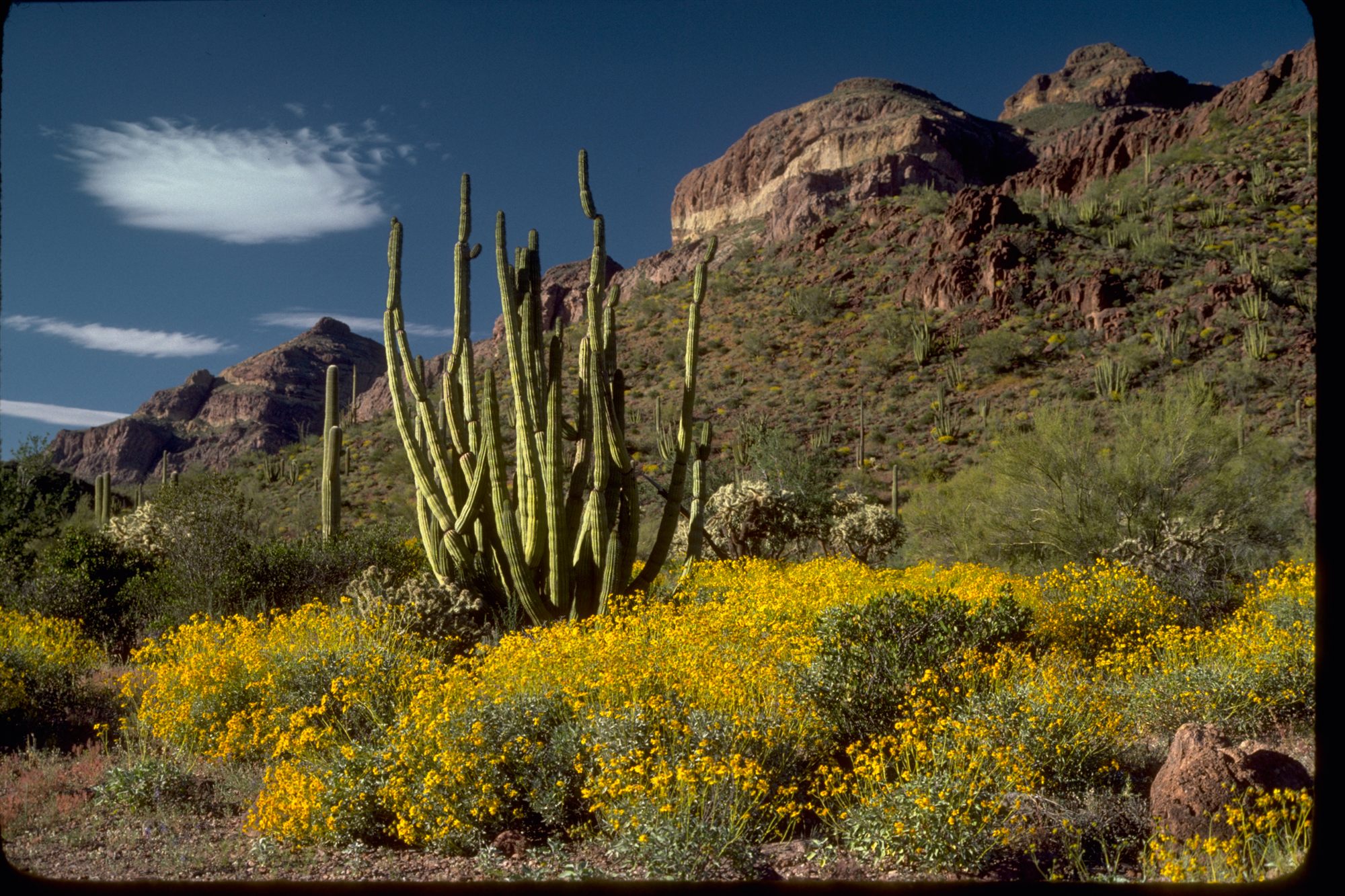
Organ Pipe Cactus National Monument at a Glance
Along the Arizona-Mexico border, a rugged desert wilderness protects one of the only places in the United States where the organ pipe cactus grows wild — part of an ecosystem so biologically rich that the United Nations designated it an International Biosphere Reserve. Before diving into what makes this desert so exceptional, here's the monument at a glance:
Located in Southern Arizona
Along the U.S.-Mexico border
UNESCO Biosphere Reserve
Designated 1976
Protected National Monument
Managed by the National Park Service
Sonoran Desert
One of the world's most biodiverse deserts
Rare Organ Pipe Habitat
One of few U.S. locations where it grows wild
National Park Service Site
Preserved for research and visitation
Why Visit Organ Pipe Cactus National Monument?
This is Arizona desert at its most extreme and most alive. Here's what makes it worth the trip:
Incredible Cactus Forests
Towering stands of organ pipe and saguaro cacti found almost nowhere else in the country.
Desert Scenery
Rugged volcanic mountains rising sharply from open desert flats.
Wildlife
Desert bighorn sheep, javelina, and dozens of species built for extreme conditions.
Mountains
Jagged desert ranges that frame every view across the monument.
Wildflowers
Spring blooms that transform the desert floor into a carpet of color.
Night Skies
Some of the darkest, clearest night skies remaining in the Southwest.
Photography
Dramatic desert light and iconic cactus silhouettes at sunrise and sunset.
Biological Diversity
A UNESCO-recognized ecosystem unlike any other desert in North America.
The Sonoran Desert
What Makes the Sonoran Desert Unique?
Most people picture deserts as barren, lifeless places. The Sonoran Desert breaks that assumption almost entirely. It's widely considered one of the most biologically diverse deserts on Earth, supporting a density and variety of plant and animal life that few arid regions anywhere can match. Stretching across parts of Arizona, California, and much of the Mexican state of Sonora, it's also one of the largest deserts in North America, and Organ Pipe protects one of its most complete, least disturbed corners.
Climate
The Sonoran Desert is a genuinely hot desert, with summer temperatures regularly exceeding 100 degrees Fahrenheit, but its winters are mild by comparison, rarely dropping to the hard freezes that limit plant life in colder deserts farther north. That mild winter window is exactly what allows cold-sensitive plants like the organ pipe cactus to survive here at all, at the very edge of the frost line that would otherwise kill them.
Rainfall
The defining feature of the Sonoran Desert is its unusual two-season rainfall pattern: gentle, widespread winter rains followed by intense, localized summer monsoon storms. Few deserts anywhere receive rain in two genuinely distinct seasons, and that rhythm is a major reason this desert supports so much more life than a typical one-season desert. Total annual rainfall is still modest by most standards, often under ten inches a year, but its division into two separate wet periods matters more than the total amount.
Seasons
Those two rainy seasons create two distinct blooming and growing periods each year, rather than the single brief growing window found in most deserts — effectively doubling the opportunities for plants, insects, and the animals that depend on them to thrive. Many desert annuals have evolved to specialize in one season or the other, meaning the plant community visible in March can look meaningfully different from the one that appears after summer monsoon rains in August.
Desert Ecosystems
This combination of mild winters and two rainy seasons allows the Sonoran Desert to support an unusually tall, complex plant community — towering cacti, small trees, and dense shrubs layered together in a way that provides food and shelter for a remarkable range of wildlife. It's less a barren landscape than a fully structured, three-dimensional forest built from cactus, not conifers, with distinct layers of vegetation from ground level up to the crown of a mature saguaro or organ pipe, each layer supporting different species.
The Organ Pipe Cactus
Appearance
Unlike the single towering trunk of a saguaro, the organ pipe cactus grows as a cluster of many slender, upright stems rising from a single base at ground level, resembling the pipes of a church organ — the source of its name. A mature plant can reach up to 20 feet tall and produce dozens of individual stems, often forming a dense, rounded thicket rather than a single dominant column.
Growth
Organ pipe cacti are extraordinarily slow-growing. A young plant may take decades just to branch for the first time, and a full, many-armed specimen visible in the monument today likely represents well over a century of steady, patient growth. Growth rates vary considerably depending on rainfall, meaning a single plant's stems can tell a rough story of wetter and drier years across its own lifetime.
Flowers
The cactus produces funnel-shaped white to pale pink flowers that open only at night and close again by mid-morning, timed to attract nocturnal pollinators rather than daytime insects. Bats are the primary pollinators, drawn by scent and the flower's pale color, which shows up well in low light — a highly specialized relationship that leaves the cactus dependent on a single group of pollinators most visitors never see.
Fruit
Following pollination, the plant produces spiny fruit that ripens to reveal sweet, red flesh — a traditional food source for the Tohono O'odham, who have harvested it for generations. The fruit ripens in early summer, adding a valuable, water-rich food source at one of the hottest, driest points of the year for both people and wildlife.
Lifespan
Individual organ pipe cacti can live for more than 150 years, slowly adding stems and height across a lifespan that spans many human generations. A cactus germinating today could still be standing, and still growing, well into the next century.
Why It Only Grows Here
The organ pipe cactus is fundamentally a warm-climate species, unable to tolerate the hard, prolonged freezes common farther north or at higher elevations. This monument sits at the very northern edge of the species' range, in one of the few pockets of the United States warm enough, in most years, to let it survive — which is exactly why this particular monument bears its name. Even here, an unusually severe cold snap can damage or kill exposed plants, which is part of why the species remains so geographically limited within the country despite being common across much of its range farther south in Mexico.
Desert Survival Guide
Every plant here has evolved its own specific answer to the same basic problem: how to survive months without rain. Laid out side by side, those strategies become easy to see:
| Desert Plant | Adaptation | Why It Matters |
|---|
| Organ Pipe Cactus | Stores water in thick stems | Survives long dry periods |
| Saguaro | Expanding ribs | Holds large amounts of water after rain |
| Ocotillo | Rapid leaf growth after rainfall | Conserves energy during drought |
| Creosote Bush | Waxy leaves | Reduces water loss |
| Ironwood Tree | Deep root system | Accesses groundwater during dry seasons |
Incredible Desert Plants
Beyond the organ pipe cactus itself, this monument protects a remarkably dense and varied plant community, each species solving the challenge of desert survival in its own way.
Saguaro: The iconic single-trunked giant of the Sonoran Desert, with expandable, pleated ribs that let it swell with water after rain and slowly draw down that reserve through the dry months that follow.
Ocotillo: A cluster of tall, whip-like stems that appear dead for most of the year, then rapidly sprout small leaves within days of rainfall, allowing the plant to photosynthesize efficiently without maintaining costly leaves during drought.
Cholla: A group of cactus species covered in dense, easily detached spines; segments break off and root readily, letting some cholla varieties spread almost as effectively through breakage as through seed.
Prickly Pear: Flat, paddle-shaped pads store water efficiently while minimizing surface area exposed to the sun, and its fruit and pads have long served as a food source for both wildlife and people.
Creosote Bush: Perhaps the most successful desert survivor of all, protected by waxy, resin-coated leaves that dramatically reduce water loss; some creosote clones are estimated among the oldest living organisms on Earth.
Mesquite: A deep-rooted desert tree capable of tapping groundwater far below the surface, providing crucial shade and food in the form of protein-rich seed pods.
Ironwood Trees: Among the longest-lived trees in the Sonoran Desert, with extraordinarily dense wood and deep roots reaching groundwater; ironwoods also act as "nurse plants," sheltering young saguaro and organ pipe seedlings beneath their canopy until the cacti are large enough to survive on their own. Without nurse trees like ironwood and mesquite, far fewer young cacti would survive their first, most vulnerable years of exposure to sun and frost.
Wildlife of Organ Pipe
This is a landscape built for specialists — animals shaped by evolution to handle heat, scarcity, and long stretches without water. Many species here are active mainly at dawn, dusk, or after dark specifically to avoid the harshest daytime heat, which is part of why patient, early-morning or evening visitors tend to see far more wildlife than midday travelers.
- Desert Bighorn Sheep — sure-footed climbers able to navigate the monument's steep, rocky mountain ranges with ease.
- Javelina — social, pig-like mammals that travel in small herds and are frequently seen near washes and vegetation.
- Coyotes — adaptable and widespread, often heard calling at dusk across the open desert.
- Roadrunners — fast, ground-dwelling birds well adapted to hunting lizards and insects in open desert terrain.
- Gila Monsters — one of only two venomous lizard species in the world, slow-moving and rarely seen, but a genuine desert icon.
- Rattlesnakes — several species call the monument home, playing an important role in controlling rodent populations.
- Owls — including tiny elf owls, which nest in holes carved into saguaros by woodpeckers.
- Bats — including the lesser long-nosed bat, a critical nighttime pollinator for both the organ pipe cactus and the saguaro.
For a closer look at the animals found throughout the wider region, see our full Arizona Wildlife → guide.
Indigenous History
Long before this land became a national monument, it was — and remains — the traditional homeland of the Tohono O'odham, whose name translates to "Desert People." For countless generations, the Tohono O'odham have developed deep, practical knowledge of how to live well in one of the harshest environments in North America: which plants offer food and water, when and where to travel, and how to read a landscape that looks empty to untrained eyes but is, in fact, abundant. That knowledge includes an intimate understanding of seasonal water sources, edible and medicinal plants, and safe travel routes across a terrain that can be genuinely dangerous to the unprepared.
Harvesting the fruit of the organ pipe and saguaro cactus remains a living tradition, not a historical footnote — the Tohono O'odham continue to gather saguaro fruit each summer to make traditional foods and syrup, carrying forward practices passed down across countless generations. This annual harvest traditionally marks the start of the Tohono O'odham new year, tying the cactus fruit not just to nutrition but to a broader cultural and ceremonial calendar. The Tohono O'odham retain recognized cultural ties to this land today, and the National Park Service works with tribal representatives on decisions affecting the monument.
This monument should be understood as more than a natural landscape. It is part of a living cultural homeland, and the desert's plants and resources continue to hold meaning well beyond their ecological role.
Organ Pipe Through the Seasons
Spring
Wildflowers carpet the desert floor and cacti burst into bloom, making spring the single most popular and rewarding season to visit.
Summer
Monsoon storms build dramatically over the mountains each afternoon, but extreme heat — often well over 100 degrees — makes summer a genuinely demanding season for visitors.
Fall
Warm, comfortable days give way to cool desert nights, offering a pleasant middle ground between summer's heat and winter's chill.
Winter
Mild days and clear skies make winter the most comfortable season for hiking and exploring, with conditions many visitors consider close to ideal.
A Day in the Sonoran Desert
The desert isn't a static backdrop — it transforms completely over the course of a single day, and understanding that rhythm changes how you see it.
Morning
Cool overnight temperatures linger into early morning, and the desert comes alive with activity while it lasts. Birds are at their most active, calling and foraging before the heat sets in, and the low morning sun gives the landscape a soft, golden quality that photographers prize above any other time of day.
Afternoon
As temperatures climb, the desert appears to empty out — but the activity hasn't stopped, it's simply gone underground or into the shade. Cacti quietly draw on the water they've stored, reptiles retreat into rock crevices and burrows to escape the worst of the heat, and the desert settles into a hot, still stillness that dominates the middle hours of the day. Even experienced desert wildlife can be genuinely hard to spot during these hours, which is exactly the point — survival here often means being seen as little as possible.
Evening
As the sun drops and temperatures fall, the desert wakes up again. Coyotes begin moving and calling, bats emerge to feed on nectar and insects, and once full darkness arrives, the Sonoran Desert reveals one of its quietest, least-advertised rewards: a night sky, largely free of light pollution, filled with more stars than most visitors have ever seen at once. It's a fitting close to a landscape that spends much of its day in hiding: the desert's true scale and richness only become fully apparent once you've experienced it from morning to night.
Why This Landscape Is Protected
Organ Pipe Cactus National Monument protects far more than a single unusual plant. It safeguards rare species found in few other places in the country, provides critical habitat for animals like the endangered Sonoran pronghorn, one of the fastest and rarest mammals in North America, and preserves one of the most intact, undisturbed examples of Sonoran Desert ecosystem remaining anywhere. Roughly 95 percent of the monument is designated wilderness, among the highest proportions of any unit in the National Park System, meaning the vast majority of this landscape remains free of roads and permanent development.
The monument's UNESCO International Biosphere Reserve designation, granted in 1976, recognizes its exceptional value for scientific research into desert ecology, and researchers continue to study the monument's plant and animal communities as a benchmark for understanding healthy Sonoran Desert ecosystems more broadly. Conservation here isn't just about protecting scenery — it's about preserving one of the most complete, functioning desert ecosystems left on the continent.
Interesting Facts About Organ Pipe
A handful of details tend to surprise first-time visitors most:
- The organ pipe cactus naturally grows in only a small portion of the United States, found almost exclusively within and near this monument.
- The monument protects more than 330,000 acres of Sonoran Desert wilderness.
- Over 300 bird species have been recorded within the monument, an extraordinary number for a desert environment.
- The Sonoran Desert is considered one of the world's most biologically diverse deserts, thanks in large part to its two annual rainy seasons.
- Spring cactus blooms transform the desert with vibrant flowers, drawing photographers and naturalists from around the country.
Why the Sonoran Desert Is Unlike Any Other Desert
It's tempting to assume all deserts are more or less interchangeable — sand, heat, and not much else. The Sonoran Desert is the clearest possible argument against that assumption:
- Two distinct rainy seasons create significantly greater biodiversity than most single-season deserts.
- It's home to the organ pipe cactus's primary range in the United States, found almost nowhere else in the country.
- Hundreds of bird species rely on its varied desert habitats throughout the year.
- An extraordinary variety of reptiles and mammals have evolved highly specialized adaptations found here and few other places.
- It holds a rich, continuous Indigenous history stretching back countless generations.
- It's widely regarded as one of the world's premier desert ecosystems, studied by researchers around the globe.
Taken together, these qualities explain why the Sonoran Desert draws naturalists, photographers, and researchers from around the world — and why a single monument here can hold so much more life than its stark, arid appearance first suggests.
Organ Pipe and Arizona's Desert Story
Organ Pipe is one entry point into a much larger story about how life has adapted to Arizona's desert landscapes:
Organ Pipe Cactus National Monument
↓
The Sonoran Desert
↓
Saguaro National Park
↓
Arizona's Desert Wildflowers
↓
Arizona Wildlife
↓
Arizona Native American Culture
Each of these guides looks at a different piece of the same larger picture: a desert far more alive, and far more culturally significant, than its reputation as an empty landscape would suggest.
Frequently Asked Questions
What is an organ pipe cactus?
The organ pipe cactus is a large, multi-stemmed cactus native to the Sonoran Desert, named for its cluster of upright stems resembling the pipes of a church organ. It's closely related to several other columnar cacti found farther south in Mexico.
Why is the monument famous?
It's one of the only places in the United States where the organ pipe cactus grows wild, and it protects one of the most biologically diverse desert ecosystems in the world, recognized internationally through its UNESCO Biosphere Reserve status.
Why is it protected?
The monument safeguards rare plant and animal species, preserves a largely intact Sonoran Desert ecosystem, and holds UNESCO International Biosphere Reserve status for its scientific and ecological value.
When do the cacti bloom?
Most cacti here bloom in spring, though the organ pipe cactus's own flowers open at night and can appear across a somewhat broader window depending on rainfall, with occasional additional blooms following summer monsoon rains.
What animals live here?
Desert bighorn sheep, javelina, coyotes, Gila monsters, rattlesnakes, owls, and nectar-feeding bats are among the many species adapted to this desert environment, alongside more than 300 recorded bird species.
Is it part of the Sonoran Desert?
Yes. The entire monument lies within the Sonoran Desert, one of the largest and most biologically diverse desert regions in North America.
Why is the desert so diverse?
Its unusual two-season rainfall pattern — mild winter rains plus summer monsoons — supports a wider variety of plant and animal life than most single-season deserts can sustain, giving plants and animals two separate opportunities each year to grow, bloom, and reproduce.
What makes this monument unique?
Few places in the country combine this cactus's rare U.S. range, UNESCO-recognized biodiversity, dramatic desert mountain scenery, and a living Indigenous cultural connection in one protected landscape.
Continue Exploring Arizona
Organ Pipe is one chapter in the much larger story of Arizona's deserts, wildlife, and cultures. Here's where to go next:
Arizona Wildlife
The animals that call these desert landscapes home.
READ GUIDE →Arizona Desert Wildflowers
The spring blooms that transform the desert floor.
READ GUIDE →Arizona Native American Culture
The living tribal nations connected to this land.
READ GUIDE →Saguaro Cactus Guide
A closer look at the Sonoran Desert's iconic giant.
Coming SoonArizona Photography
Capturing Arizona's light, landscapes, and desert color.
READ GUIDE →
Discover Arizona's Desert Landscapes with Grand Canyon Journeys
While Northern Arizona is known for towering canyons and ancient ruins, Southern Arizona reveals an entirely different side of the state. Organ Pipe Cactus National Monument showcases the extraordinary diversity of the Sonoran Desert, where unique plants, remarkable wildlife, and centuries of cultural history come together in one of America's most distinctive protected landscapes.
Our monument pages tell the story of people adapting to Arizona's landscapes — Sunset Crater's volcanic eruption, Wupatki's resilient farmers, Walnut Canyon's cliff dwellers, Montezuma Castle's engineers, and Tuzigoot's traders. Organ Pipe tells a different, equally remarkable story: not of people, but of life itself adapting to one of the harshest environments in North America — and thriving there for millions of years.